Inspired by Miss Fisher

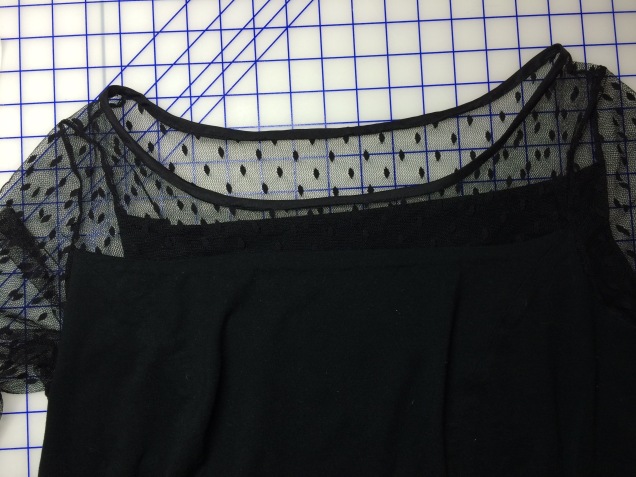
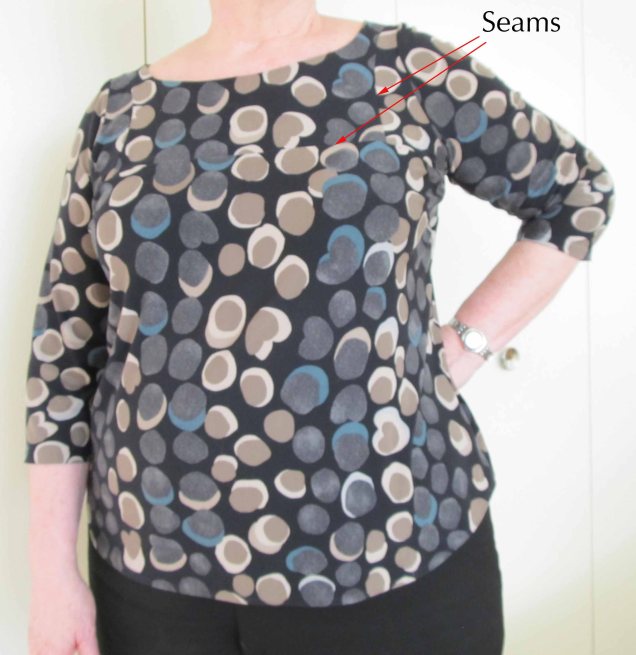
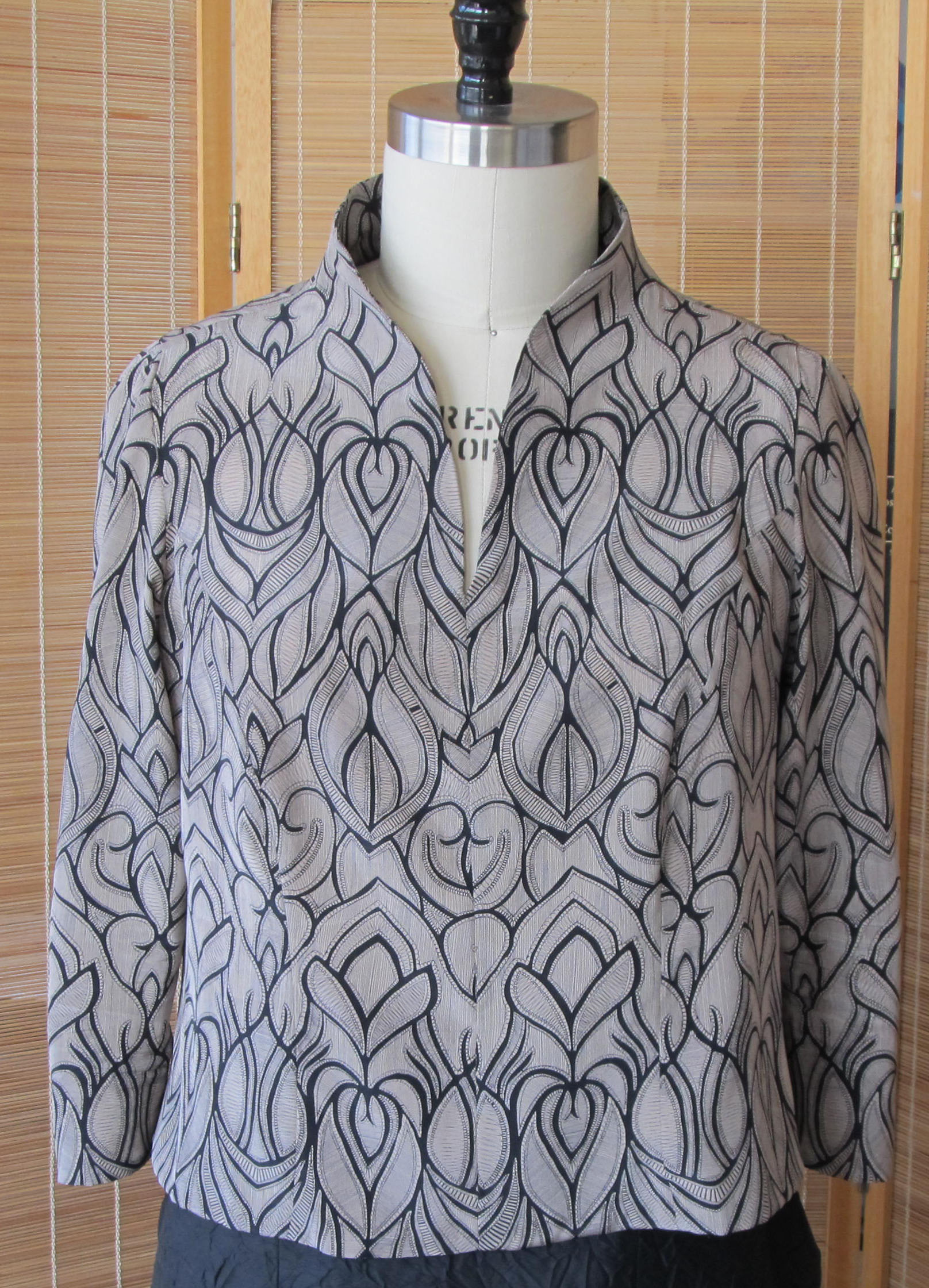
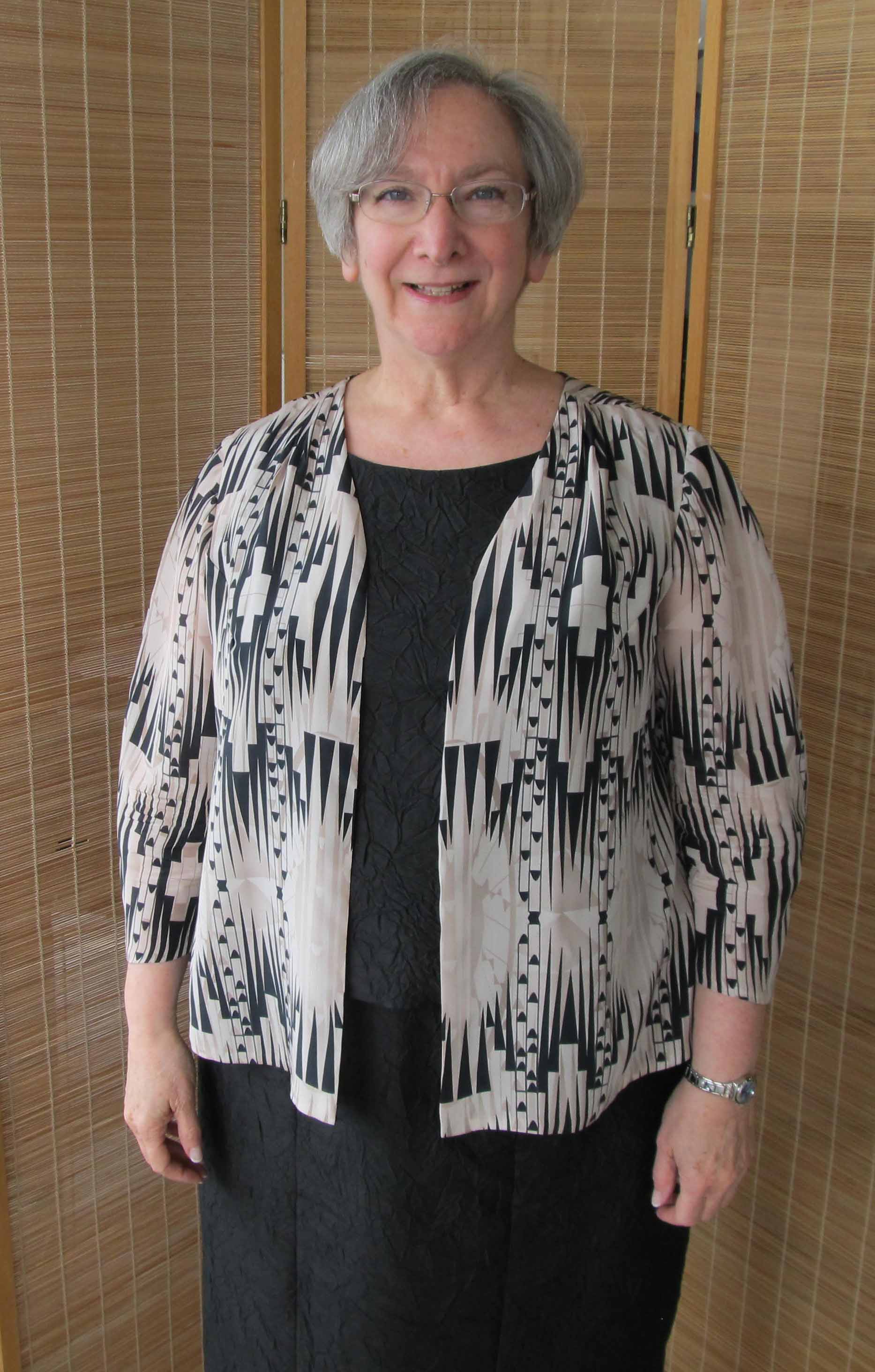
I adore the Australian TV series Miss Fisher Murder Mysteries. Set in the 1920s, the series has much to offer in the way of engaging characters you can’t help caring about, but the bonus is that the costumes are absolutely fabulous. I’m talking rivaling Downton Abbey fabulous, and that’s saying something. The show had a three-season run that can be streamed here in the US on Netflix and sometimes found on PBS. After watching an episode all the way through, I would often rerun it so I could stop and sketch costumes that inspired me. In one episode, Miss Phryne Fisher appeared in a pair of black wide-legged trousers and a black top that had a mesh inset at the top and sleeves made of the same mesh. I had to have one of my own.

The pattern I used as a starting point is my knit version of my basic fitting bodice, which has armscye princess seams. I know, fussy for a knit but the shaping is worth it. Besides, I managed to make this project quite a bit fussier.

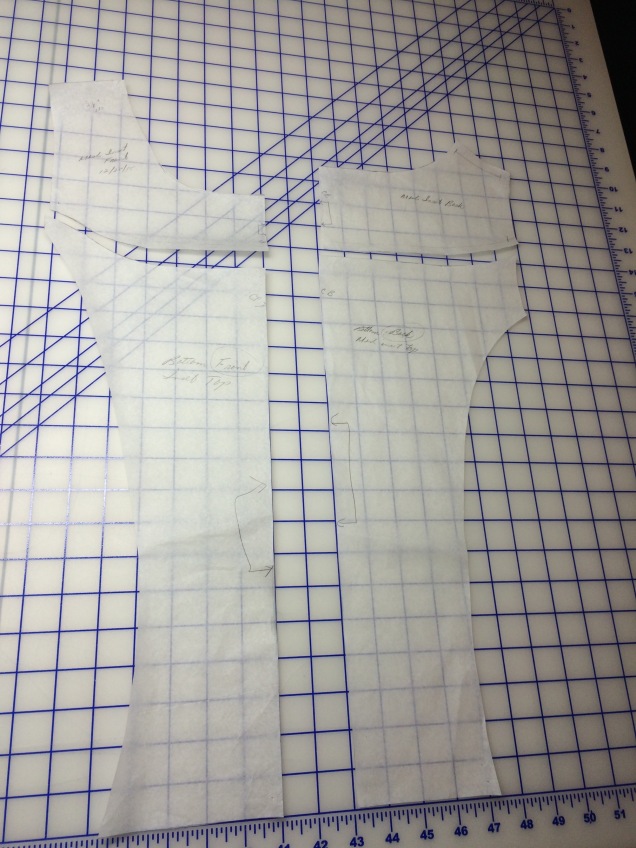
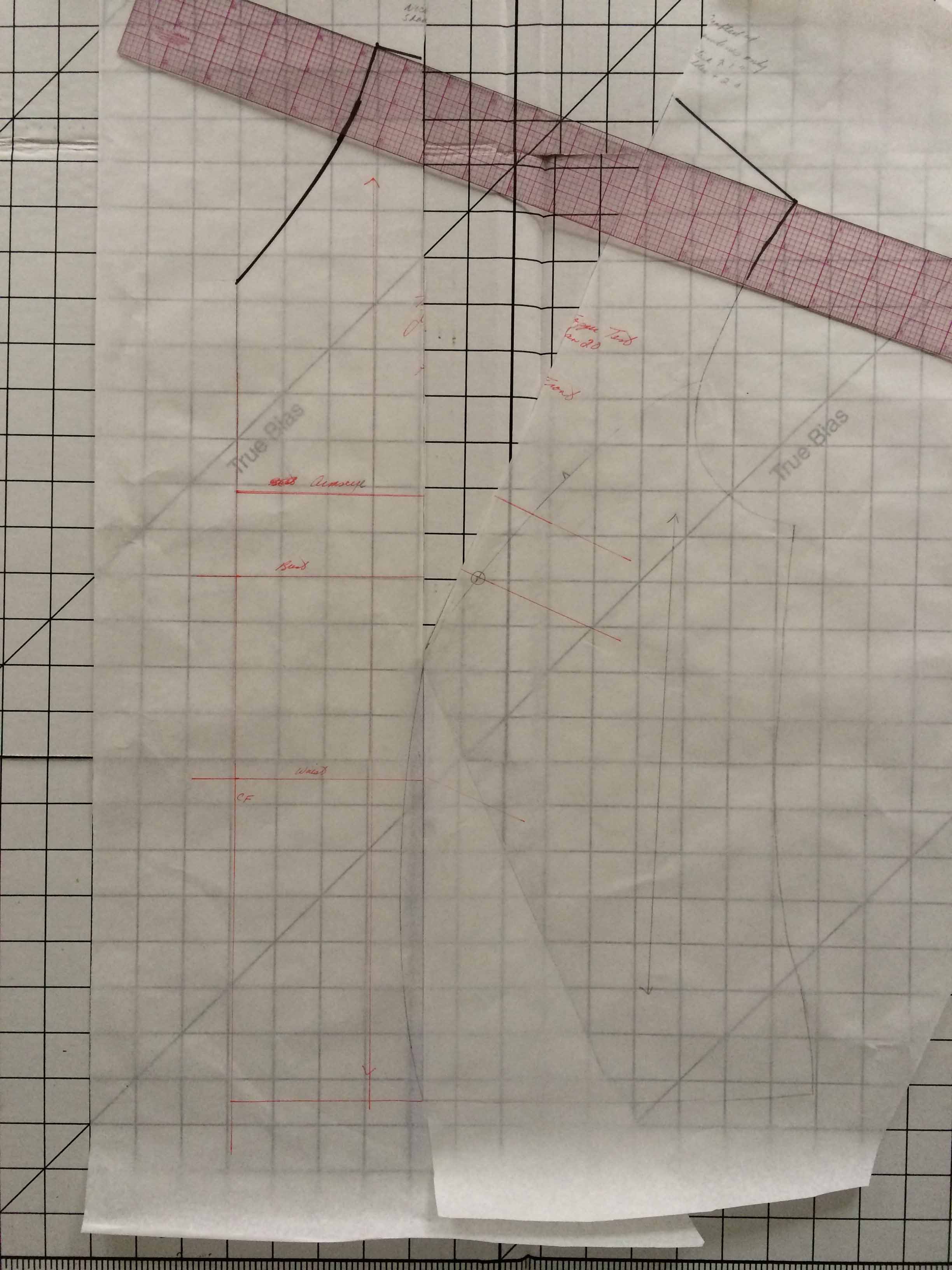
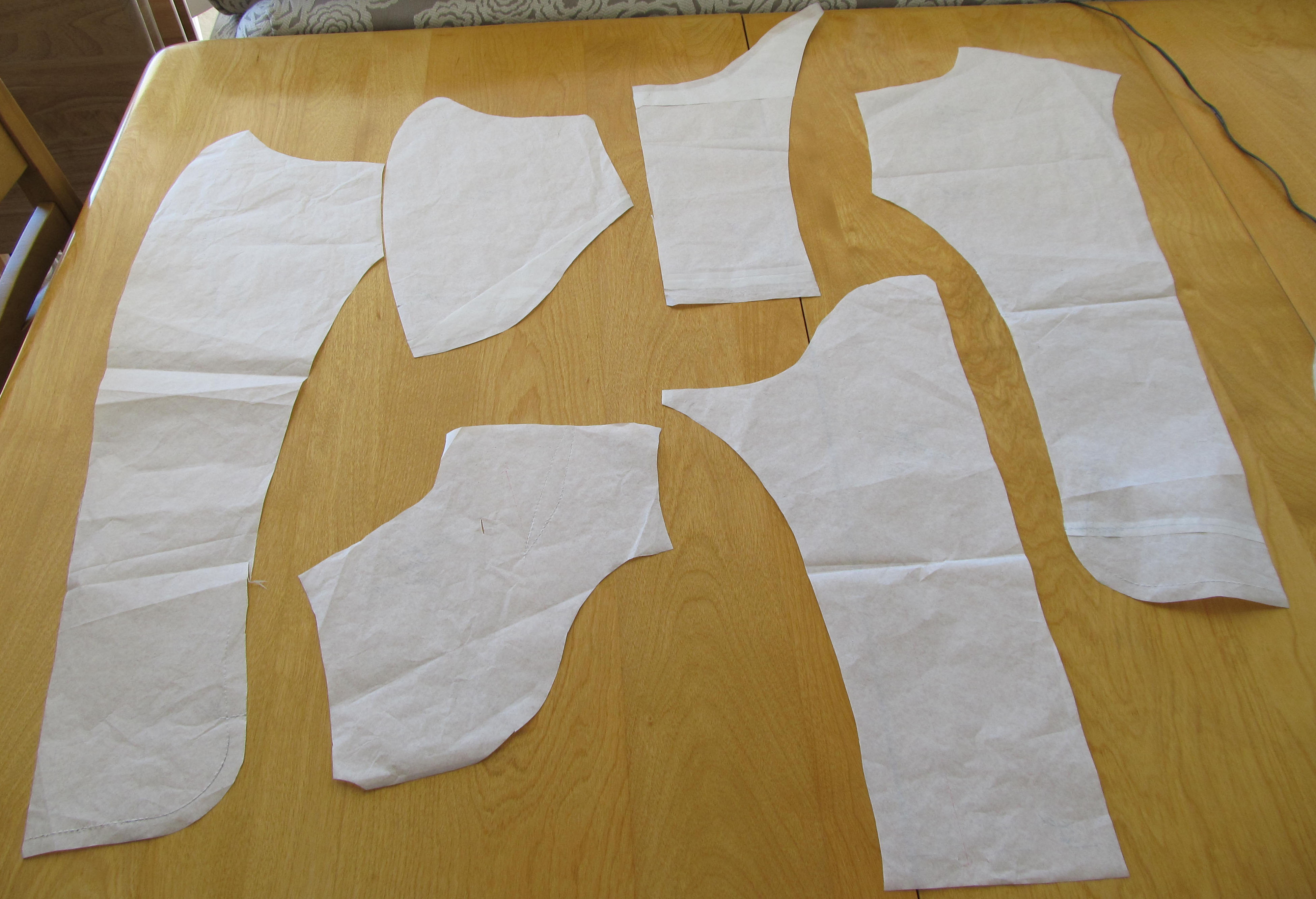
The pattern work was pretty straightforward. Buy a strapless bra. Try on a muslin from another garment and trace where the bra ended. I drew a line  across the front pattern piece that was above that point and made two new pattern pieces with seam allowances.

IMG_0729

Miss Fisher’s version of the top has a jewel neck, which I tend to avoid. Still, I think I could have gone a bit higher on the neckline for this.

The black knit has been residing in my fiber archive collection for some time. The mesh inset is a Pointe d’Esprit that sang out to me on Marcy Tilton’s web site. She has an entire section on her web store devoted to mesh, lace and net.

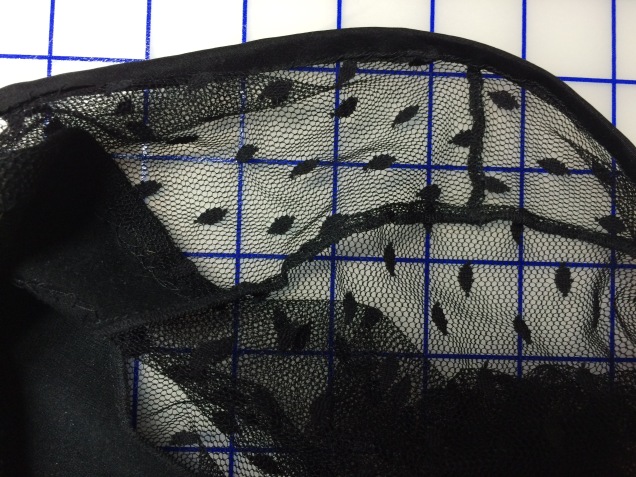
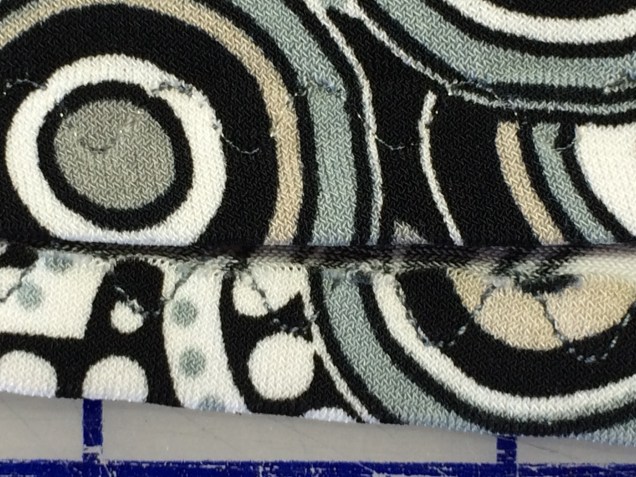
I had never worked with mesh before and so I did some reading and tested some seaming options on scraps. I decided to baste the mesh on the sewing machine and then finish the seams with a narrow hem on the serger. It gave me the effect I was after.

IMG_0732

Of course I needed to sew down the seam allowance on the seam separating the mesh from the knit so that it would stay hidden, but when I tested topstitching I didn’t like the way it looked. That’s where this project started getting more involved than I had planned.

IMG_0731

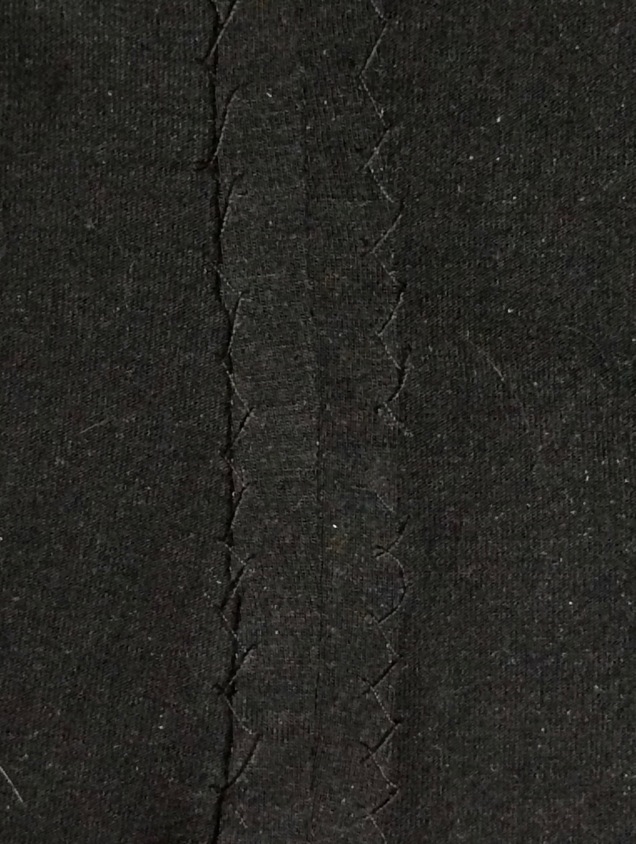
I remembered from an online class taught by Susan Khaljie that in couture, the generous 1-inch seam allowances are attached to underlinings with catch stitches. I didn’t have underlining to work with, but I wasn’t using a tissue knit so I figured I could just catch a thread or two in the body of the garment in each catch stitch and it wouldn’t show on the the outside. The results were nice and smoooth. That’s when I got carried away and decided to use the same treatment for the princess seams and the hem.

IMG_0734

Yes, that’s the point at which I asked myself if I was completely crazy to do this much work for a knit top, but it’s not just any ordinary knit top.

I considered binding the neck edge and sleeves with a strip of the knit fabric, but I decided that would be too heavy. Instead, I opted for a bias binding of China silk. Of course, that was attached on one side by machine, then wrapped around the edge, pinned and sewn to the inside by hand.

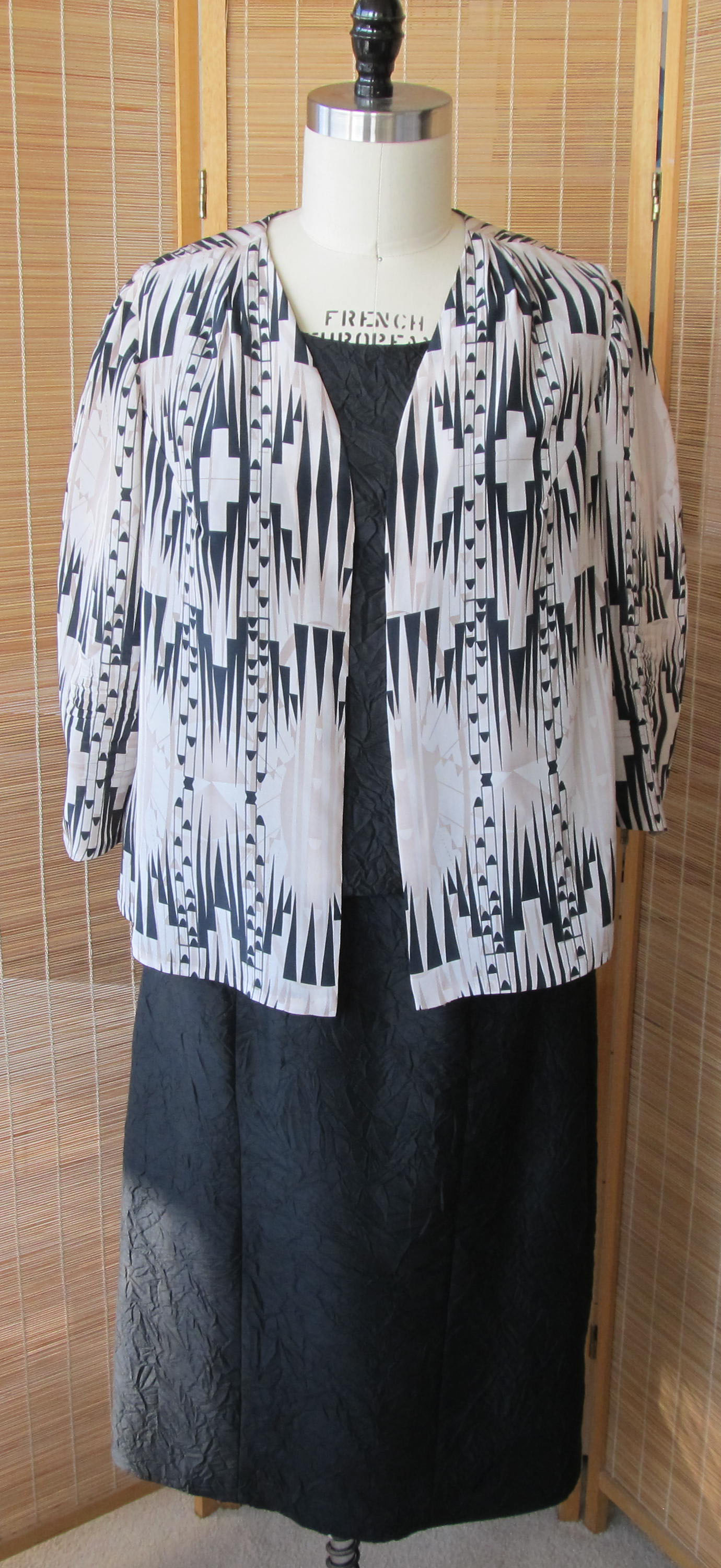
So, it’s definitely a fussy project but I enjoyed the process of experimentation and discovery and I really enjoy wearing the finished product. So far I’ve worn it with black slacks, but I’m contemplating a black trumpet skirt (the current term is fit and flare) in a drapy rayon crepe that I think will look great with it too.


Sarah Veblen’s You Choose Your Focus Workshop

Last weekend I took another quantum leap in developing my sewing and personal design skills. As always, Sarah Veblen was at the heart of this experience.

Sarah was here in Chicago to teach a workshop she calls “Choose Your Focus.” Instead of having a predetermined topic such as fitting or jacket fit and construction, this workshop provides an opportunity for each participant to work one-on-one with Sarah with whatever project or projects are at the top of that person’s wish list. It is basically private instruction in a group setting. This is the second Choose Your Focus Workshop I’ve attended and it definitely won’t be my last.

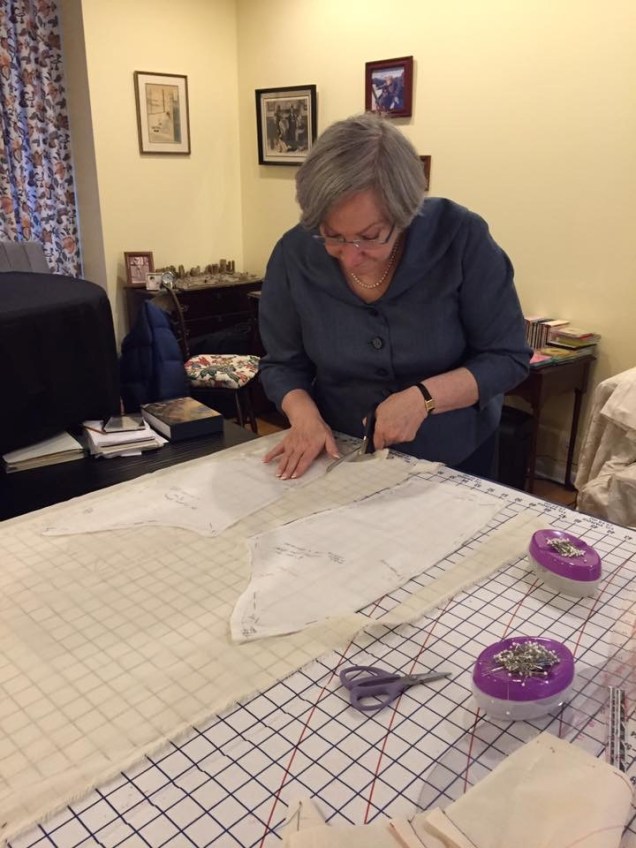
All levels of skill are welcome in these workshops and Sarah is more than capable of meeting each participant’s particular needs. Everyone’s experience in these workshops is unique. Steph has shared her perspective on her blog, 10 Sewing Machines & A Serger, and she also generously allowed me to use her workshop pictures in this post. I always start out with the intention to document with pictures, but often don’t follow through.

The first morning, the group gathers and each participant discusses what she hopes to accomplish in the workshop. Often we’ve emailed Sarah in advance to give her an idea of what we will be bringing, but this is everyone’s opportunity to crystallize their thinking and Sarah’s opportunity to formulate an idea of workflow and how she can most effectively help the participants reach their goals. Some topics come up that will best be handled with a demo, which the entire group will benefit from watching. This exchange also allows other participants to learn from the other projects that are being worked on.

IMG_0168

I arrived with a list of projects in order of priority that I placed into two categories: “required” (a/k/a “gottas”) and “extra credit.” The workshop was three days long, but I only had 2½ days because of a volunteer commitment. Factor into that my lack of speed in all things sewing and patternmaking and I knew that I needed wiggle room in my list of goals.

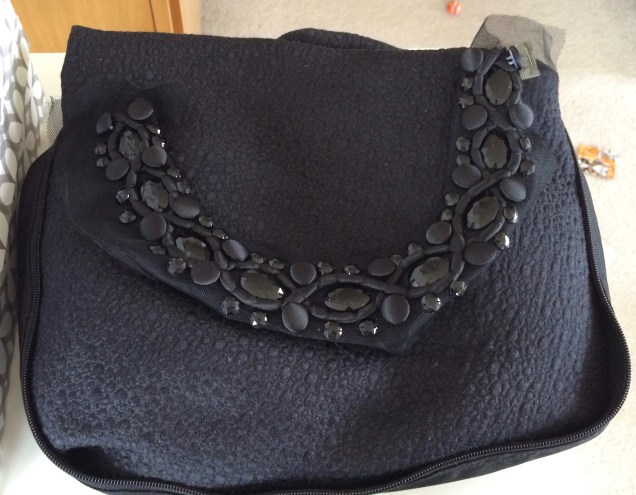
At the top of my “gotta” list was finalizing the design, pattern, fabric, embellishment and construction methods for a Little Black Dress to wear to a wedding in June and, I hope, model in the Haute Couture Club of Chicago fashion show that I’m co-chairing in April. I had chosen a lovely matlesse that I bought at A Fabric Place outside Baltimore (known as Michael’s Fabrics online) when I had worked with Sarah at her home studio a while back. I had questions about whether I should make the collar out of a different fabric and whether I should go with my original plan to add a few black faceted beads or use the fabulous embellishment piece made of beads and covered buttons that I bought at Soutache quite some time ago with no idea what I would do with it.

IMG_0667

The verdict was to use it on this dress and Sarah demonstrated to the group how I should handle it. The collar will be made of the same fabric as the rest of the dress. I also asked about underlining—yes, with silk organza—and confirmed that I will be using China silk lining.

I also had questions about fabric choice, closure placement and design details for the dress I’m making to wear to the luncheon portion of the upcoming fashion show and to a bridal shower I’m co-hosting the following week. (It’s going to be a ridiculously busy spring). Those questions were answered and I was able to check that item off my list.

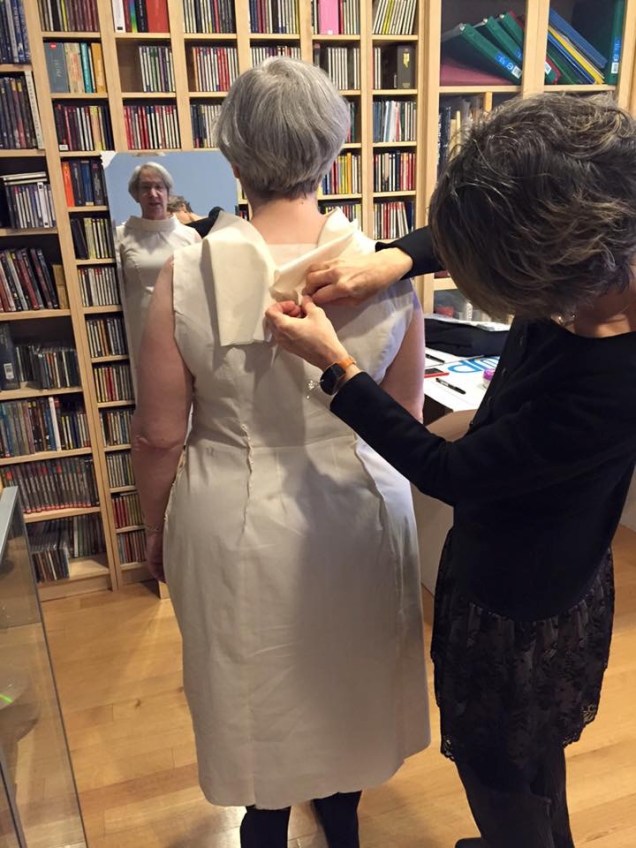
To finalize the design of the LBD, I assembled the muslin pieces that I had cut last fall before the workshop began. The body of the dress is derived from my sheath pattern, which has armscye princess seams. I wanted a curved Empire waist seam that dips lower in the back, but not so low that it reaches waist height and accentuates my most prominent feature. (My derrière draws quite enough attention without any help.) I wanted to use the 60’s-esque collar that I’ve worked with before, only I wanted it to sit higher in the front and extend a little farther out on my shoulders and then follow a dip in the neckline in back and trail off in points. In preparing the muslin, I made the front of the neckline what I thought it would end up being, cut the collar longer than I would need and only attached it from the front to the shoulders so that Sarah could drape it.

IMG_0164

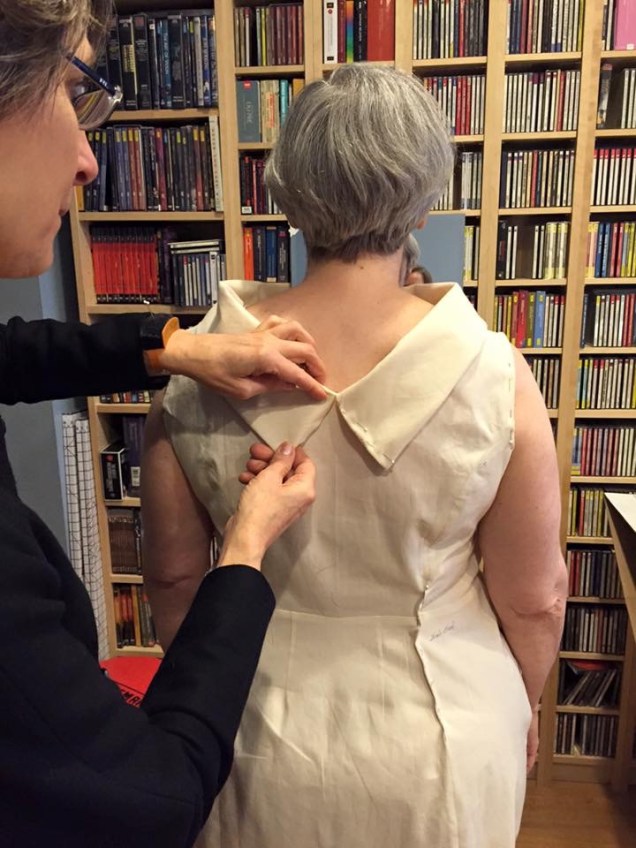
After some testing, we decided to make the front neckline a bit wider and Sarah worked her magic on the back.

IMG_0163

This is exactly as I had envisioned it!

The next step was to transfer the adjustments to the pattern. This is an area where I still am prone to doubts and confusion. As the workshop progressed, I got more confident about drawing new lines with the Fashion Ruler that don’t pick up every single pin placement mark. (It’s only pencil! I have a lifetime supply of erasers!) I’m just so worried about making a mistake that will throw off the entire garment when I sew it. I got better at this as the workshop progressed and was able to draw lines where I thought they should go. This confidence came from knowing I could ask Sarah to check my work right away. Call it a crutch if you must. I prefer security blanket. In any event, the whole point of participating in these workshops is that we don’t have to guess and compound our errors until we end up with a mess.

Anyway, Sarah ended up doing much of the pattern work on the LBD and I did more on my own on the next project.

IMG_0166

The final step was to test out the collar on a quick mock-up of the neckline on Day 2 of the workshop. It worked perfectly. I’m now ready to cut the fashion fabric!

My next project was to address yet another issue that has cropped up with my two-piece sleeve pattern. When I attended Sarah’s workshop last November, I corrected my basic two-piece sleeve pattern so that it fit well and had a total of ¾” ease evenly divided between the front and back when it is set into my basic jacket pattern. However, I’ve been using this as my all-purpose sleeve pattern and when I walked my pattern pieces to make a two-piece dress last month I noticed that the sleeve pattern had too much ease and it was not evenly distributed front to back. Both garment patterns were derived from my basic fitting bodice pattern but there have been some adjustments along the way and now there are differences. When I made this discovery, I prepared muslin pieces for my fitted blouse pattern and my topper pattern and brought the lining pieces for my two-piece dress bodice, along with all three patterns. I also started the project of making a full set of pattern pieces for each of my garments, instead of reusing side panel pieces and sleeves for multiple garment patterns.

I tried to make a mock-up of the sleeve before the workshop by putting in one adjustment to the sleeve pattern to even out distribution of ease, but I did what I almost always do—I added to the piece that was supposed to be made smaller and subtracted from the piece that was supposed to be made larger. I’m amazed at how often I defy the odds in that annoying way. Sarah straightened me out and I made a new test sleeve.

IMG_0161

I now have a two-piece sleeve pattern that works as it should for my fitted blouse pattern, my two-piece dress and my topper pattern. The topper pattern is going to be a building block for upcoming blouse projects.

That brought me to the end of my must-have list. Amazingly, I was able to make substantial progress on my extra credit.

I consulted with Sarah about my plans for developing a “flowy” blouse pattern from my topper pattern for a lovely teal hammered silk and a gray and cream striped rayon that have been aging in my collection for quite some time.

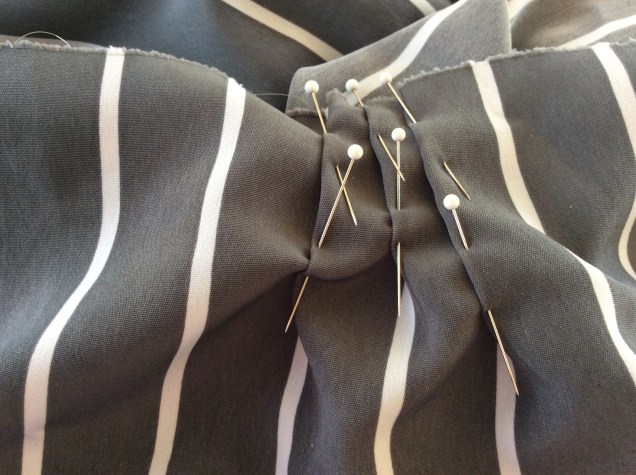
I can’t get the true color of the silk, but the picture is a close-up of its texture. I’ve been wanting to do that trick with the rayon that uses stitched-down tucks to hide the stripes at the shoulder, extending down just a bit. We decided I’d do that at the sleeve cap as well.

IMG_0169

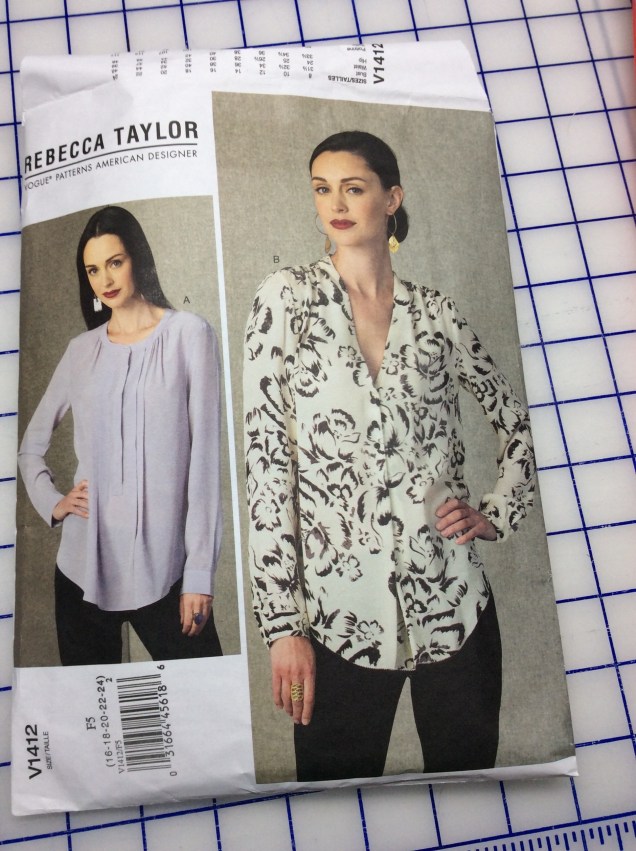
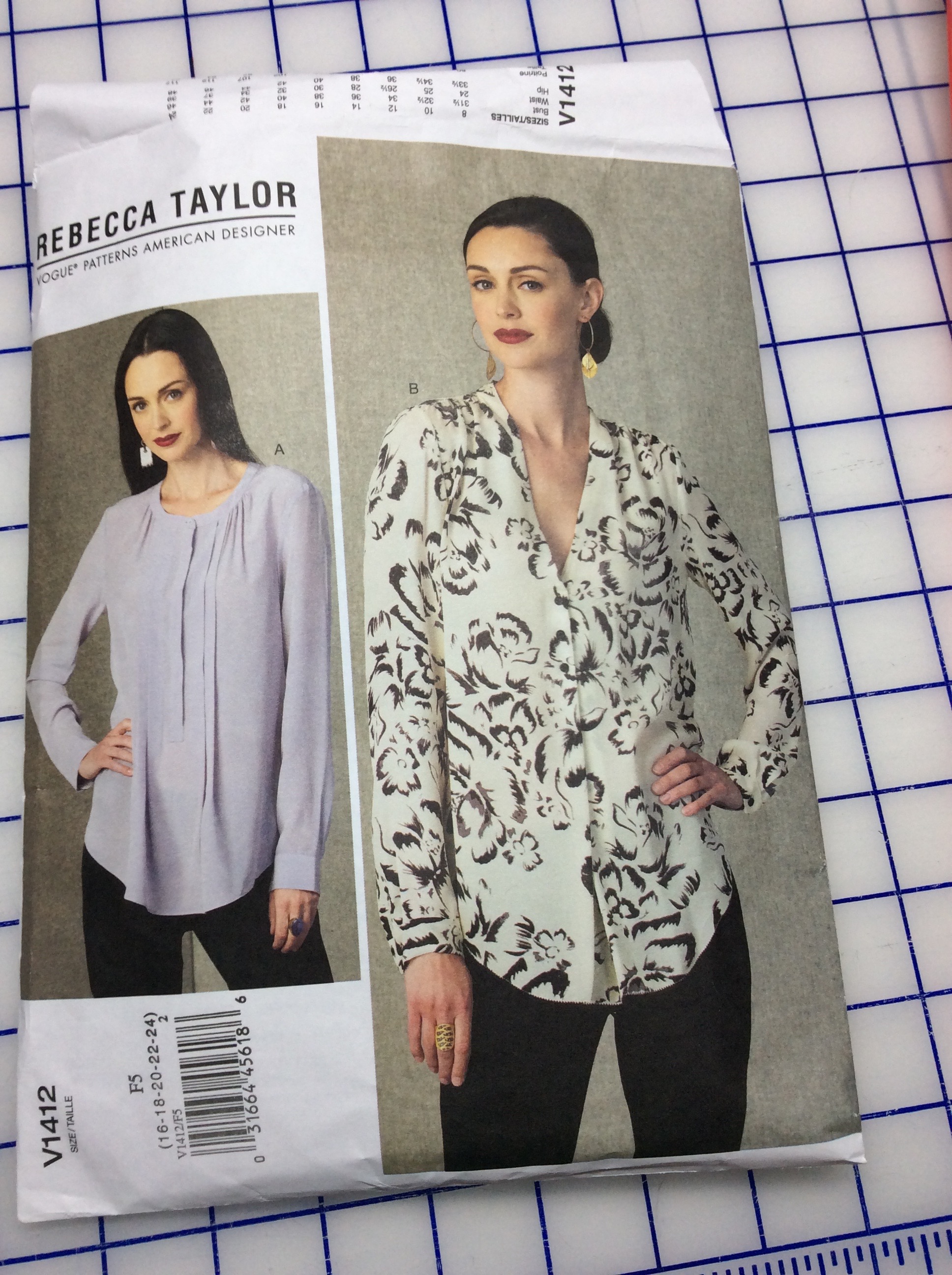
The blouse will use the front pleat from Vogue 1412 that I used in my shirtdress and have a shirt-tail hem or a curved hem with side vents.

IMG_0135

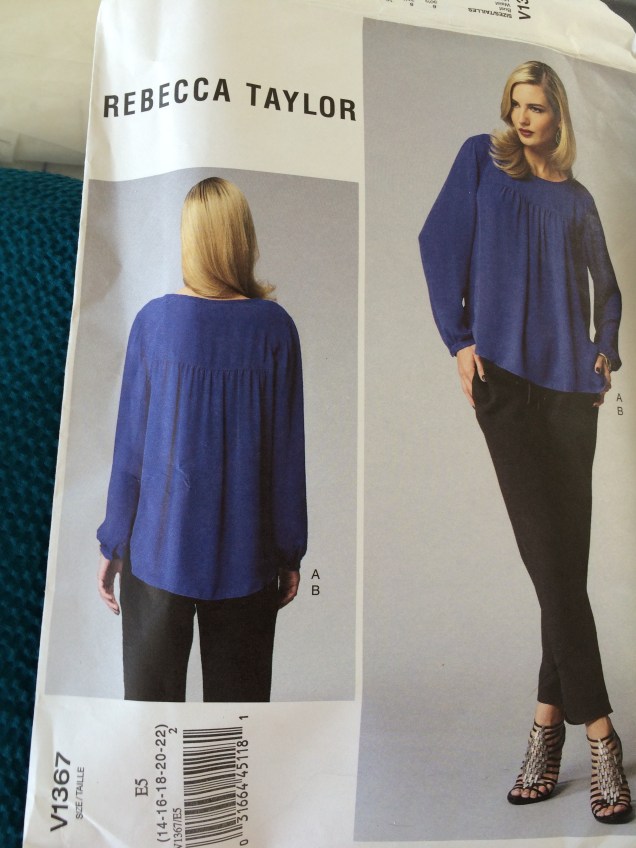
The striped version will have a variation on the neckline from View B of Vogue 1412 and the teal silk will have the shirtdress neckline and collar. For both, I wanted sleeves similar to the one in Vogue 1367, a scaled-back poet’s sleeve. IMG_0673

Development of the sleeve required me to merge the two-piece sleeve pattern together and make the necessary design changes. Sarah worked closely with me to get this done. I then mocked it up and Sarah worked on getting it into the topper armhole.

IMG_0162

We decided on a series of tucks, which are going to be a lot of work but will achieve the effect I’m after. I now have a pattern for the sleeve and cuff and instructions for working with the tucks.

Sarah took this opportunity to give us a demo on her method for attaching a continuous sleeve placket using a bias strip of fabric.

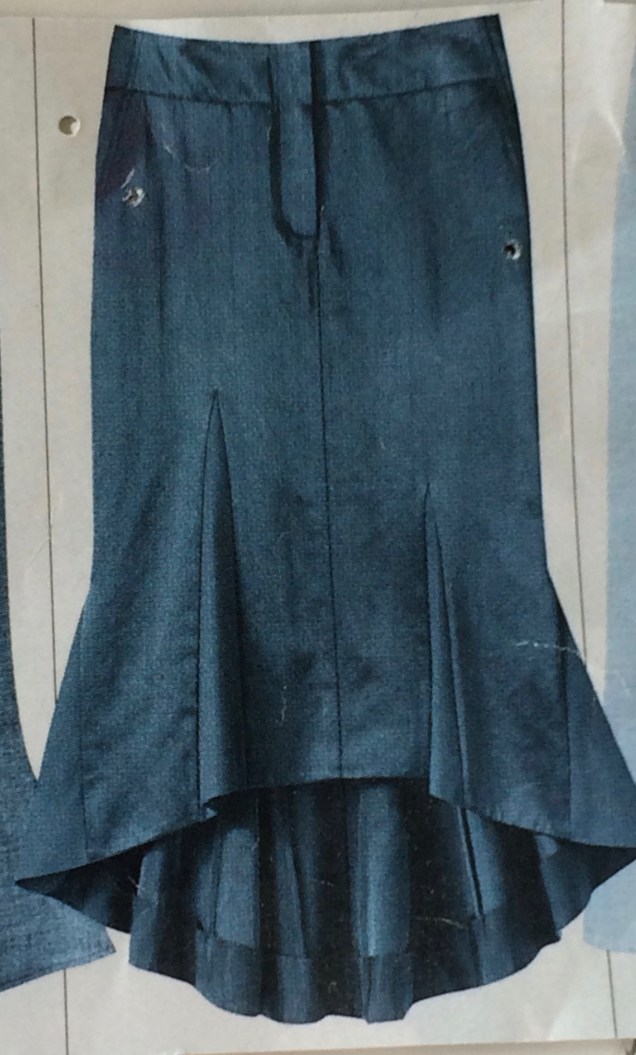
With this checked off my list, I couldn’t believe there were still a couple of hours left in the workshop. I started on my second “extra credit” project, which is to draft a trumpet skirt. The shape will be similar to this picture, but without godets.

IMG_0672

I got a little bit of the way into it, but realized I was tired and that would make me prone to even more mistakes than usual. Still, I have a process plan and Sarah answered my dumb questions about the pattern work so I can pick this up after my “gotta” sewing projects are done.

As always, the workshop time flew by and all too soon it was time to say good-bye to Sarah and get back to the real world where sewing and design have to share time with earning a living and volunteer commitments. I’m really amazed at how much I accomplished and I have renewed energy around my projects. All that, plus I got to spend time with a group of talented, dedicated home sewers who always inspire me and never fail to offer encouragement. Who could possibly ask for more?

Best Knit Top Ever – J. Stern Designs Tee

This is hard to believe but there actually is a pattern on the market that works for me straight out of the envelope. It’s the Women’s Tee from J. Stern Designs. There are two versions of this pattern. One is in Misses sizes and the other in women’s, or plus sizes. Unlike basic tees that are essentially shapeless, Jennifer Stern-Hasemann designed a knit top with panels that act as darts, a boat neckline and a shirt-tail hem. The combination is flattering and a joy to wear.

JSD Knit Worn

I was introduced to this gem at a workshop Jennifer taught here in Chicago. She brought samples of her tees in every size and I was astonished when the first one she had me try on fit beautifully. All I needed to do was shorten it and I was good to go. That NEVER happens.

Since then, I’ve made five different versions of this Tee, four with ¾ length sleeves and one with short sleeves. My favorite fabric for it is ITY knit. ITY stands for Interlock Twist Yarn. It’s not clingy and sews like a dream. It’s one of a very few polyesters I enjoy working with. Most of my ITY knits come from Marcy Tilton’s web site.

I don’t have a coverstitch machine, so I hem my knits on the sewing machine. Typically, I stabilize the hem allowance with fusible knit or fusible bias tape, turn up the hem and sew with invisible thread using a serpentine stitch.

IMG_0509The invisible thread I like to use is MonoPoly from Superior Threads. It’s made of polyester rather than nylon and doesn’t melt when pressed. It’s only when you get this close up that you can see the stitches.

For neckline finishes, I either line the top panels with self fabric or a lightweight knit lining, or I apply a self-fabric band using the technique from Lynda Maynard’s excellent book, The Dressmaker’s Handbook of Couture Sewing Techniques.  She also teaches this technique in a Crasftsy class called “Sewing on the Edge Finishing Techniques.”

Jen Stern-Hasemann has introduced a workbook called “Beyond the Boatneck” which has neckline variations for her Tee. She is also offering a class on PatternReview.com by the same name. I bought the workbook but I haven’t tried any of the variations yet. I’m pretty fond of the boatneck.

It’s really nice to have a go-to pattern like this when I need something that’s fairly quick and pretty much foolproof.

Lessons Learned the Hard Way

I could give you a list of reasons why it’s been three months (!) since my last blog post, but that would accomplish nothing. The real reason I’ve been hiding – yes, hiding – is that I made a series of avoidable mistakes in a jacket that made me lose confidence in my abilities. Simply put, I was too embarrassed to post anything.

This episode has taught me that it is absolutely essential to check all assumptions and reinforce the basics no matter how far I think my skills have progressed. With a lot of encouragement from Sarah Veblen, I overcame the urge to allow the jacket to become yet another UFO and then worked with Sarah to correct the pattern mistakes I had made for a new version of the jacket. We also revised the collar pattern because the design needed some fine-tuning. The final step in this learning process will be to make the 2.0 version of the jacket. Before going on to that step, I want to share the experience to reinforce the lessons learned so that I don’t make the same mistakes again and, I hope, you will be able to avoid making them in the first place.

Back to Basics

First and foremost, test all assumptions. I made two muslins, so all the adjacent seamlines on the pattern pieces had been walked, right? Then how did I end up with a back piece that had a much longer shoulder seam than the one on the front piece? Obviously, I made an adjustment somewhere and didn’t recheck to make sure the adjacent seams matched before cutting out the fashion fabric. The thing that really got me is that the mistake wasn’t buried in a princess seam or something that took some time to check. The difference in the shoulder seams is something that hits you in the face when you lap the pieces over one another at the shoulder.

Lesson learned: keep track of all steps. The simple solution is to use a checklist before cutting the fashion fabric. I’m not doing this just when I’ve made changes to the pattern, but also when I pull different pieces from different garments. I might have made tweaks in a garment that I’ve forgotten about, so I can’t assume that the side front piece from one blouse will fit together with the front piece from another project. In this project, I started out intending to make three-piece sleeves, using the pattern from my still unfinished French jacket, but changed my mind and used the two-piece sleeves I’ve used for other jackets. It was only after I found myself struggling to ease in the sleeves that I realized the armscye for my French jacket is smaller than the armscye for my jacket sloper.

My new routine is to make a checklist with all the garment pieces and all the adjacent seams that need to walk. It looks something like this:

  • Front to Side Front
  • Side Front to Side Back
  • Side Back to Back
  • Front to back at shoulder
  • Sleeve to armscye

When everything is checked off, I’m ready to cut.

Resist the Temptation to Combine Steps

When teaching patternmaking in her fit and design workshops, Sarah carefully lays out each step that her students should follow, which includes cutting the pattern on the cut line before walking adjacent pattern pieces. I thought this was a step I could skip and simply cut away excess paper when I used the pattern to cut fabric. I was wrong.

After I had kvetched to Sarah Veblen about all the mistakes I made with this jacket, I worked on fixing each of the problems in a workshop that she calls “You Choose Your Focus,” where each participant works on whatever she needs to accomplish with Sarah’s supervision. As Sarah watched me walk two pattern pieces, she noticed that I had veered off from the seamline on one piece and was walking one seamline onto a cut line. She assured me that this is not an uncommon mistake, especially when changes have been made to the pattern and there are extra lines and markings that have been crossed out. She then said in her gentle, patient and non-accusatory manner that the best way to avoid this mistake or at least minimize the number of times you make it is to trim away the excess pattern paper before walking the pattern pieces.

Lesson learned: If a step seems unnecessary, ask the instructor why she advises taking that step before skipping it.

Don’t Forget to Think Seamline

This is another place where the number of lines on a pattern piece can cause confusion. Some lined garments are lined to the edge, whereas others have linings that hang from a facing at the neckline and other really ambitious garments have both a neck facing and a faced hem with a lining in between. Here is what that looks like on this particular jacket:

IMG_0564 (1)

The facings are made of a beautiful black silk taffeta that has a tone-on-tone embossed rose pattern. Sigh. The silk lining is from A Fabric Place outside of Baltimore and I managed to buy more when I was there in November. Yea.

So, on my first attempt to make the lining pattern I marked the depth of the facings on the garment pattern pieces, plus cut lines above and below each of those seamlines, which meant I had three sets of lines at the top (seamline, then cut line for lining and another cut line for the facing), plus two at the bottom, since the lining and hem facing don’t get attached as a seam but have a jump hem instead. I also got mired in math trying to figure out the depth of the jump hem, which is why you see that seam at the bottom of the lining in the picture above. That’s where I attached a bias strip to add length.

Sarah’s advise is to only draw the seamlines, or if you must draw multiple lines, color code them. She draws her seamlines in blue pencil.

Here is a visual for the neck facing/lining segment of that convoluted explanation:
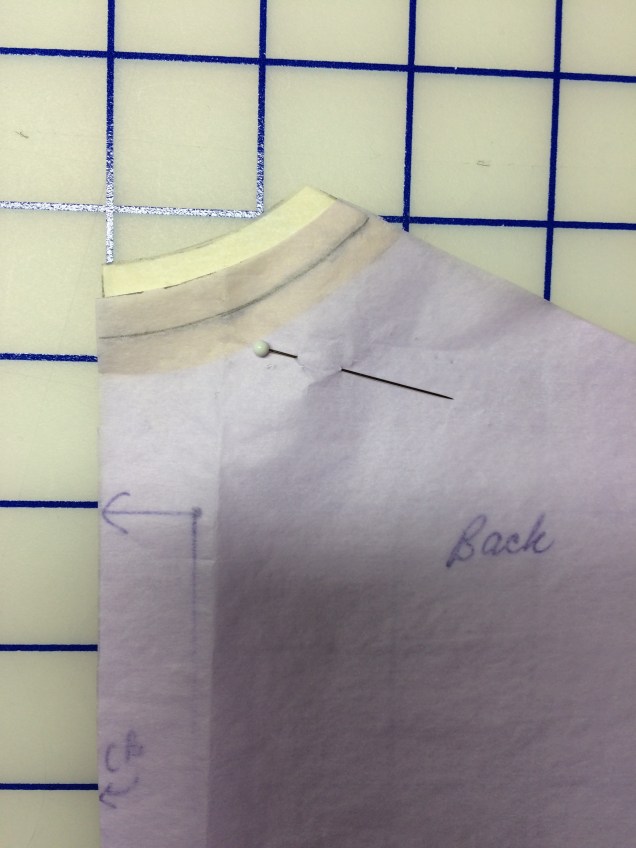
IMG_0572

The reduced scale pattern piece for the garment back is on white paper. I’ve marked only the seamline where the lining (purple tissue paper) attached to the facing (yellow tissue paper). As you can see, the lining’s seam allowance extends up like it’s supposed to and the facing seam allowance extends down. The process was to mark only the seamline, then draw the facing piece, add the seam allowance and cut, then draw the lining piece, add the seam allowance and cut.

Lesson learned: Pattern pieces that get too cluttered are confusing and it’s a mistake to think I will always be able to remember which piece goes up and which goes down.

The whole jump hem thing is a little more involved, so it gets its own section.

Map Out Jump Hems Visually

You don’t have to be math-challenged for math to trip you up, at least I don’t. And there’s something about jump hems that have had me confused for a long time. Sarah walked me through the process visually with strips of paper and I think I finally get it.

When a jacket is lined to the edge (no neck facing) and the hem is turned up (no hem facing), the lining pattern pieces are the same length as the fashion fabric pattern pieces. To get a nice jump hem that covers the hem stitches and ensures that the fashion fabric isn’t pulled up by a too-short lining, we build in a jump hem, which simply means that the fabric hangs down part way over the hem allowance, has a soft fold, comes back up to the hem stitching line and is hand stitched in place. Sarah advises to turn the raw edge of the lining under by ¼” and pin that fold to the hem stitching line and then stitch. Everything works out just fine.

Here is an attempt at a visual representation of how that works:
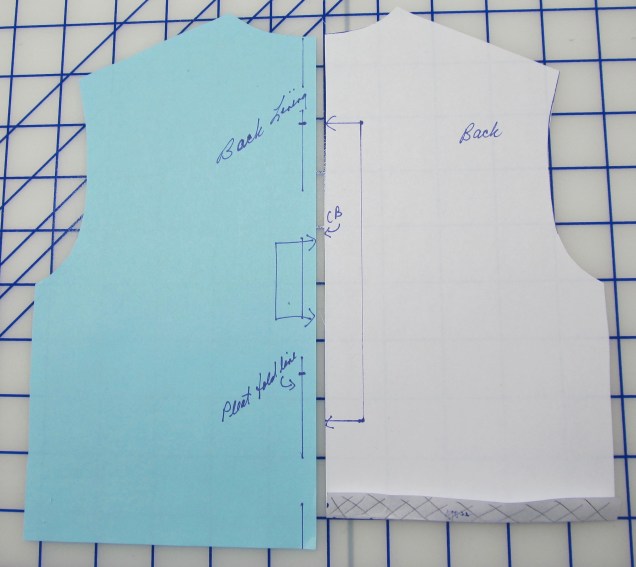
IMG_0015

The blue paper simulates a back lining for a jacket that is lined to the neck edge. It is the same length as the back jacket piece. The only difference is that it has a little extra width to allow for a pleat at center back and it is marked in approximately the places where the stitching ends to allow for arm movement. The white paper represents the fashion fabric pattern piece, which is turned up at the hem with cross-hatching to represent the right side of the fabric in the hem allowance.
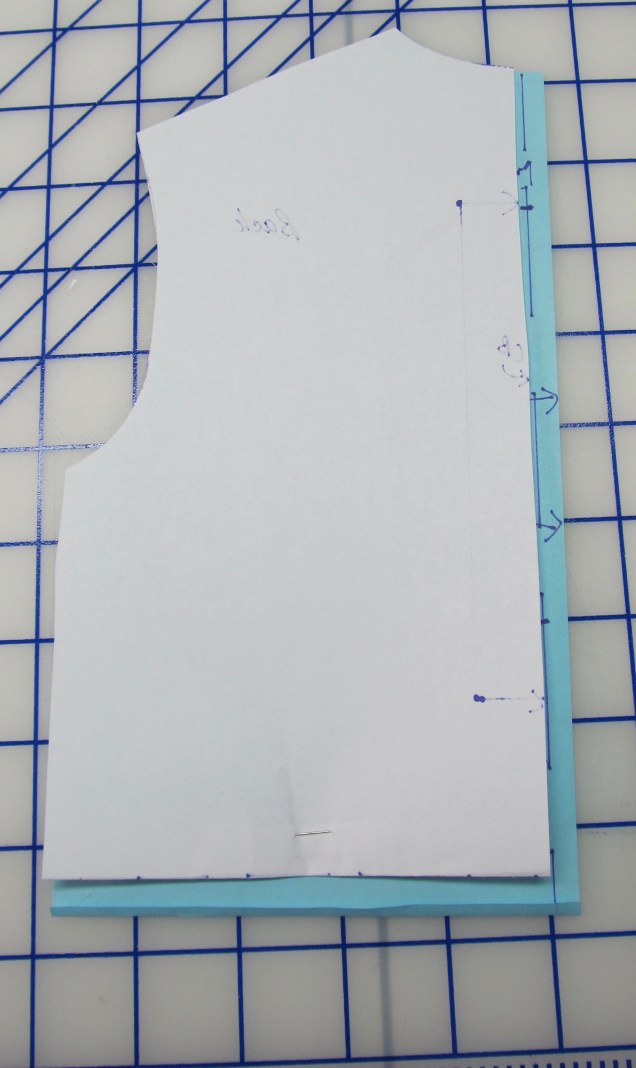
IMG_0017

The picture above shows the fashion fabric piece with the hem turned up overlaying the lining piece, which has ¼” turned up at the hem edge.

The rest of the pictures show mock-ups of a jump hem with a lining, neck facing and faced hem. The principles are the same. The only difference with the faced hem is that you want a bit more of the facing to not be covered up by the lining.

IMG_0568 (1)

Here we have the lavender tissue paper as the lining (it worked much better than the stiff blue paper I used earlier), plus the yellow tracing paper showing the facings at the neck and hem. I’ve turned the lining under ¼” and pinned it to the top edge of the hem facing. Notice the fullness above the area that’s pinned.

IMG_0569 (1)

Here it is with the lining tissue smoothed down. Try to ignore that hemline that I drew in.  Obviously, I misjudged where this would end up, which is why this method is better than doing the math.

IMG_0570 (1)

Here is a view that tries to show everything that’s going on in the area under the jump hem that is hidden when you see a sewn sample.

Lesson learned: Visual mock-ups can avoid a whole bunch of stress and can sometimes clarify things that were once a mystery.

Resewing Has Its Limits

Not all of the problems I encountered were in the pattern. I made some plain, vanilla sewing mistakes that gave me quality time with my seam ripper. There was a snowball effect to this, which I encounter quite a bit. Once I make one dumb mistake I seem to make a whole slew of them. One example was that I set the collar with right sides together. Very dumb. Ordinarily, sewing mistakes are easy to fix, assuming you haven’t trimmed or clipped anything yet. But the lovely silk and wool blend fabric I used for the jacket raveled an unbelievable amount when handled. No matter how careful I was in removing stitches, I was left with very little seam allowance in many areas. It makes me worry about the jacket falling apart when I wear it.

Lesson learned: check the big picture before sewing a seam. Just because the pieces went together nicely when pinning doesn’t guarantee that they are oriented correctly.

There’s More, But It Can Wait

I also learned that my understanding of collars and undercollars had some gaps. We can walk through that in a later post once I’ve gotten comfortable employing my new knowledge on the subject. Besides, I’m more than ready to stop dwelling on my disappointment and move on to some successes.

Here is what the jacket looks like. I finished it in time for the Sew Chicago holiday brunch. Everyone was very supportive and had nice things to say about it and I know that if I hadn’t blabbed about all the mistakes I made most people would never have noticed. I’m looking forward to getting the 2.0 version of it done and feeling really good about the work.
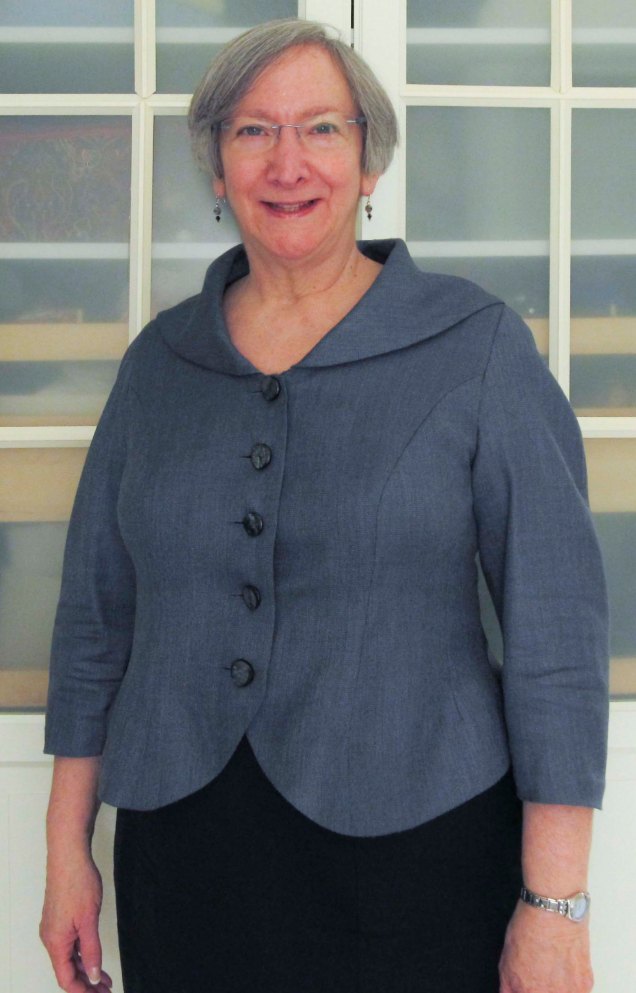
Homage Jkt 1 Modeled

Wardrobe Planning and Peace of Mind

Fall is well underway, which means I’m already late in getting my fall-winter wardrobe planning done. There are reasons, of course. There were preparations for the ASG Chicago fashion show last Saturday, for which I collaborated with a friend to coordinate submissions and prepare the lineup and then I wrote the commentary for the 65 entries that walked the runway. There were 67, but one of mine and one other had to be pulled because they didn’t get finished. Before that, I was working on a jacket for a challenge for the Haute Couture Club of Chicago. The challenge topic was actually my idea, so I wasn’t planning to enter the challenge, just show the jacket. It, too, is unfinished. Sigh.

IMG_0445

Oh, and there’s the dress I promised to a very dear, very understanding friend almost a year ago. And then there are the countless garments I have in my head, some of which seem urgent because they belong in my core wardrobe.

So, if the title of this post left you wondering what wardrobe planning has to do with peace of mind, the best explanation I can give is that it helps me clear a calm space in my head.  Sometimes, creative paralysis stems from something other than perfectionism. Or maybe it is actually a form of perfectionism. Sometimes I can’t dig in and do one thing because all the things I have to or want to do are vying for my attention. Pretty soon I’m feeling overwhelmed and I can’t decide what project to work on first because I’m sure I’ll never get through all the projects in time for this season. Does any of this sound familiar?

In reading about strategies for overcoming procrastination or perfectionism (great avoidance activity!) I’ve seen this syndrome described as mental static or mental clutter. The clutter analogy resonates with me, because I’m one of those people who has to take a break from work from time to time just to sort through the piles of paper on (and sometimes surrounding) my desk. I’m convinced it’s impossible to think in the midst of clutter. Yes, organizing papers and tossing months-old to do lists does sound like another avoidance activity, but I find it very useful. I feel as if I’m getting a fresh start when I sit down at my desk again and the writing goes much better.

So, how can this strategy be applied to wardrobe planning for a sewist? I’ve tried lists because I’m a compulsive list-maker. That doesn’t work, because the list goes on and on. I’ve tried flow charts – same problem. Plus there’s the whole mastering-flow-chart-making-time-sucker issue.

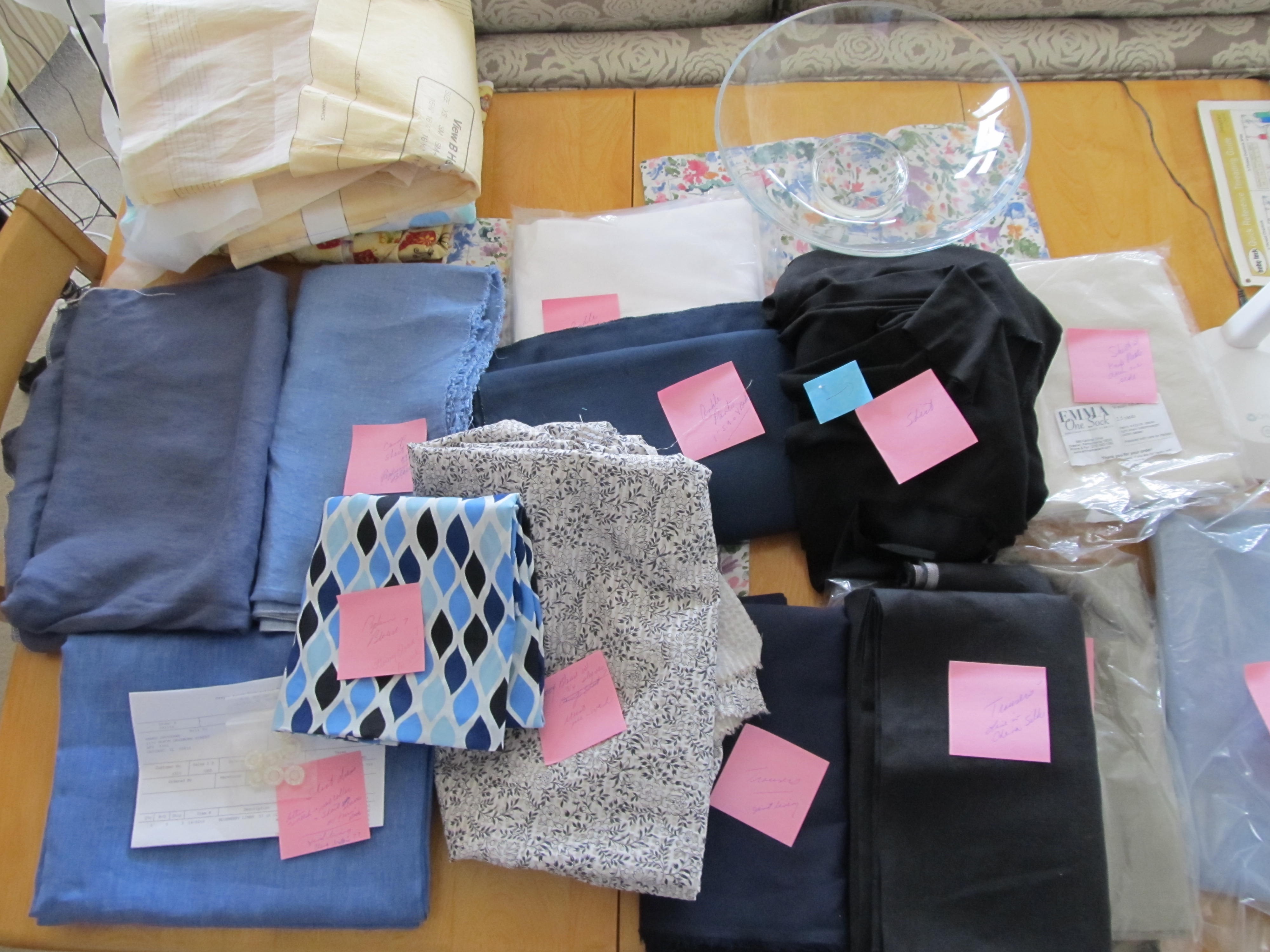
Last summer, I stumbled on a method that actually worked. I was “shopping” in my fabric collection (I hate the word stash) for a piece of fabric I thought I had for a blouse I wanted to make when it occurred to me that I should pull out all the summer fabric I wanted to work with and spread it out on a table. I sorted by type – bottom weight, blouse-weight, linen I had planned to use for a dress, and knits.

IMG_0004I labeled them with Post-It Notes and what emerged for me was a clear picture of what I wanted to do with each of the fabrics in front of me. It also became clear that I had to eliminate some pieces, or at least defer them until next year.

The next step was to inventory what I needed for the pieces I planned to sew. What linings did I need and did I have them? How about interfacing, zippers, thread, etc.

The last step was to prioritize. What did I find myself reaching for most often that wasn’t in my closet yet?

Of course, summer is really short and it’s even shorter if you don’t get started until July. That means I didn’t get through everything I planned out that day, even after the culling I did. But that really didn’t matter. What mattered is that I had cleared the clutter from my head and created a calm, quiet place that allowed me to work on one garment at a time and enjoy wearing each one when it was done.

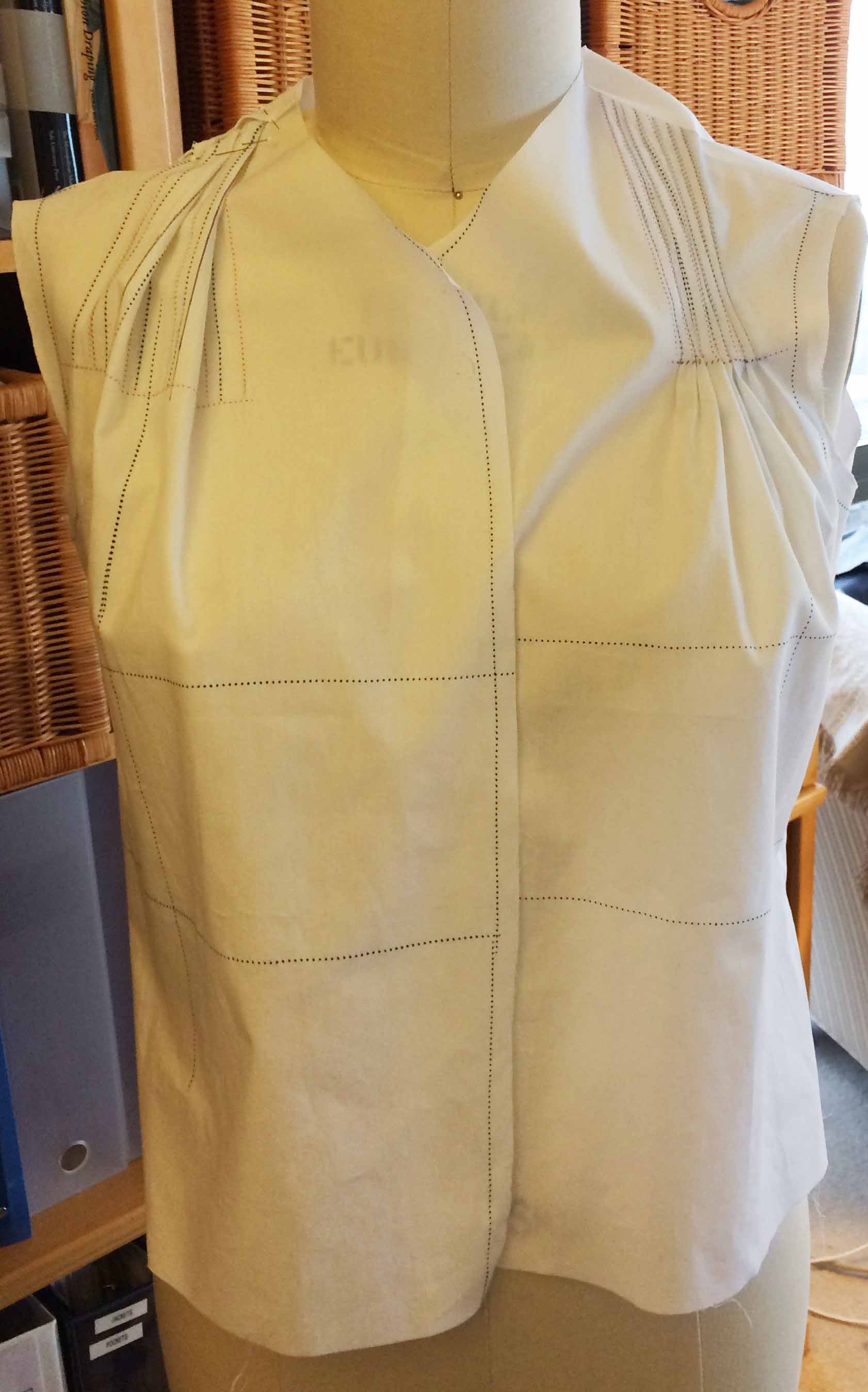
The No-Close Topper That Plays Well With Curves

Silk TopperYou may be wondering whether all of my sewing projects start out looking simple and end up being way more involved than I bargained for. A lot of them do, and those are the ones that teach me the most. My seemingly simple project to create a no-close topper to go over a knit tank or sleeveless shell is another example.

I started this project thinking I could take my basic bodice sloper, change the neckline, add seam allowances at center front, draft a front facing, set in my basic sloper sleeves and have a nice layering piece that isn’t a jacket. When I did that, I quickly discovered that, even though the garment would have fit just fine as a blouse with a closure, when left to its own devices the front automatically traveled outward. Not just a little, either. The two front pieces wanted to settle out near my arms. It hadn’t occurred to me that a pattern designed to accommodate my particular bust shape and size would resist staying put. So that’s why RTW makes these pieces so oversized, I said to myself. But if I want to wear oversized, shapeless clothes I don’t have to go to the trouble of sewing them.

At this point, I sewed my first attempt together at center front, called it a blouse and put this project on the list for my next video consultation with Sarah Veblen.

Silk Tulip Top

We discussed a number of solutions and I tried a few in a mock-up, but I still wasn’t getting the look I was after.

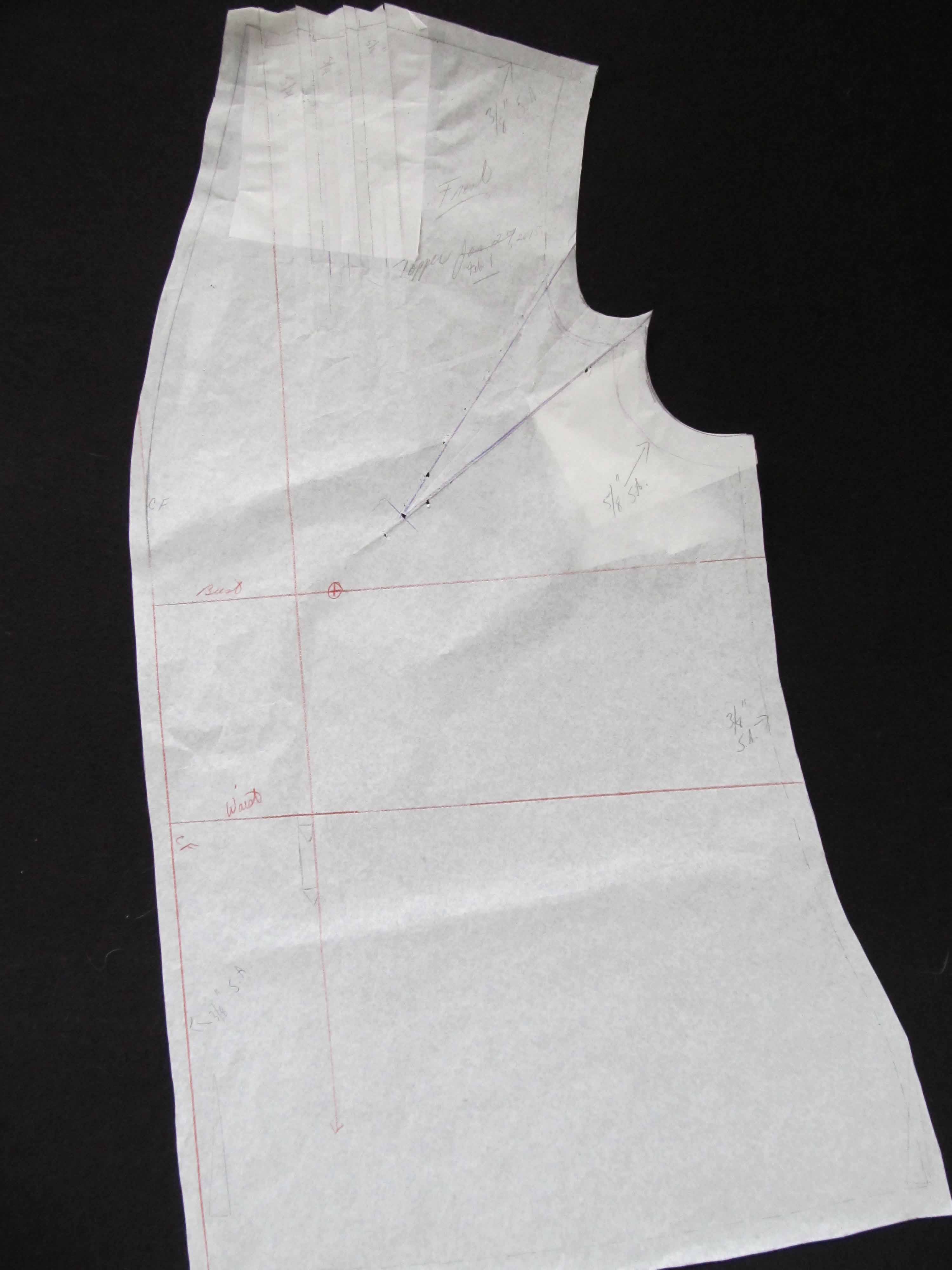
After more discussion, we came up with an approach that turned this into a redesign project. The idea was to convert my armscye princess bodice sloper pattern into a pattern that transferred the bust shaping to tucks at the shoulders. This involved dart rotation, a really educational patternmaking exercise.

Patternmaking books tell you that you have to rotate darts (or in this case, princess seams, which are dart equivalents) at the apex. Turns out that’s one of those rules that can be broken. In my case, I needed more fullness at the apex than the princess seams give me, because I wanted the fabric to hang straight over the bust on its own. That meant the dart rotation had to take place below the apex. Here is what that looked like.

Front Convert PrincessAs you can see, the Apex is off to the right and the pivot point is about 1.5 inches below it.

This picture also shows something that I found nerve wracking. I knew that moving away from princess seams was going to mean giving up the great curve-hugging fit I’d worked so hard to achieve with Sarah. I didn’t know whether I was going to like the final product, but this was a test and nothing ventured, nothing gained. The thing that set me back on my heels was the amount of distortion that took place in the shoulder seam. Seeing that dredged up all the missteps and wrong turns I’d taken when trying to make pattern adjustments. I had to remind myself that this was just an experiment and the worst thing that could happen would be I wouldn’t have this type of garment in my repertoire. So, I filled in all the gaps with paper, drew a line from the neck edge to the shoulder point and kept going.

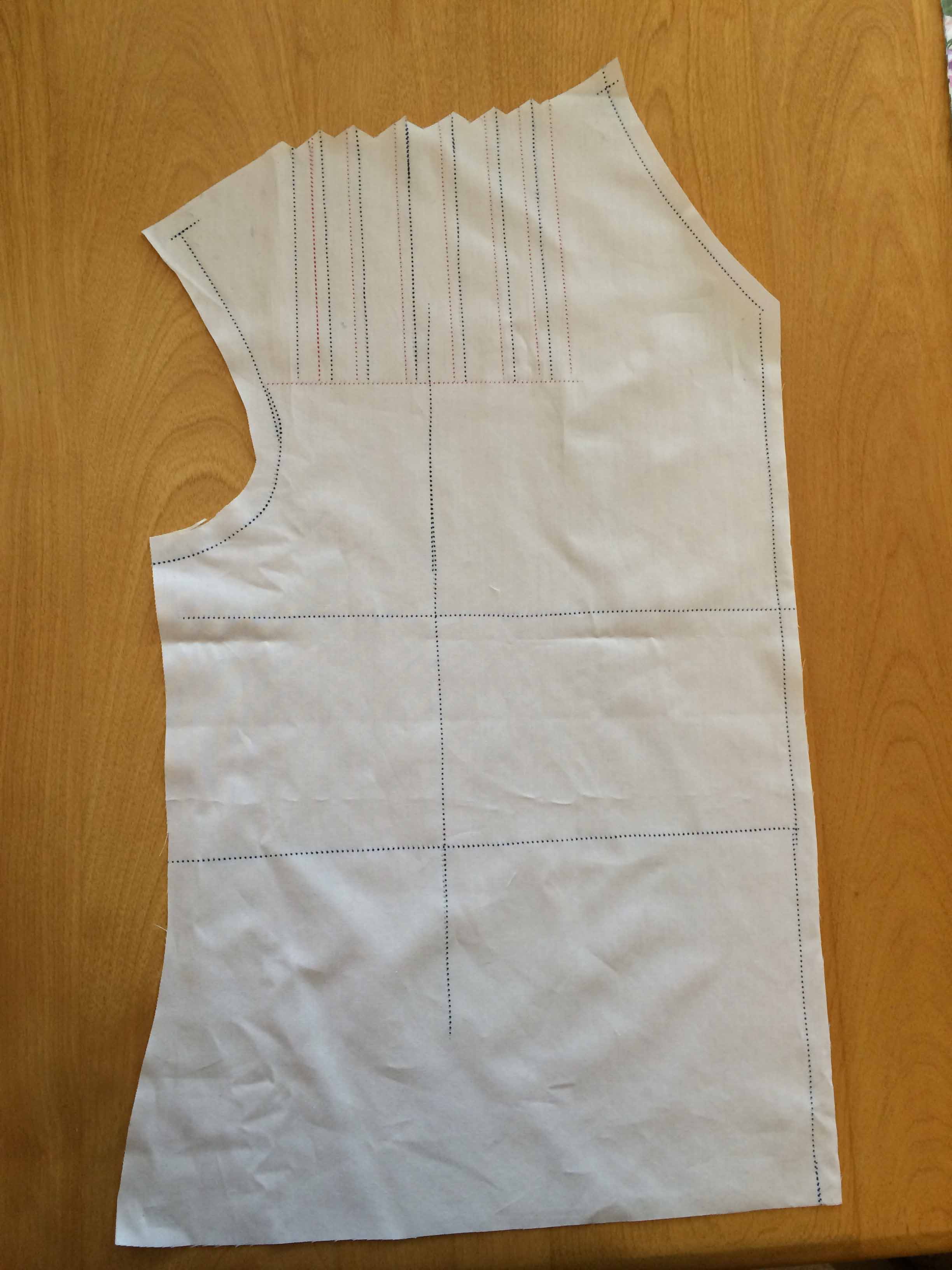
Of course, the overlapping you see at the hem has to be added back in somewhere to provide the correct circumference. For my first muslin test, I put almost all of that into extra fabric at the shoulder that became pleat intake. The rest I added to the side seams.

Here is one of the bodice pieces cut and marked in muslin.

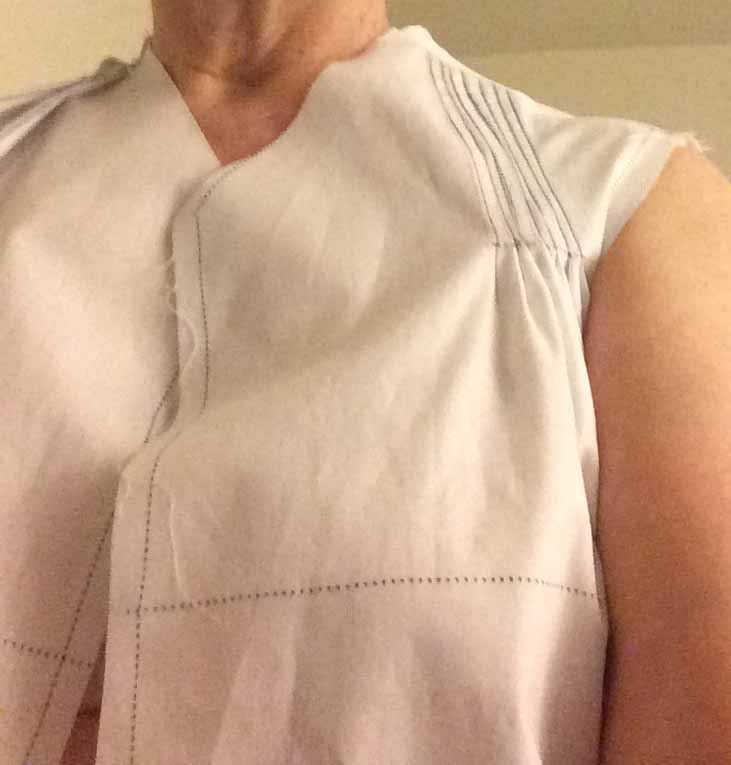
All rotated to shoulderI was pretty sure I wanted pleats, as opposed to just tucks, at least for the woven version. One thing I had to work out was how far down I wanted them stitched. As I worked on this it also occurred to me that a variation with a yoke might be nice, but first I had to get the concept to work.

Skewed pleats and splayedAs you can see, the first test did not turn out well. Although the pleats were marked on grain, they pointed outward on the body.

The next picture shows my experiments with tucks versus pleats stitched almost to the bust.

Muslin Test1_2After trying it out in rayon to mimic the drapiness of the fabric I was planning to use, I still wasn’t happy. I ended up splitting the bust shaping between shoulder pleats and an armscye dart. Here is what that looks like on the pattern.

Front FinalThe back was a more straightforward conversion. Here is what it looked like in development.

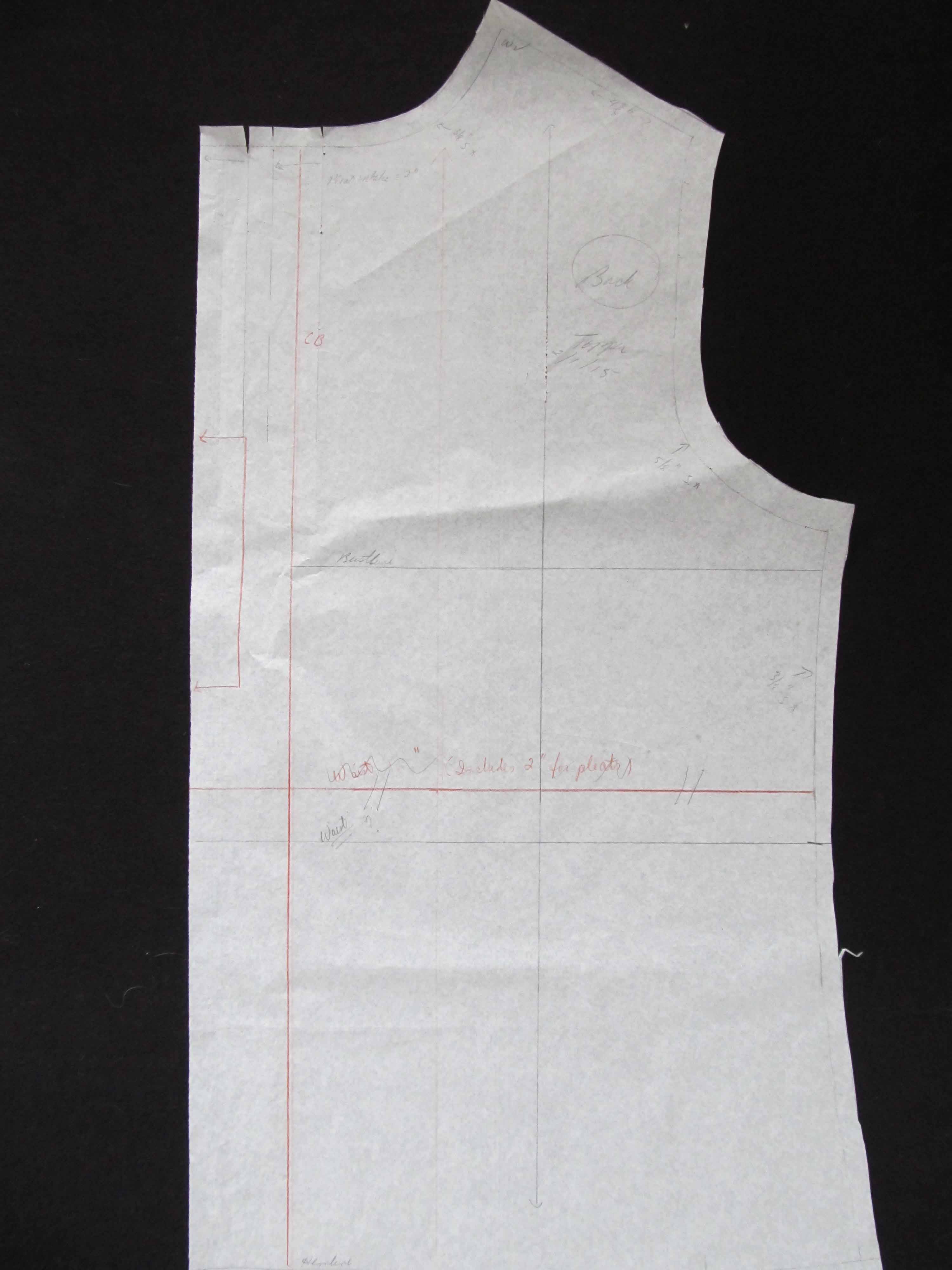
Back DevHere is the final pattern piece. All of the intake was rotated to pleats at center back. The center pleat is the deepest.

Back FinalAnd here is the final product on me. The fabric is silk crepe de chine. I love the fabric and I like the topper. It’s completely boxy and oversized, but it isn’t as flattering as the fitted pieces with princess seams. Still, I’m glad I added this to my repertoire.

Topper Modeled

Rediscovering the Lost Art of Dress

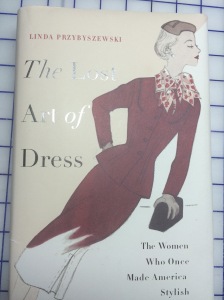
IMG_0434Reading The Lost Art of Dress by Linda Przybyszewski opened my eyes to a great deal that I hadn’t known about how women and girls learned to dress appropriately in the past and how well-educated women carved out careers for themselves in home economics departments of leading universities in this country long before women entered male-dominated professions in large numbers.
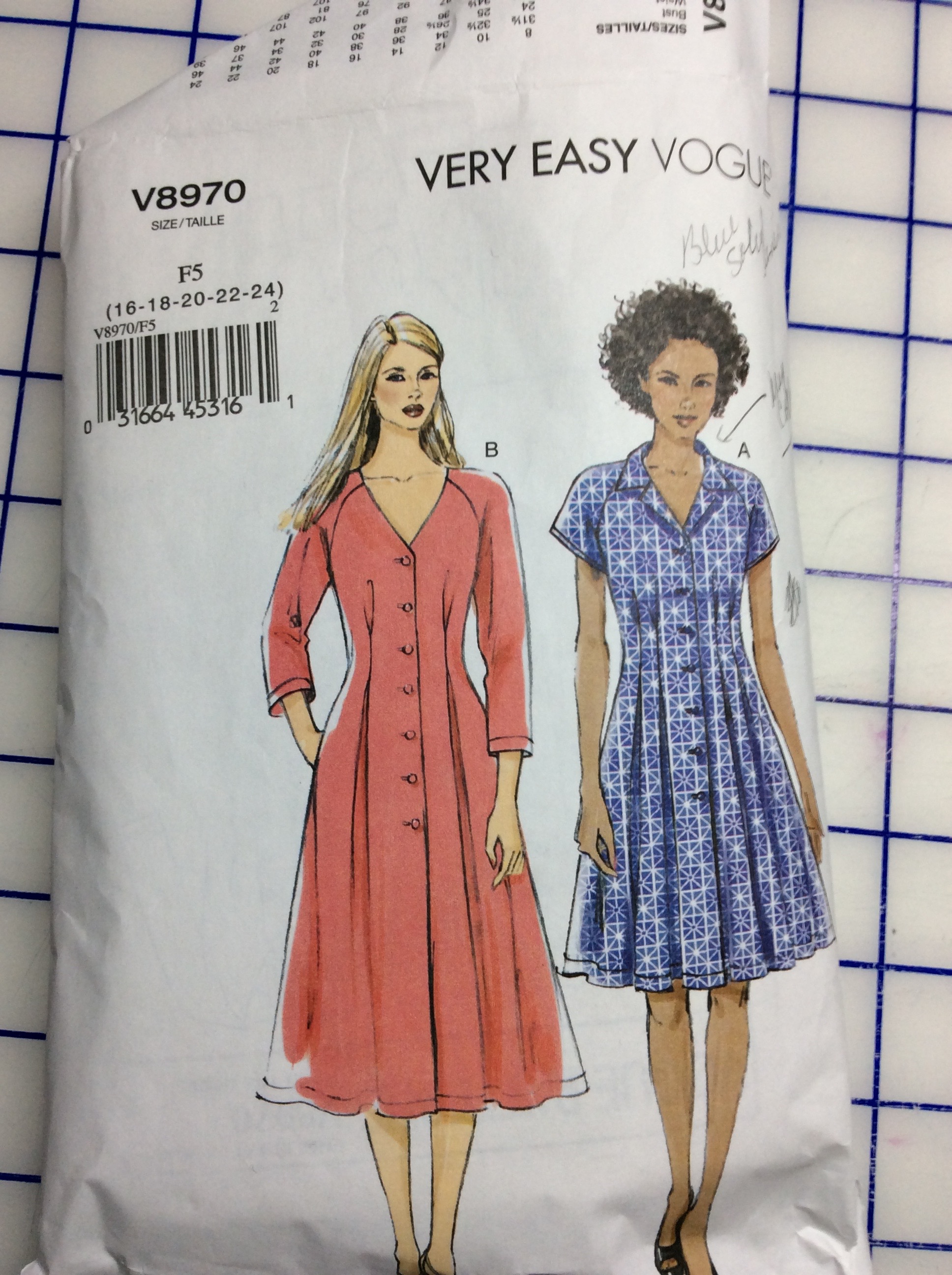
One thing the book reminded me of is how comfortable shirtdresses can be to wear and how perfect they are to fill that gap between dressed up and casual. Professor Pski herself favors  this style and shirtdresses were a mainstay of my mother’s wardrobe as well as my own back when a dress was the most casual thing I could wear to the office on a weekday. And so I was inspired to develop a pattern for a shirtdress.

Of course, I had some specific requirements for this shirtdress. First, I never liked wearing dresses that have buttons all the way down the front, because there is always pulling and gapping when I sit in them. I also liked the idea of having release pleats to control the transition between the fitted bodice and a flared skirt.

Vogue 8970 pretty much fit what I had in mind in terms of the shape.

IMG_0136The blouse pattern Vogue 1412 provided the solution I was looking for to avoid having buttons all the way down the front.

IMG_0135This pattern has a few buttons on a placket and transitions to a pleat that extends to the hem. I opted for a facing rather than a placket, but incorporated the pleat.

The first order of business in developing the pattern was to get the shape of the skirt. I had a false start trying to trace the side seams of V8970, but quickly found that adapting that pattern to my armscye princess sloper either wouldn’t work or would be much more trouble than it had to be.

Going from the sheath pattern to the shape I wanted for the shirtdress was pretty simple. Yes, there was math involved, but just to the point of approximation.

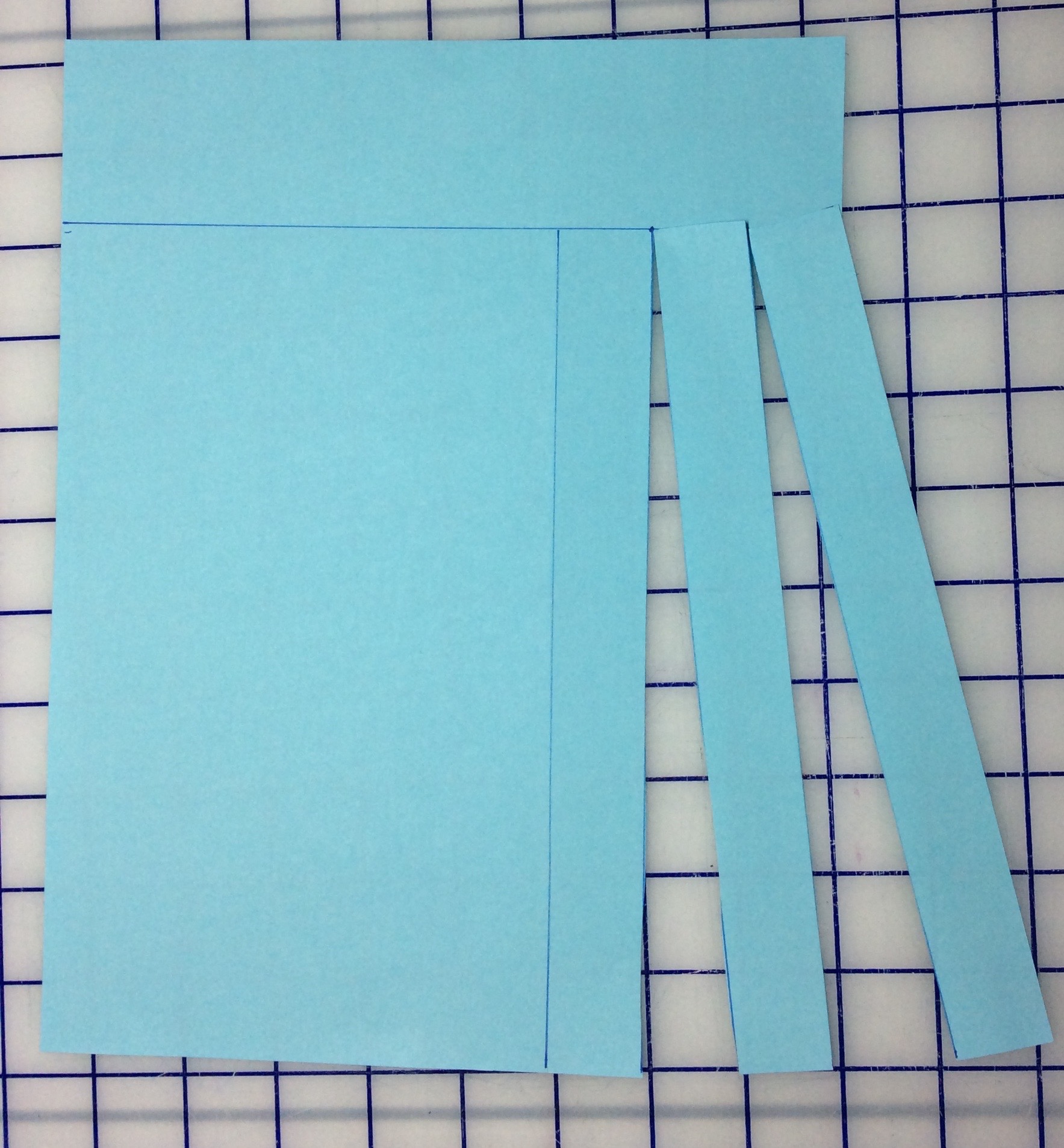
The method consists of cutting the existing pattern into strips, from hemline to a horizontal balance line (HBL) that will be used as a pivot point. Each strip needs to be cut to, but not through, the point where one of the cut lines meets the HBL to form a hinge. Here is an example of how this works.

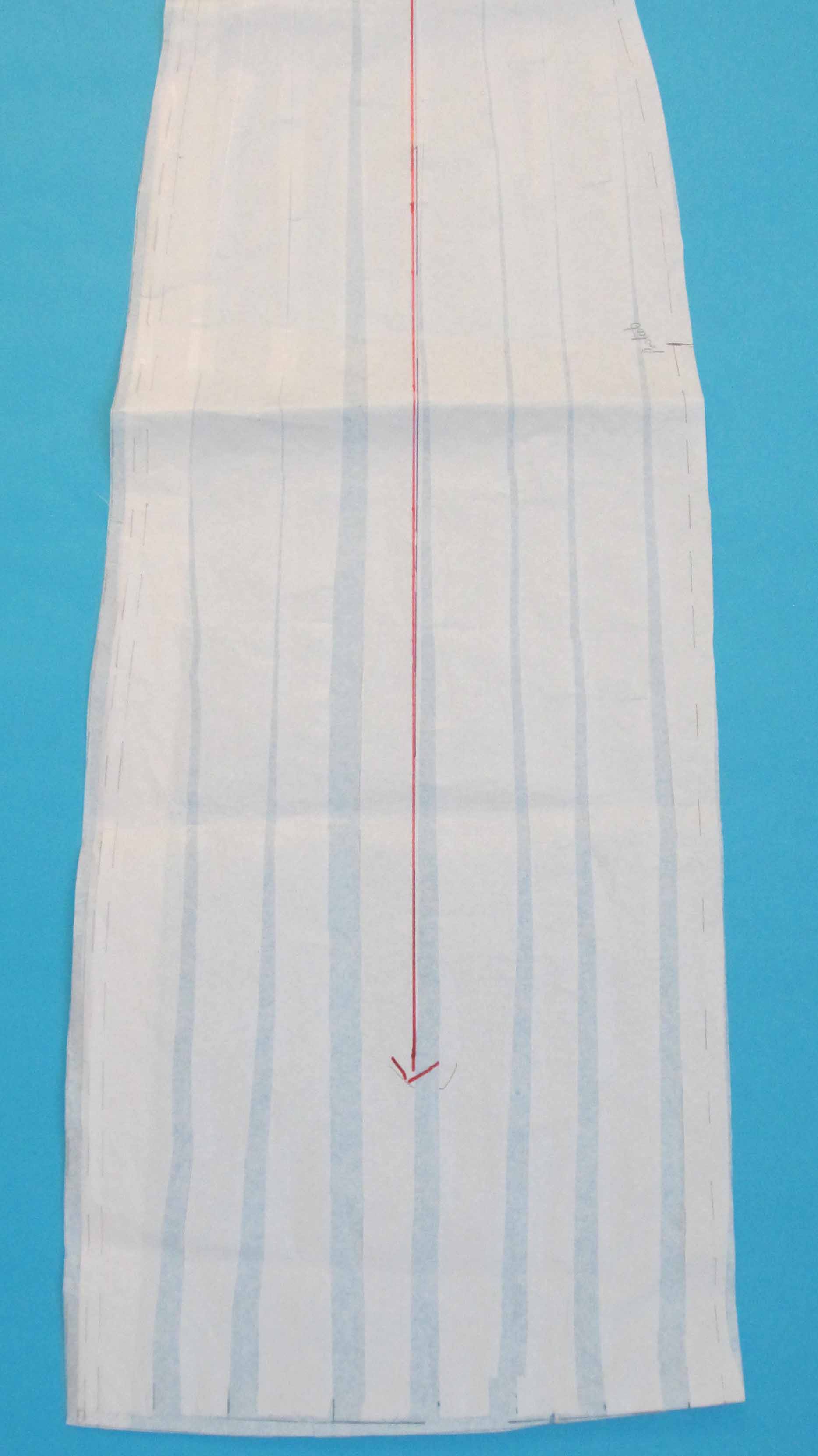
IMG_0138I decided how wide I wanted the dress to be at the hemline, subtracted the total circumference of my sheath pattern at the hem (not counting seam allowances), and divided that number by four. After rounding for convenience, I subtracted the width of each pattern piece at the hemline to arrive at how much I needed to add to each pattern piece. Then it was a question of cutting strips of equal width to the HBL, cutting the hinges, placing more pattern paper under the work and spreading the strips the same distance apart from one another at the hemline. I think I opted for ½-inch spreads to distribute the additions evenly throughout each pattern piece.
I left center back and center front alone and worked only to one side on those pieces, whereas the side front and side back had to have new graininess drawn after the process was completed. Then I taped it all down and arrived at pieces that look like this at the bottom.

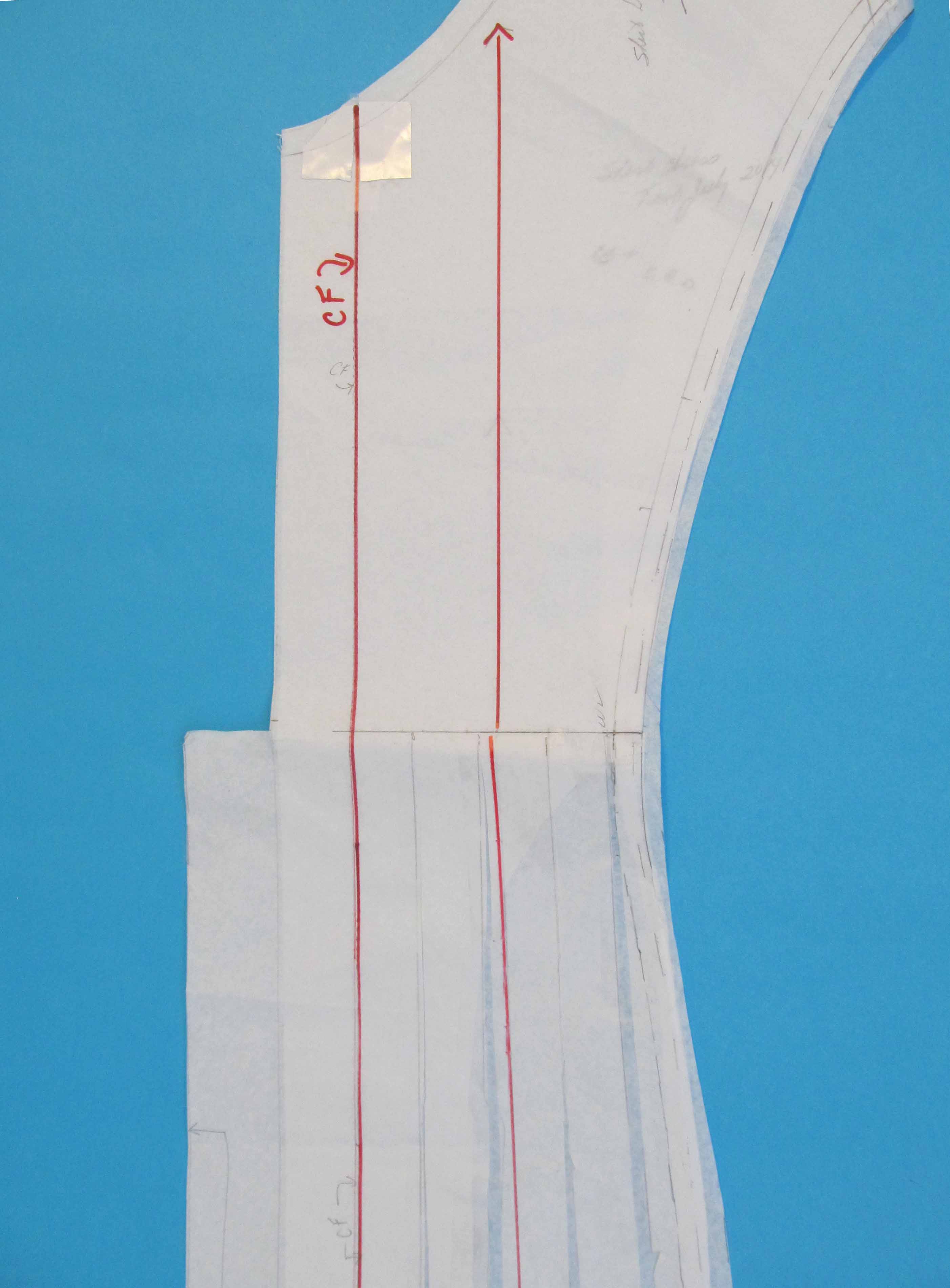
SkirtSpreadHere is what the pattern looks like in the hinge area.

ShowHingeThe picture above also shows the extension for the center pleat, which is cut on the fold, and the extension for the opening where the buttons and buttonholes are placed.

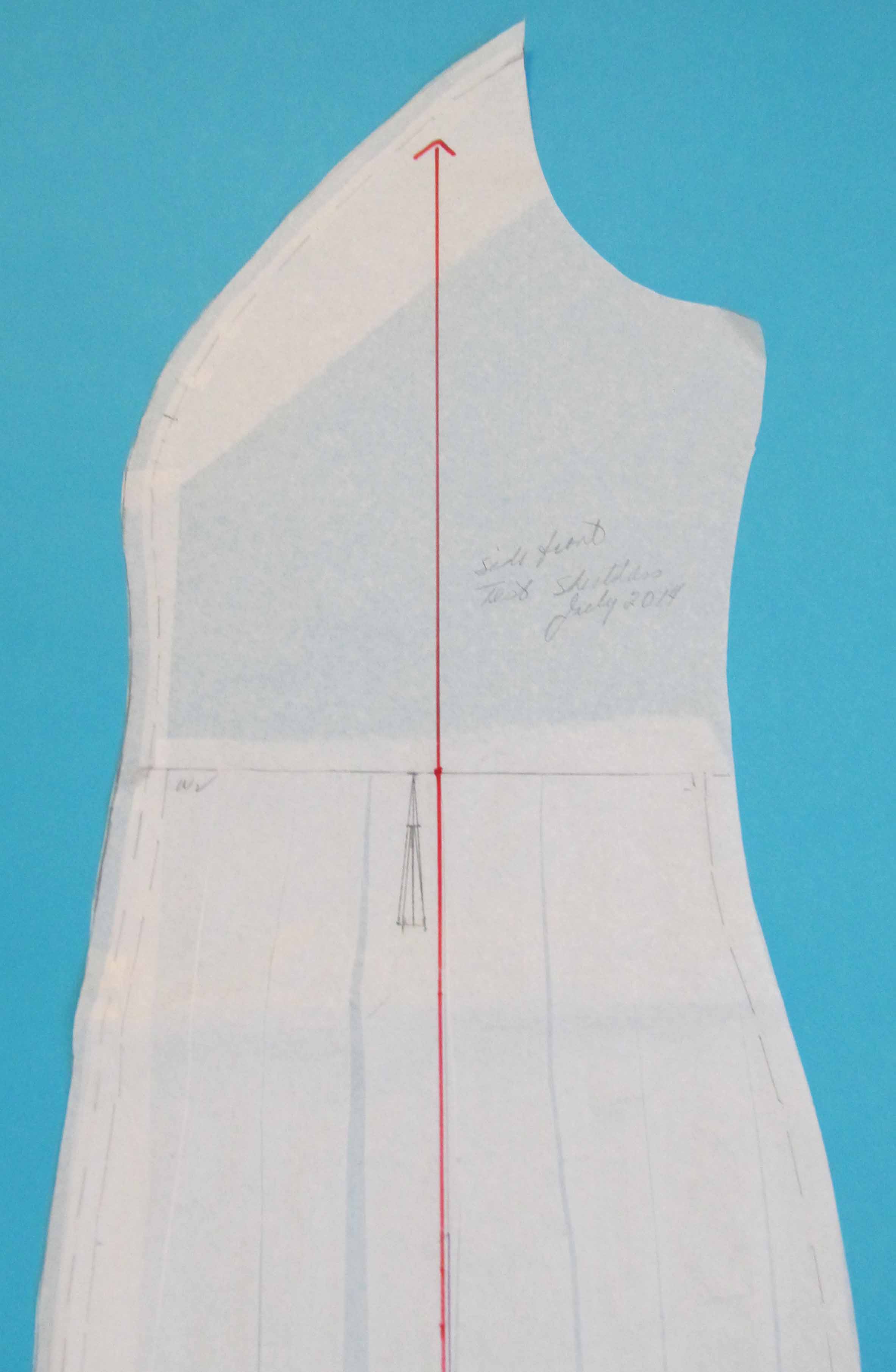
I had a friend mark the placement and depth of the release pleats for me in the side front and side back panels. Here is how that looks on the pattern. Shirtd_SF_Top

I added in-seam pockets to the pattern and was good to go.

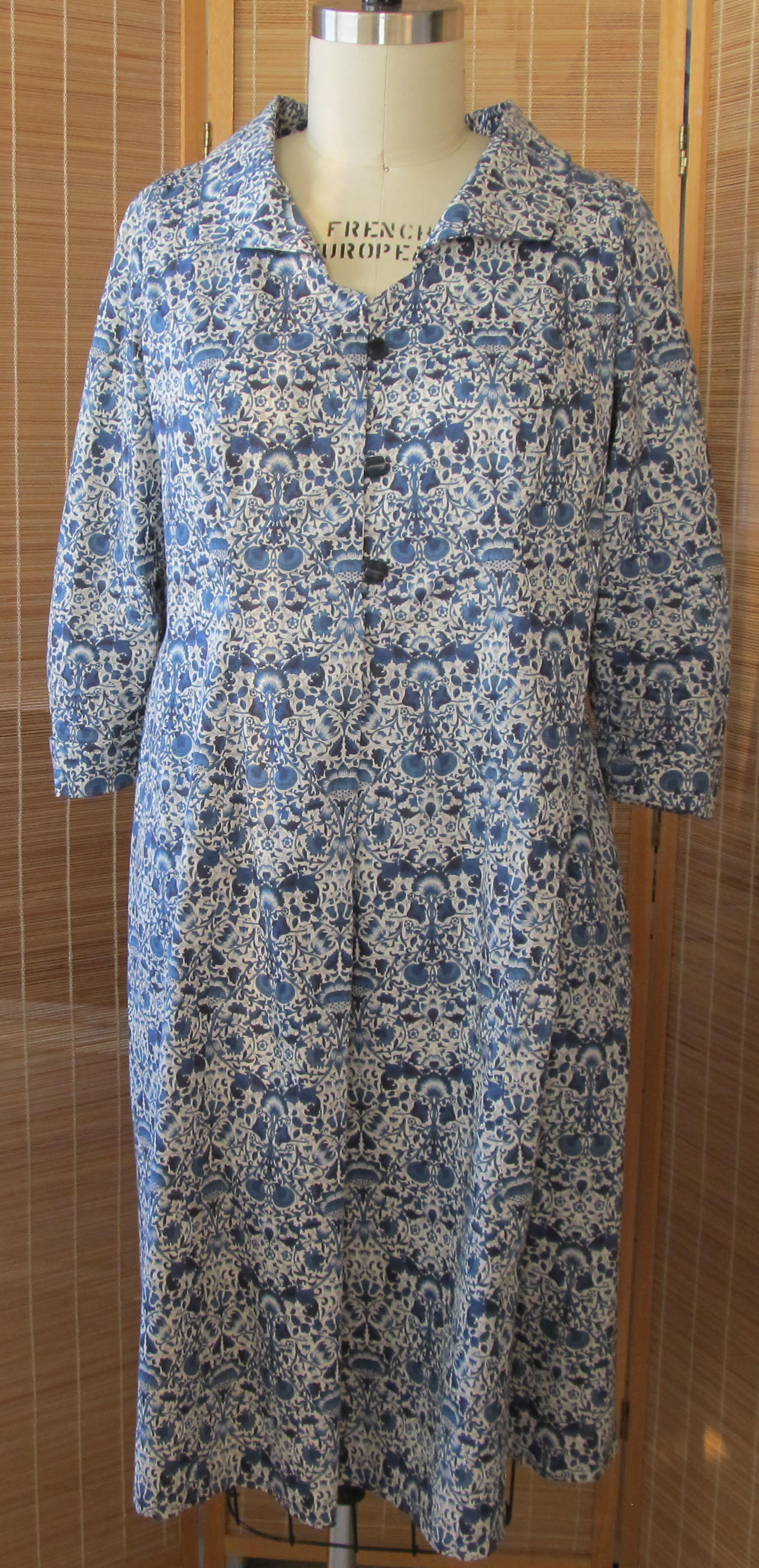
This was another project that I intended to complete in the summer of 2014 in linen. When I didn’t get to the sewing in time, I made the first version of the dress with 3/4 sleeves and turn-back cuffs out of a Liberty cotton lawn lined in white cotton batiste.

Liberty Shirtdress

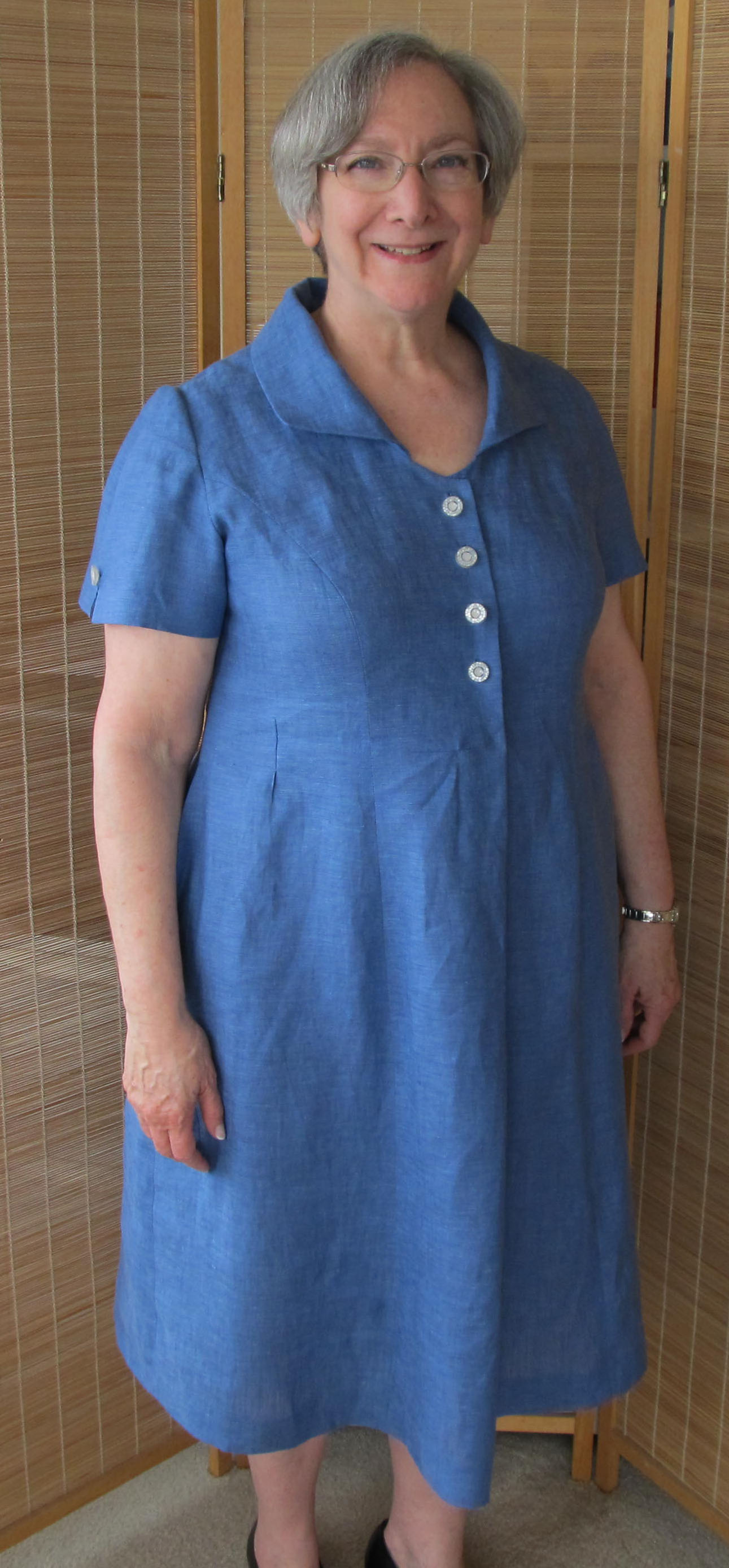
I ran into some issues with buttonholes, so I opted for button loops. I drafted the collar pattern myself and, although I love wearing the dress I decided that next time I would raise the back neck and make corresponding adjustments to the collar. I did that in this linen version, which I finished in July and wore for the rest of the summer.
Linen ShirtdressYou can see the release pleat clearly in this solid fabric. As you can see, I overcame my buttonhole issues for this version. The buttons on both of these dresses are from Soutache.

I’m much happier with this neckline and the way the collar sits in the back. I definitely want to use the collar again, maybe in a blouse next time.

I have some cotton shirting I want to use for another version of this dress with a Mandarin collar. I also have some crinkle rayon that I think would look nice with a shawl collar. As you can see, this is becoming a staple in my wardrobe.
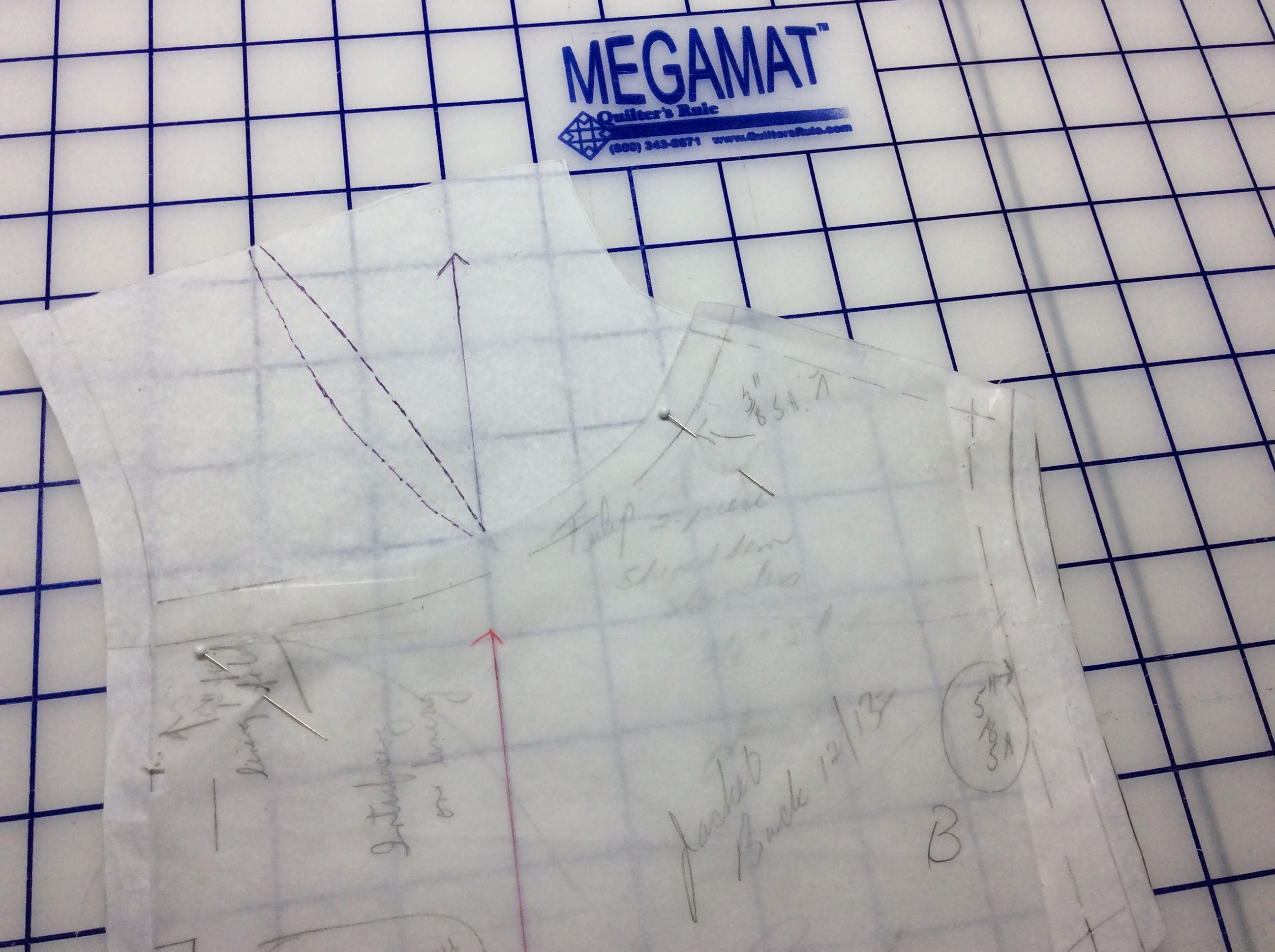
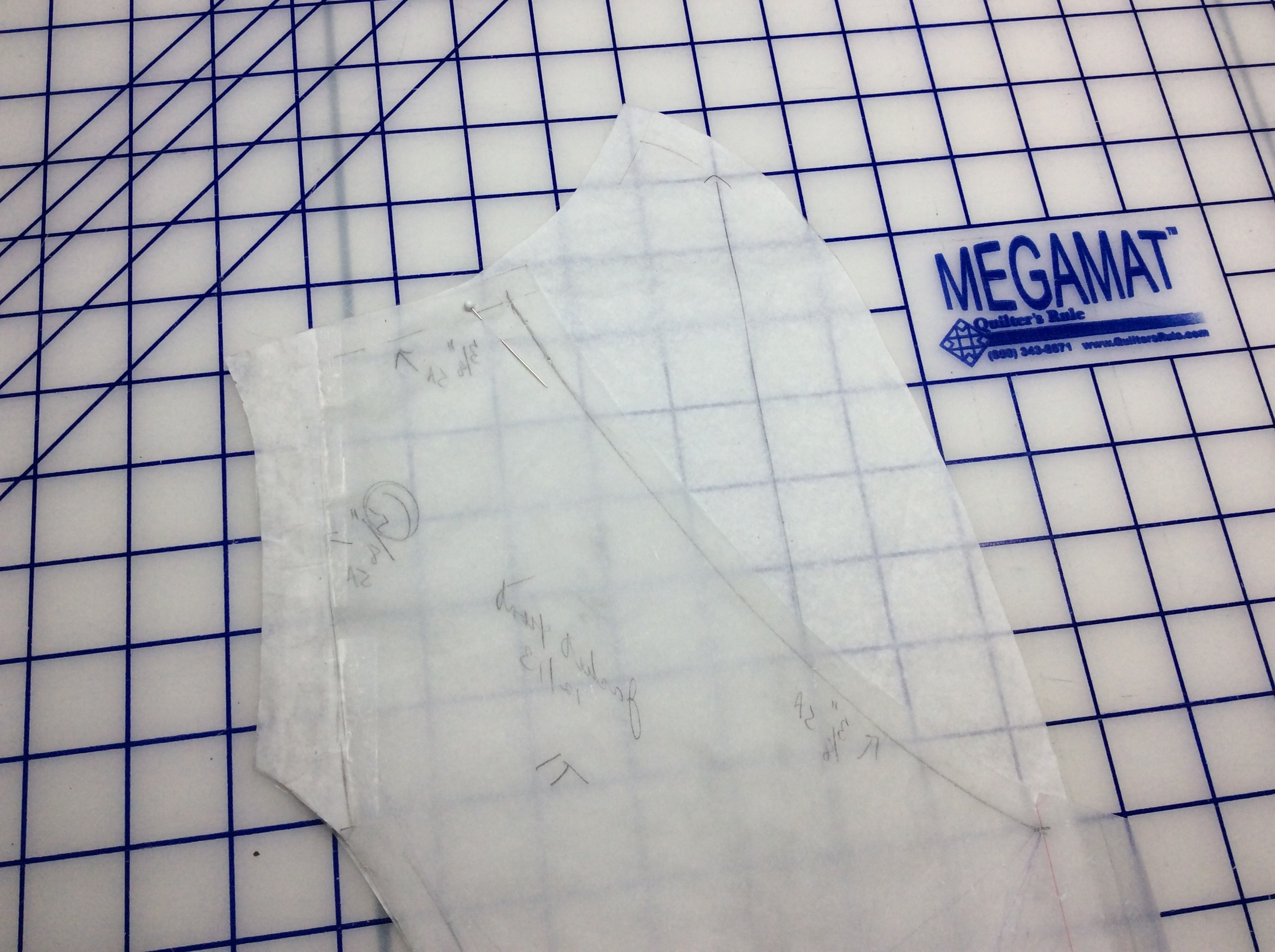
Connecting the Dots
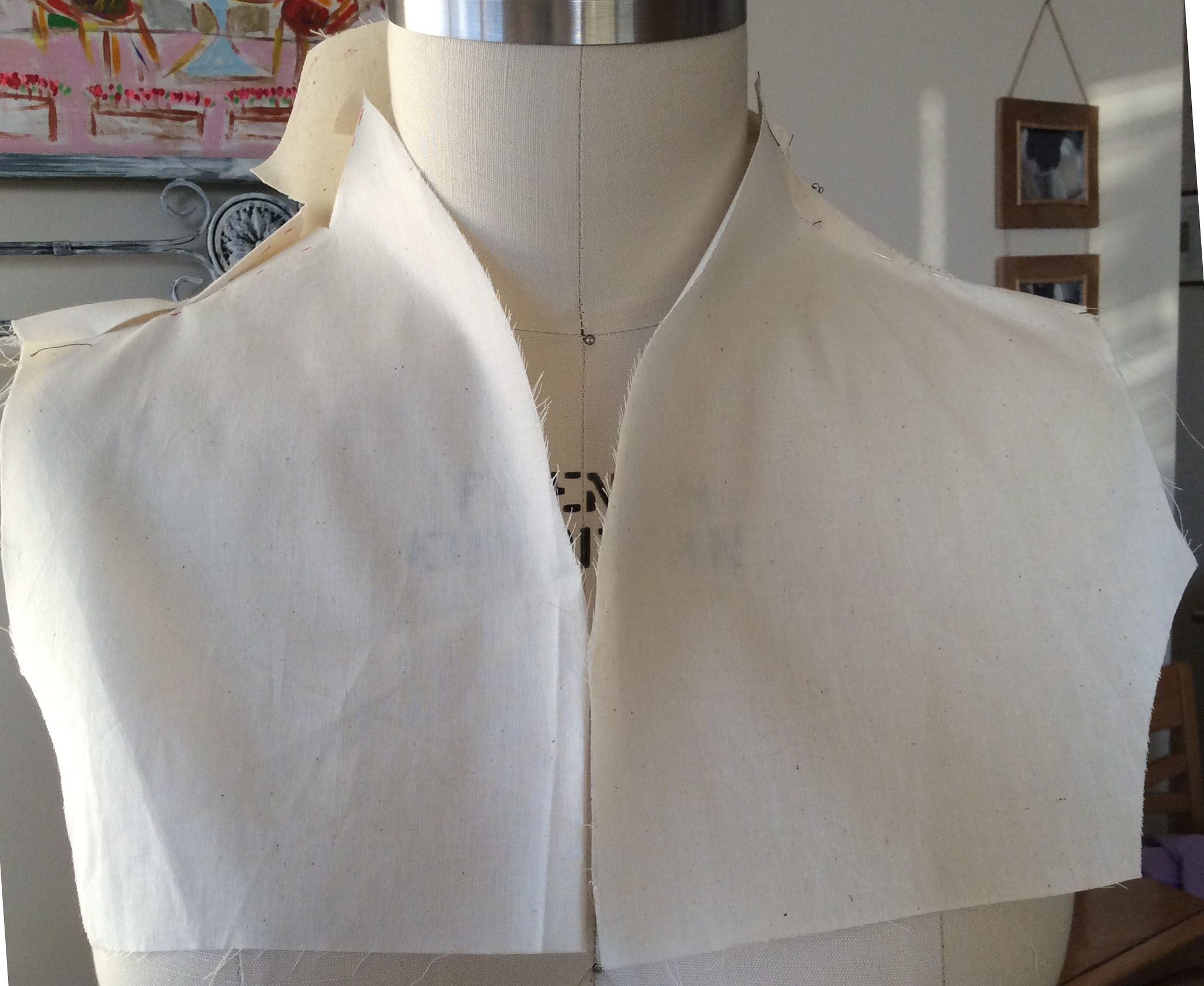
Blue SheathOkay, time to take the two-piece dress pattern and convert it to a pattern for a sheath dress. No big deal, right? Well, not a really big deal but there were issues.

The first hurdle was to decide where the bodice pattern leaves off and the skirt pattern begins. Why wasn’t it just a matter of extending the bodice piece? Isn’t that how we’re told we can convert commercial blouse or shirt patterns into dress patterns? Yes, that is what we’re told, but it doesn’t work on me.

First, let’s take a look at the two-piece dress sloper, or master pattern.

2pc front

See how the bodice is nipped in a bit, but not as much as the waistband on the skirt, then flares out? If you continue that flare the silhouette wouldn’t be anything close to a sheath.

There’s another problem lurking here. I’m one of those women with a tilted waist. And, because of my shape—lots of tush, less of me at the waist—the center back seam is not the same length as the center front seam. You can get a sense of that tilt from this picture, which also approximates the way the two pieces overlap as worn.

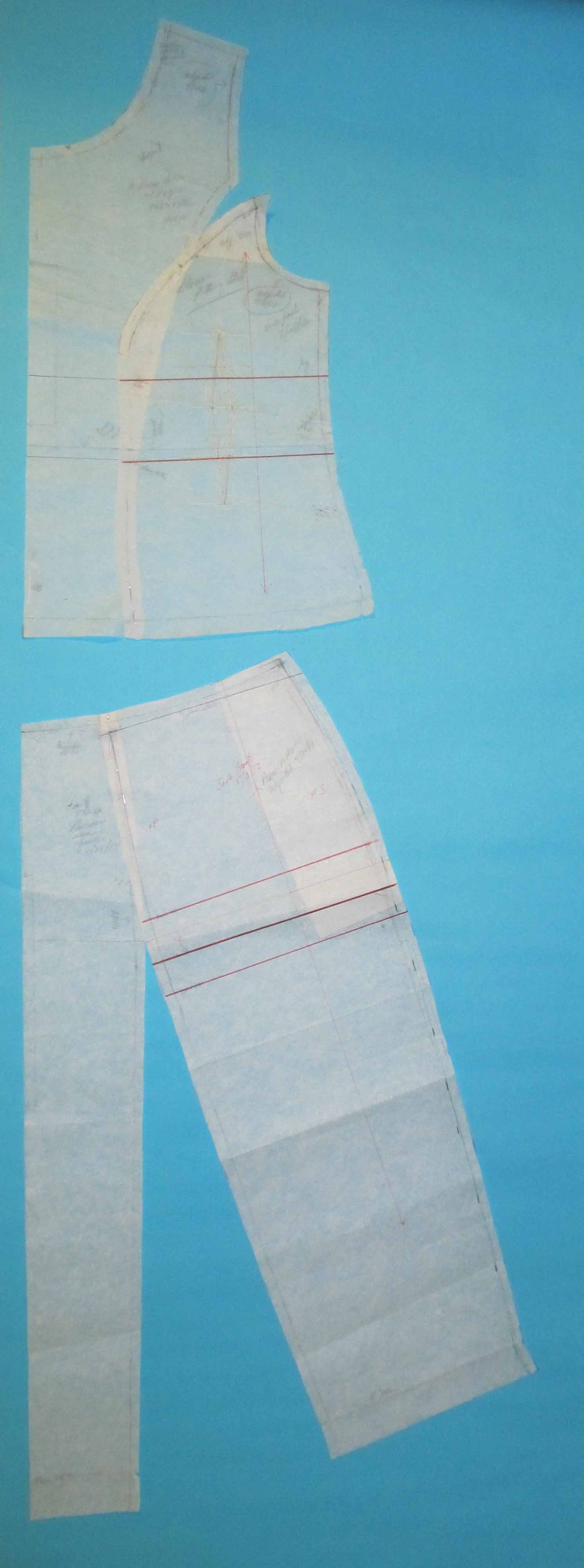
SideSeamOverlapHere’s where working with horizontal balance lines that Sarah Veblen teaches us to use comes to the rescue. When developing a pattern from one that has been fitted using Sarah’s method, there are two things you know for sure. The hem will be parallel to the floor, making hemming a breeze, and the horizontal balance line or lines (HBLs) used in the fitting process will also be parallel to the floor/perpendicular to center front and center back. HBLs are drawn somewhere below the bust on blouses and jackets and in the hip area on skirts and pants. That means I was able to use everything above the HBL in the bodice and everything below the HBL in the skirt for my sheath dress mock-up. The mystery was what the pattern needed to look like in between those HBLs.

You may be wondering why all the angst about something I’m going to mock up in muslin and can fine tune anyway. For one thing, I was still reeling from all the trial and error that had gone into getting a good fit before I started working with Sarah. A big chunk of that time was spent trying to make a sheath dress, and that includes a workshop in which everyone was close to finishing a dress at the end of the weekend and I was still getting a muslin repinned that never made it to a completed garment. In other words, this project had even more baggage than usual associated with it.

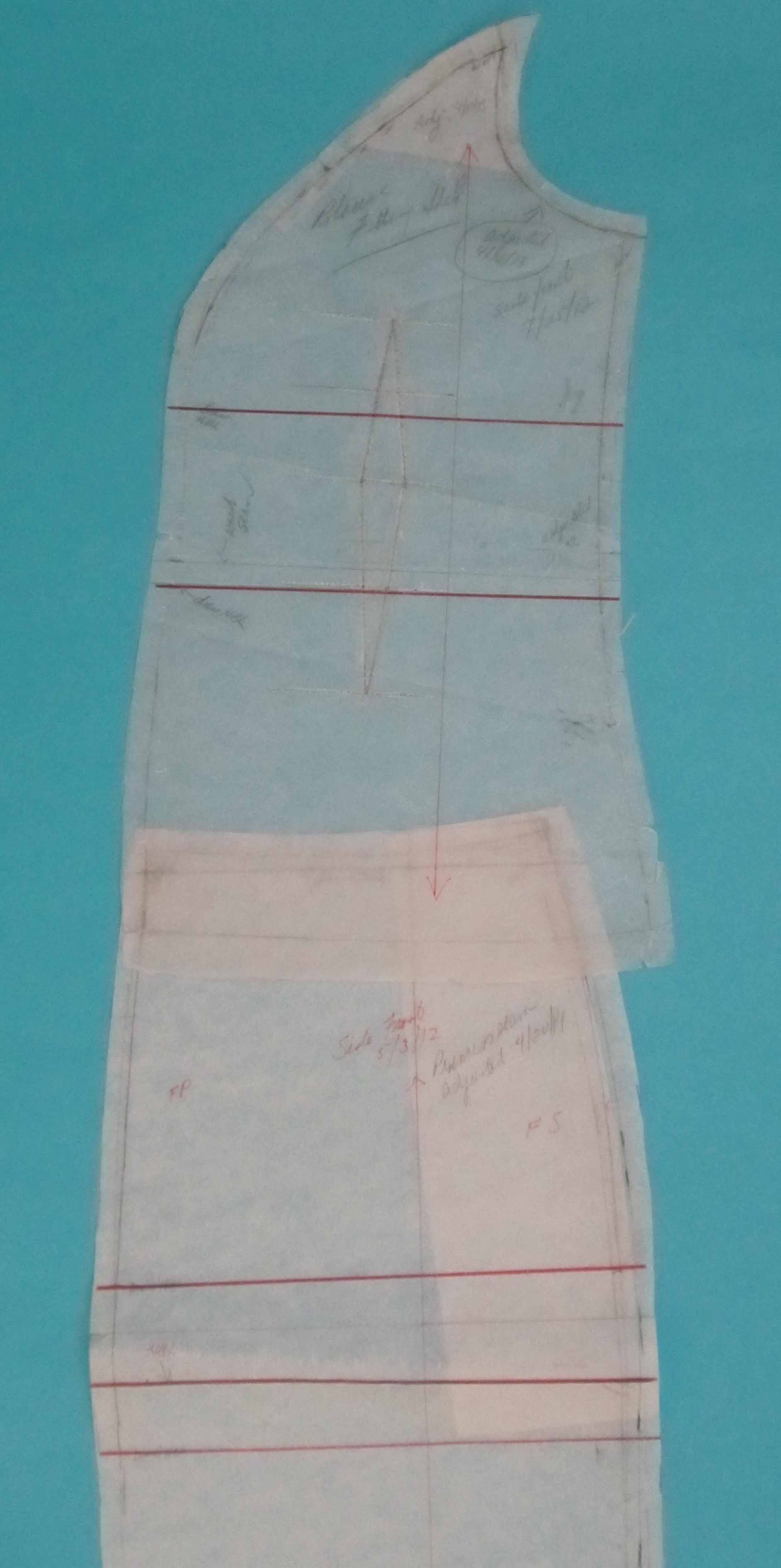
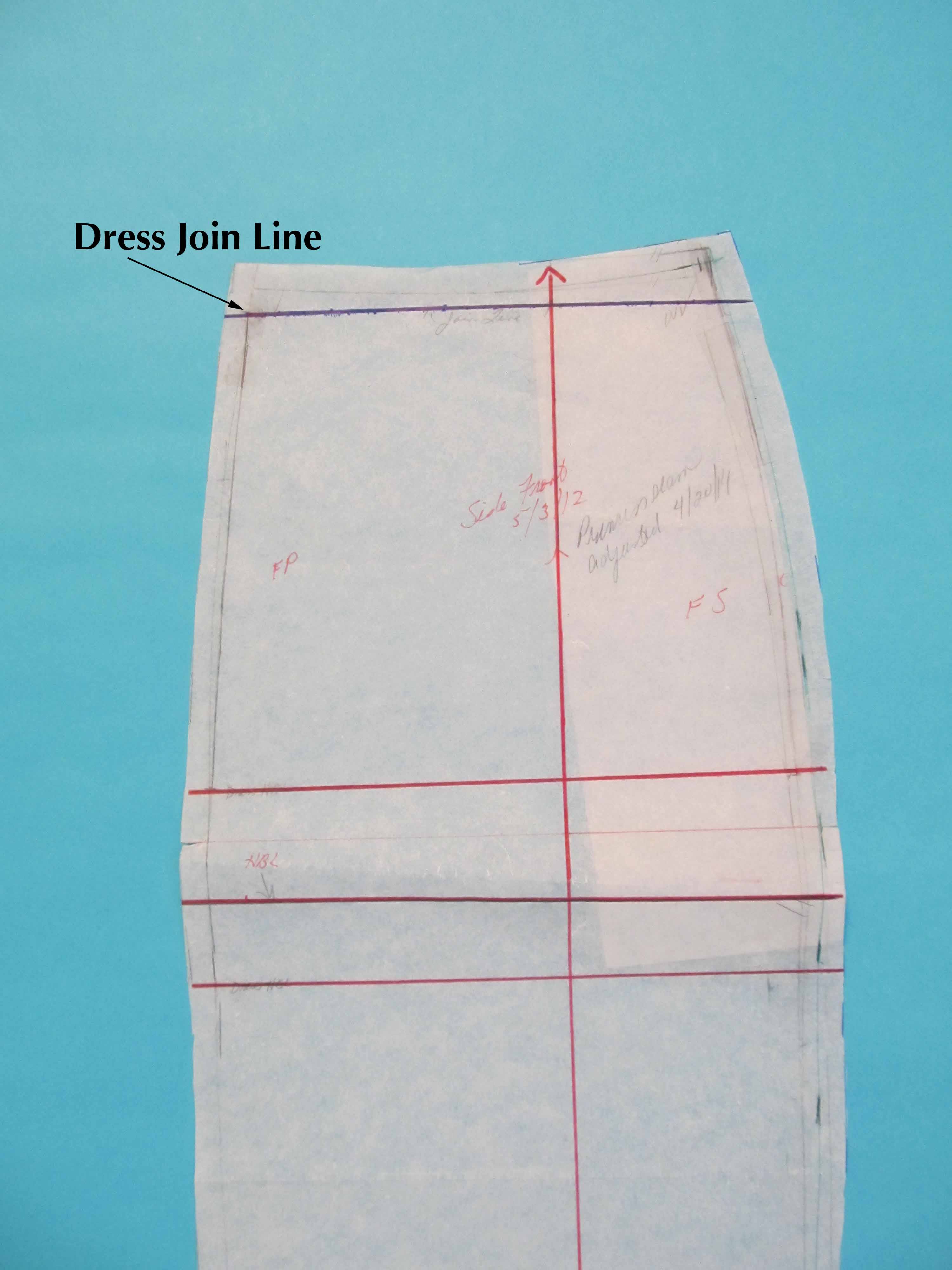
In consultation with Sarah, I chose a point on the bodice and a point on the skirt to attach the two pieces. I drew a line perpendicular to center front at that point and walked the adjoining seams (front princess, side seam, back princess) until the line was extended all the way through each of the two garment patterns.

Here is the connecting line on the skirt side front. This picture also gives you a clear view of how much tilt there is to my waist.

Skirt Join

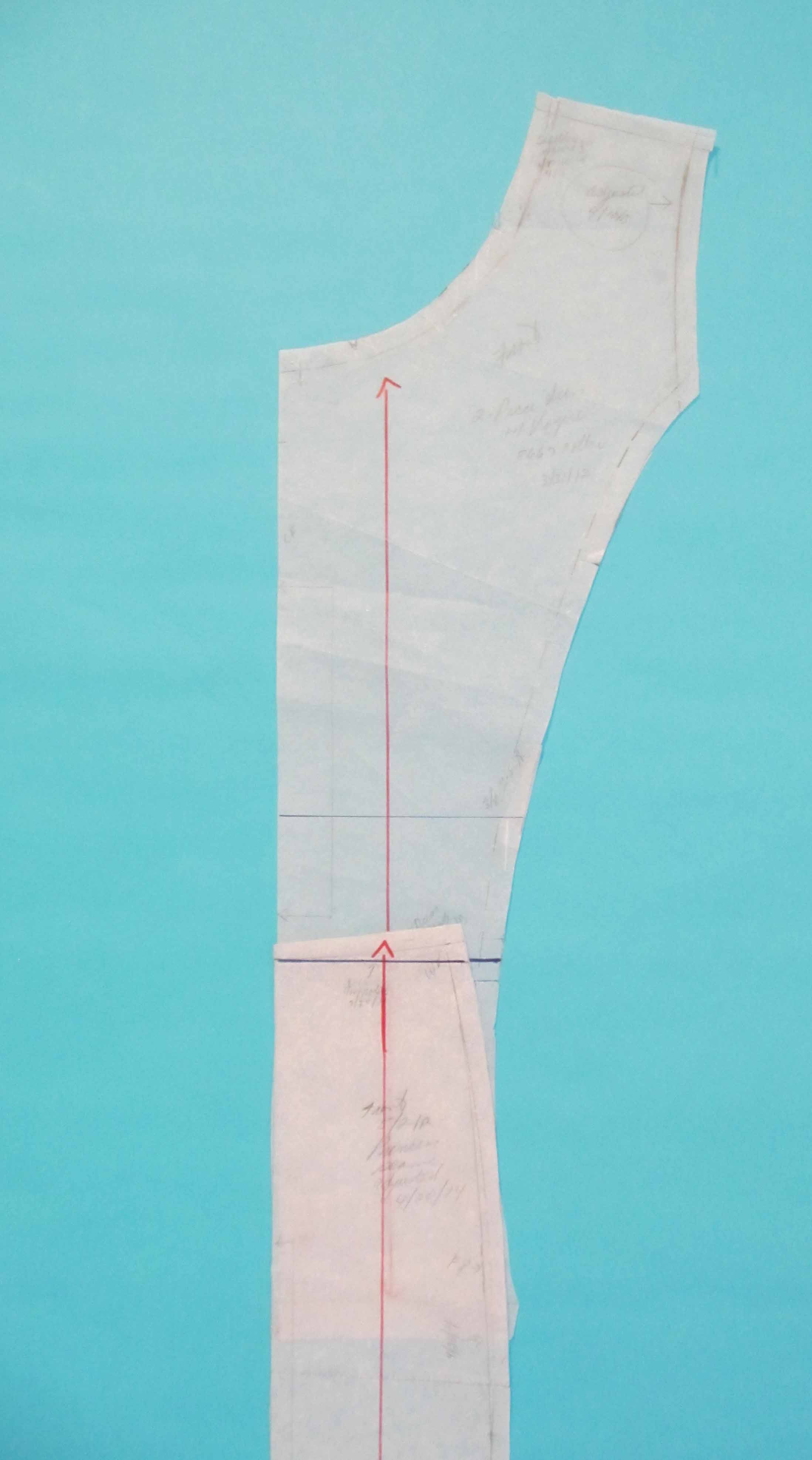
Here is how I ended up connecting the bodice and skirt front pieces.

Connected

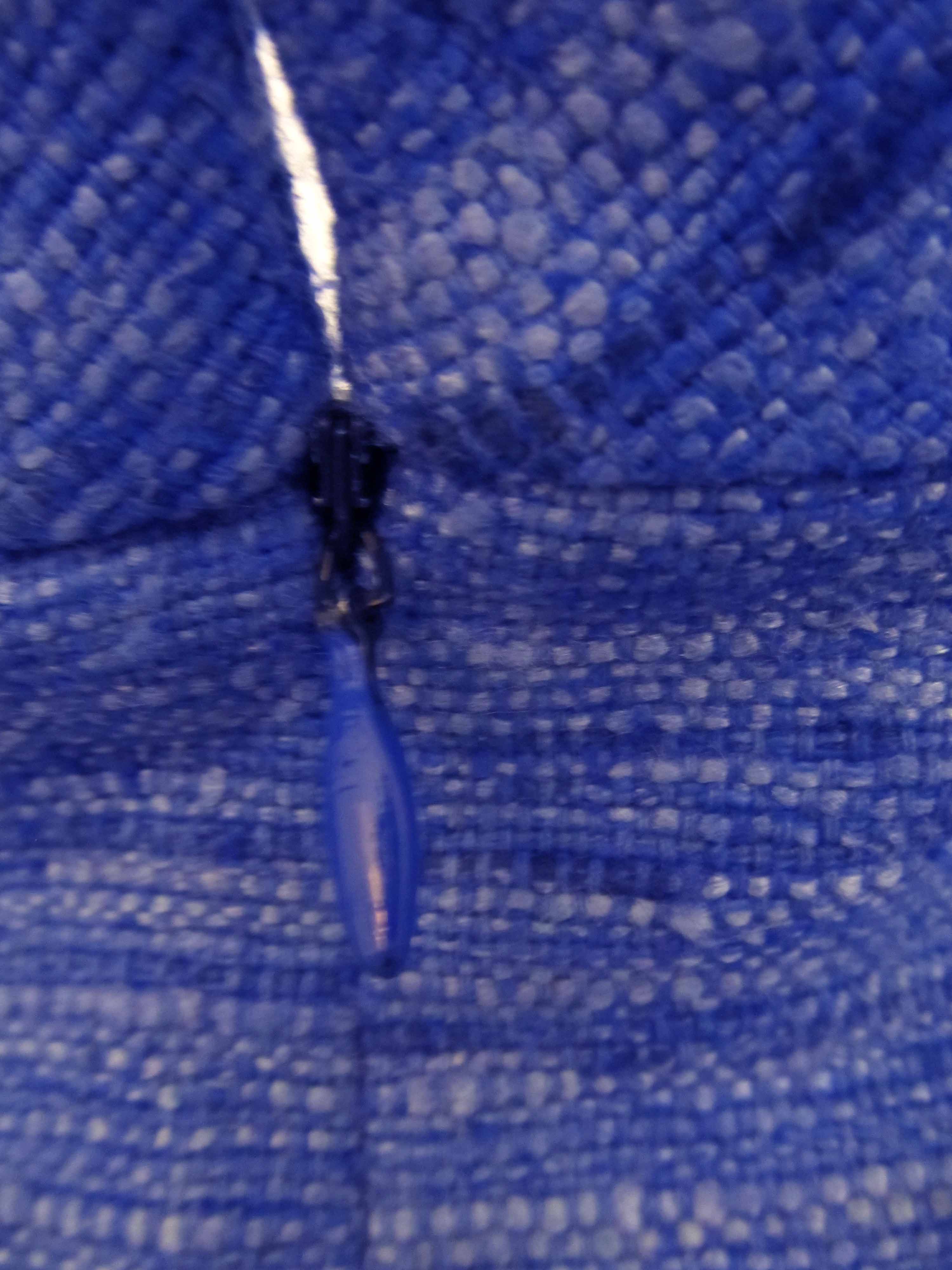
Once I mocked up the dress in muslin, I used a fit appointment with Sarah for fine-tuning. We added more shaping to the princess and side seams and everything looked good to go. After transferring the markings to the pattern, I proceeded to make up the dress in a fabulous variegated silk from Emma One Sock. I even used nail polish to make the pull on a black invisible zipper to blend in with the fabric.

ZipperPullBefore attaching the lining, I tried on the dress and absolutely hated what I saw in the mirror. There was nothing wrong with the fit, but it was definitely not flattering.

Before tackling this project, I had asked a couple of teachers, including Sarah, whether a sheath was not the right silhouette for me. That’s why I had opted for the two-piece dress in the first place. Having the skirt hugging the waist underneath the bodice and the bodice skimming over the area between the bottom of the rib cage and high hip seems much more pleasing to me than what I think of as the sack-of-potatoes look when that area is covered by a continuous layer of fabric. But I was told not to give up on a sheath and so I had invested even more time and money and I was feeling as if it was all wasted.

I put the dress on my dress form and walked away from it. Later, I wondered whether adding a collar would help by diverting attention away from the problem area. I played around with some extra fabric, cutting it on the bias and draping it along the neckline on the dress form. It certainly gave the dress a different look, but I just didn’t know. I went on to work on other projects while the dress stared back at me from the dress form.

The next time I saw Sarah, I put the dress on to show her and while she would never in a million years use a term like “sack of potatoes,” she understood why I was unhappy with the dress. Her solution was to add a design element as an “interruption” in the area I was unhappy about. I was skeptical, but it actually worked.

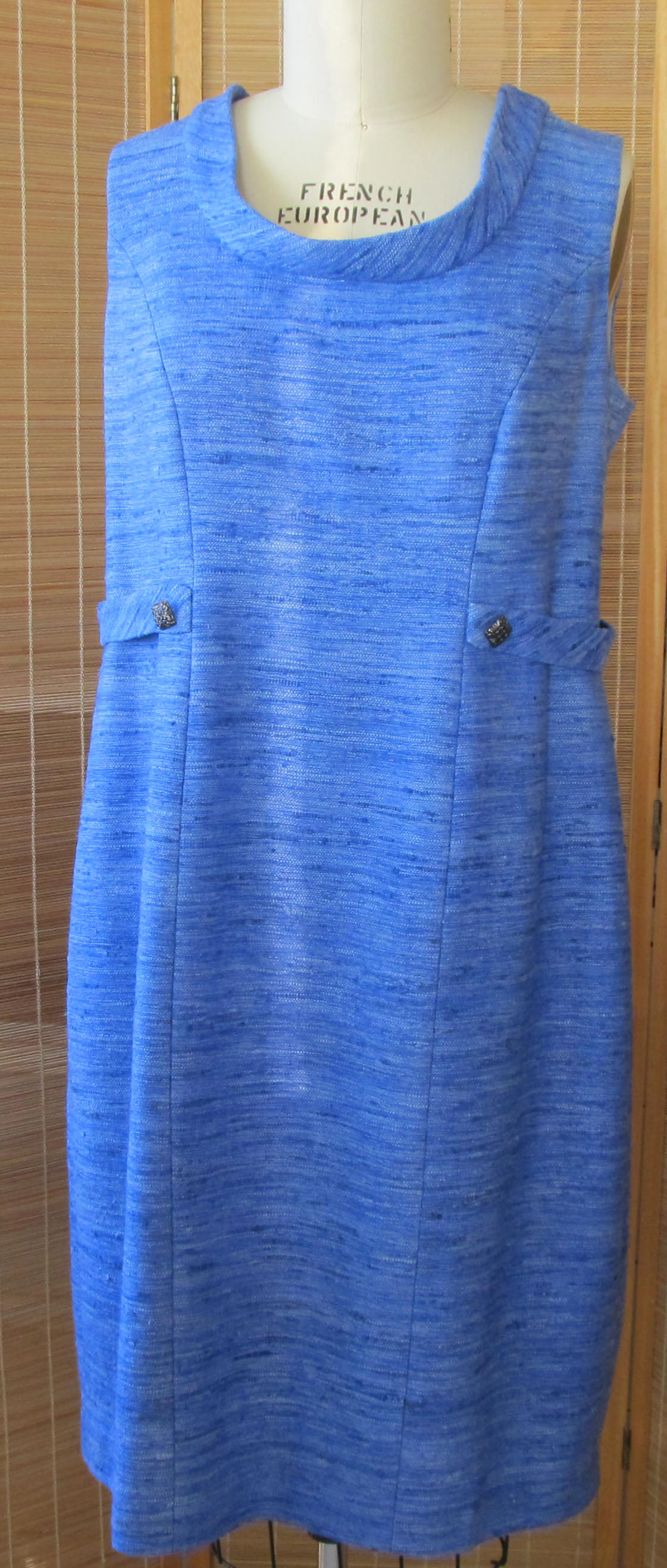
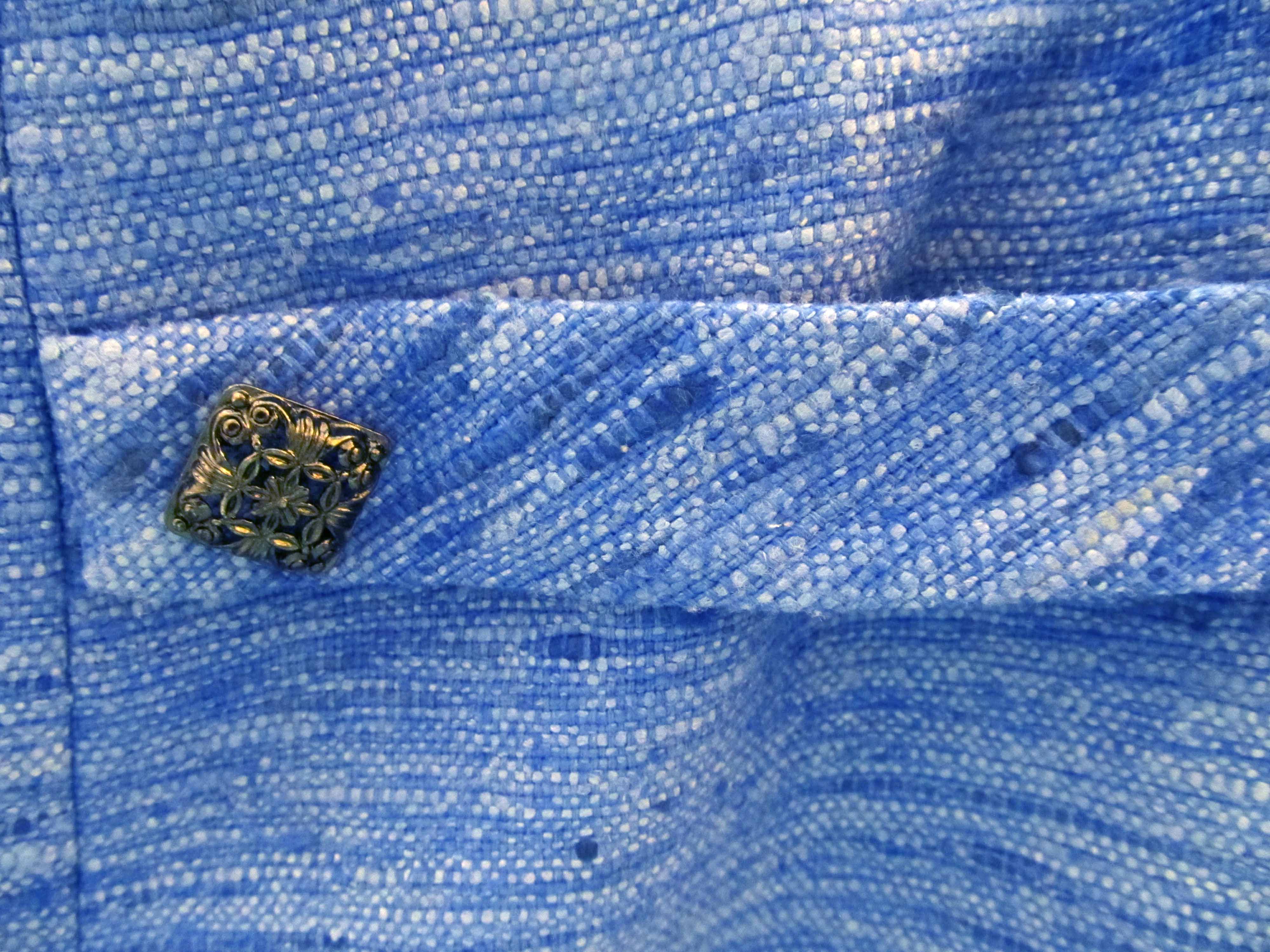
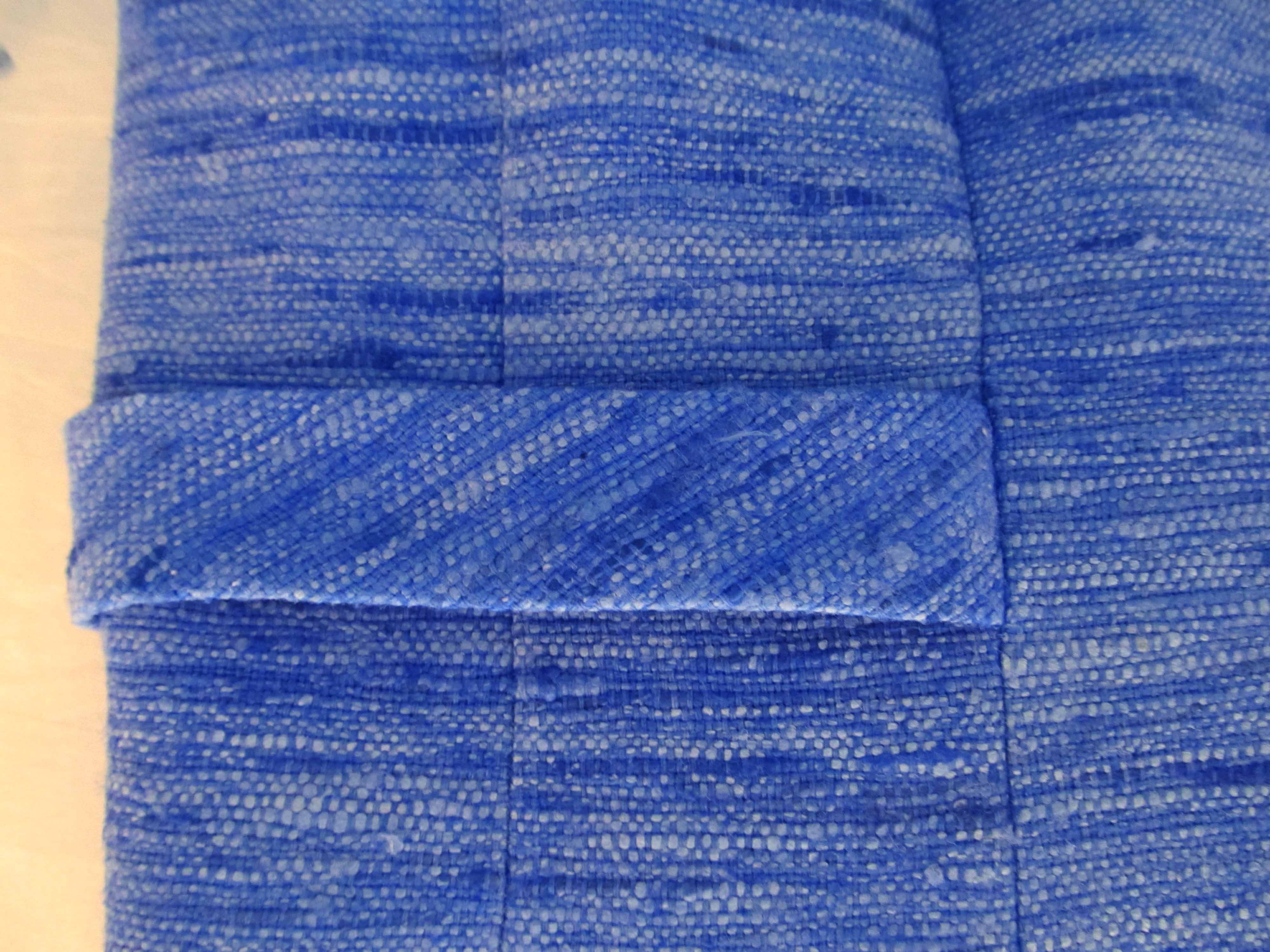
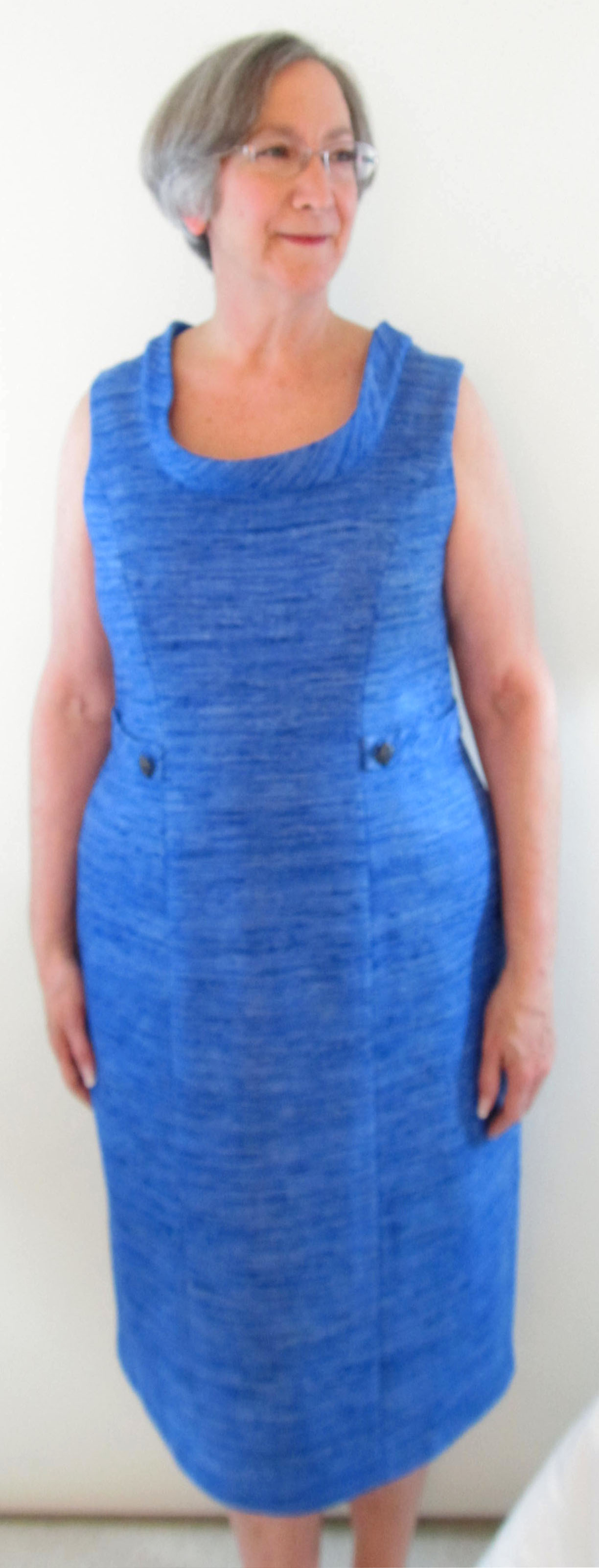
ButtonTab TabBackIt’s just a self-fabric partial belt or tab that sits next to the front princess seam on each side with a decorative button from Soutache, my favorite ribbon and trim store which is right here in Chicago.  The belt crosses the side seam and disappears into the back princess seam on each side. It’s subtle, but I think it’s effective. At least it got me to finish the dress.

Sarah thought I should also add the collar, which surprised me. But that’s what I ended up doing. Here is the result.

Wendy Blue Sheath Sep 2014I’ve worn this dress several times and I feel great in it. I’m planning another one with a different neckline and collar.

The Disorienting Experience of Constructing the Tulip Dress

Time has an annoying habit of flying by, whether you’re having fun or not, doesn’t it? I really am sorry so much time has passed since my last post. The first few days were spent away from work with friends. I should have known those days would be too full to finish another post. Then it was back to work in full immersion mode and I didn’t emerge from that for another three weeks. Okay, enough about that. We’re here to talk about sewing.

What I promised to tell you about last time was sewing the two-piece tulip dress, which was quite an adventure. Looking at fabric cut in the pieces you see below, plus all the other pieces that didn’t fit into the frame, made me think of a jigsaw puzzle with no picture to give a hint as to how to put it together. I also found the sheer number of pattern pieces daunting. Both the bodice and the skirt have princess seams, so that’s 14 main pattern pieces right off the bat.

Puzzle

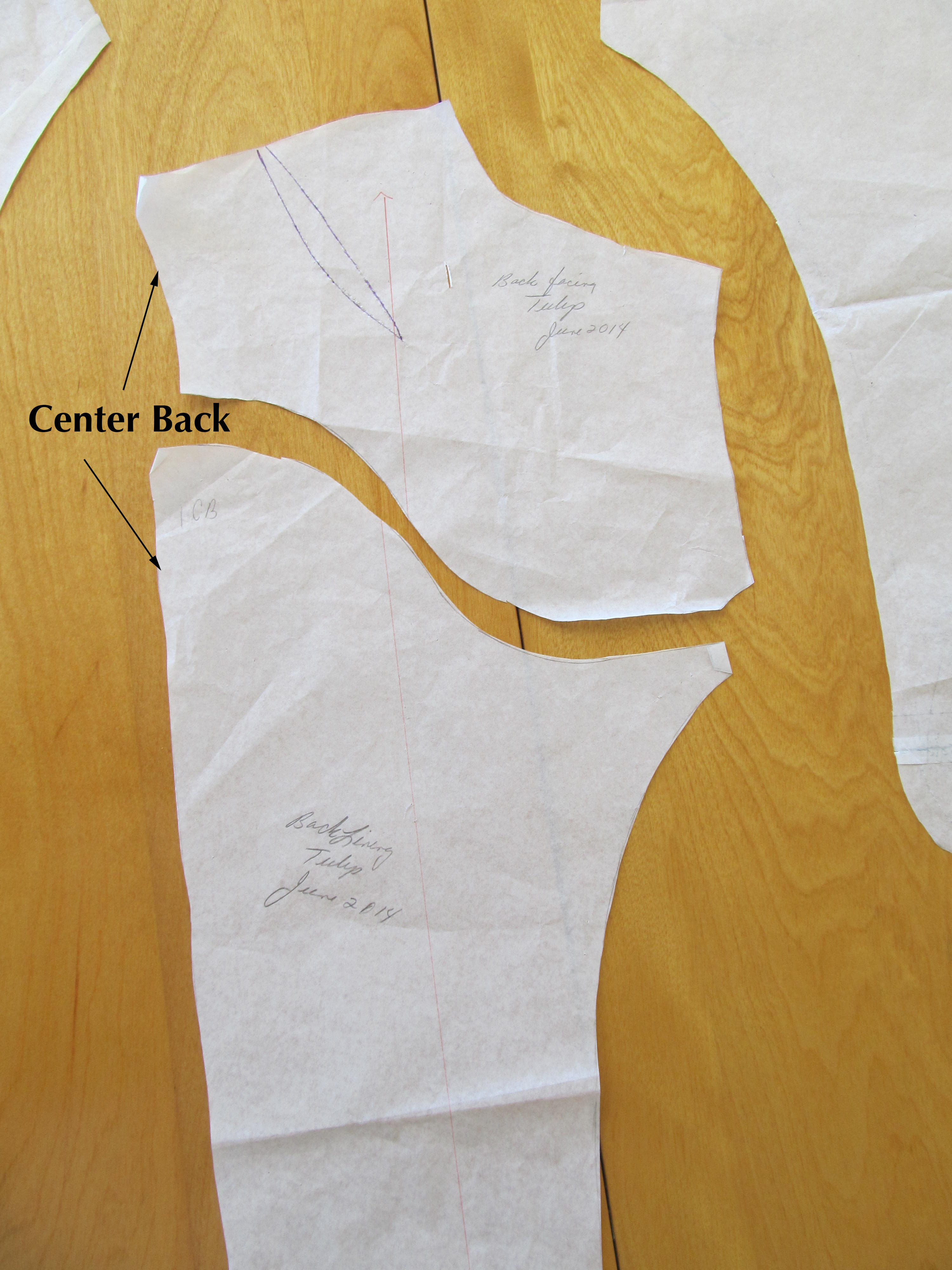
Then there are the facings for the shaped bodice hem and the front and back facings for the neckline, plus the cap sleeves and lining pieces that look pretty strange, at least in the bodice, where they hang down from facing pieces.

Back facing and liningLike I said, daunting.

This is where painter’s tape became my best friend. I usually use it to label my pattern pieces and distinguish the right side of the fabric from the wrong side. In skirts, I need to add arrows showing me which side is the princess seam and which is the side seam so I don’t repeat the mistake of trying to sew a side seam to a princess seam. For this project, the notes on the tape were more detailed and still I found myself having to refer back to the pattern to figure out which way was up. Add to that the complication that I actually cut this dress out last summer and put it aside until this spring, because linen isn’t exactly a three-season fabric in Chicago.

Once the pieces were cut and labeled, I tested some fusible interfacing on swatch “sandwiches” to find one with the right amount of body to support the neckline and retain the shape of the hem on the bodice piece. I chose fusible tricot for the neckline facings and fusibles with less body for the hem facings and the area around the invisible zippers (one in the side seam of the bodice and the other in the back of the skirt). This is where I should mention that linen worked particularly well for this design. I tried the same neckline in a light silk (broadcloth maybe?) and it tends to collapse when I move.

Silk Tulip Top

So, if I want to make it again in a a fabric with that much drape, I need to give it a little less length. Or, should I say height?

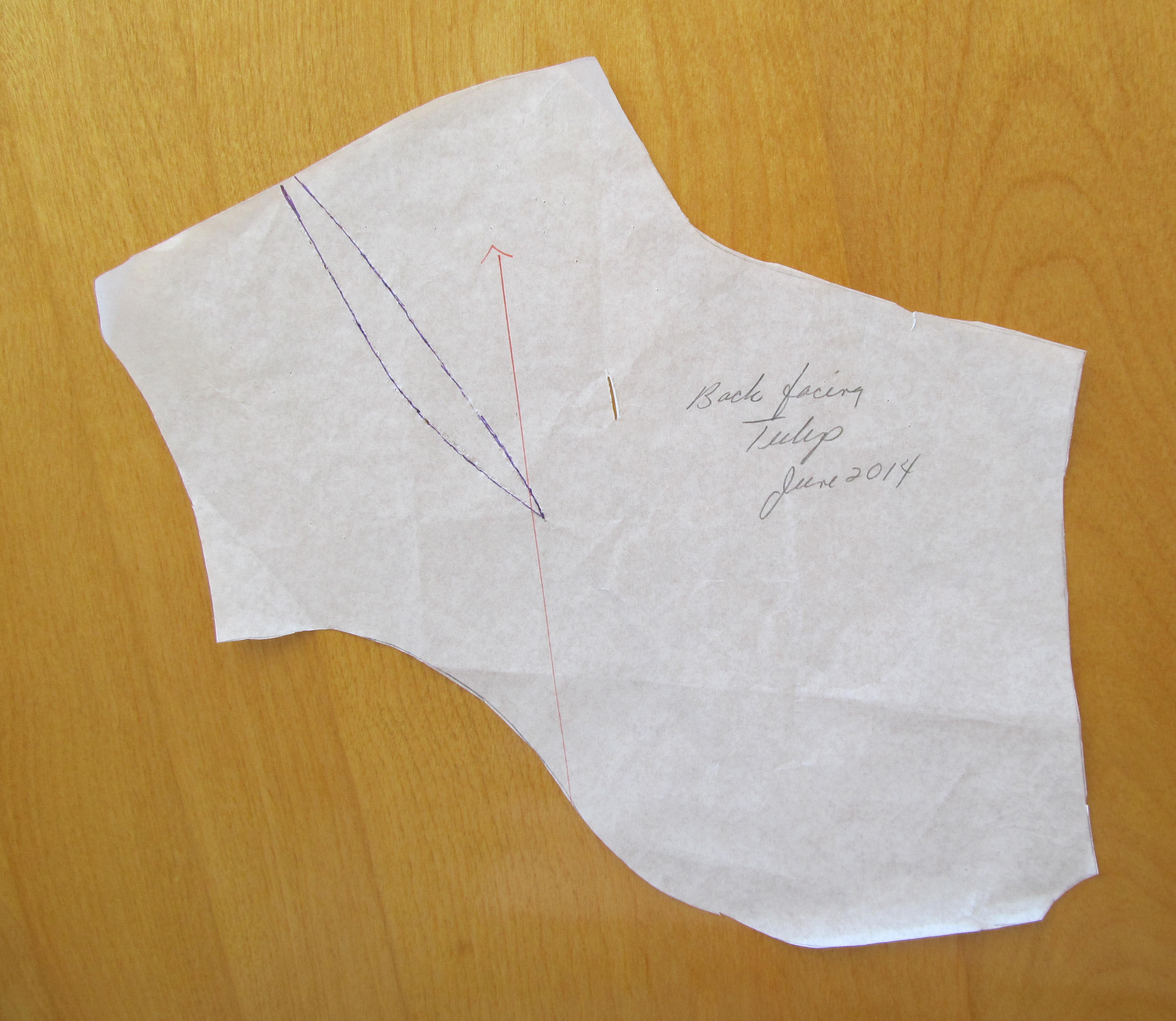
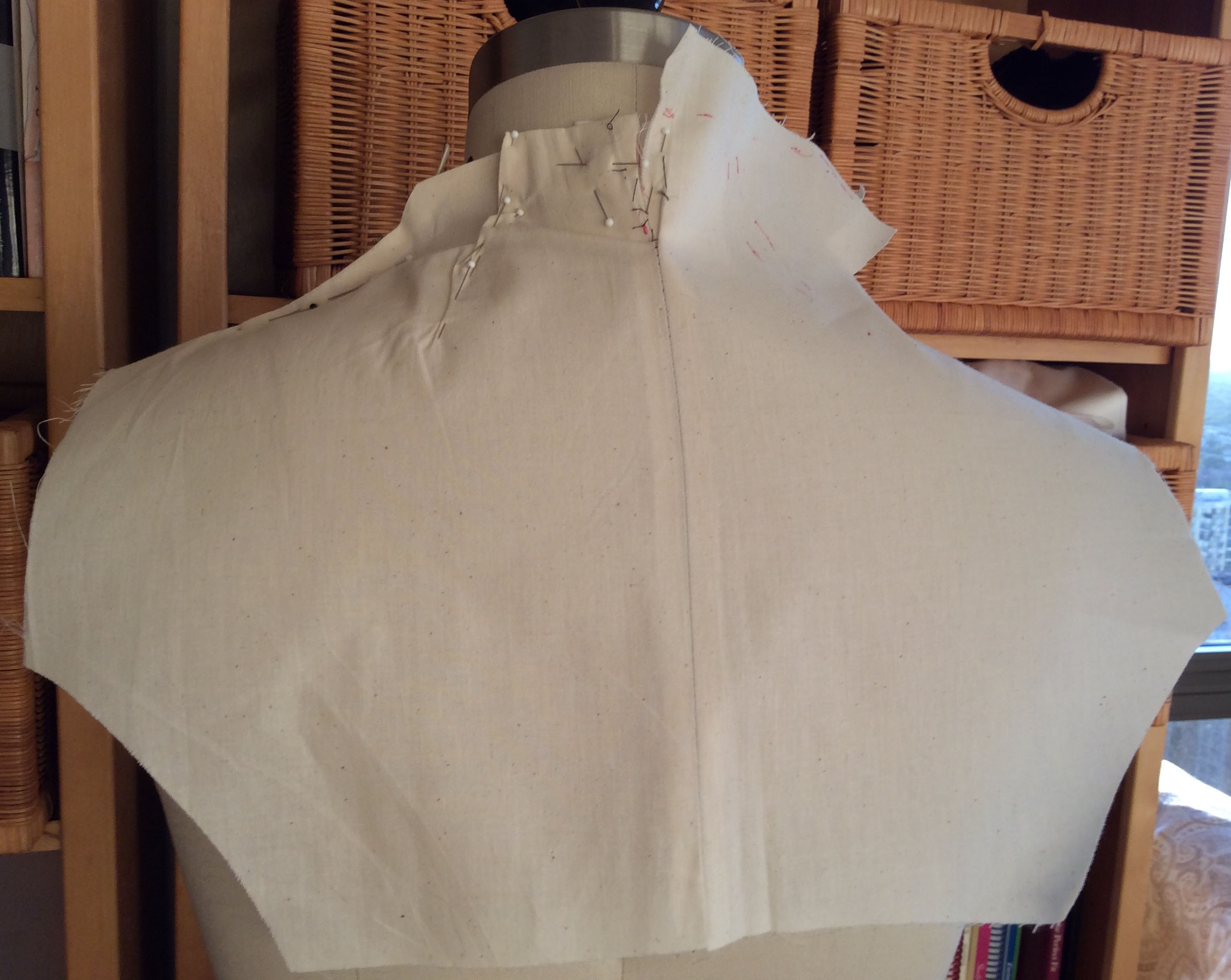
As I mentioned in my last post, the key to achieving the shape I was after in this neckline is two curved darts in the back.

Back Facing

It looks like a bear to sew, doesn’t it? But the method I use for sewing any dart accurately actually makes sewing these darts pretty much routine.

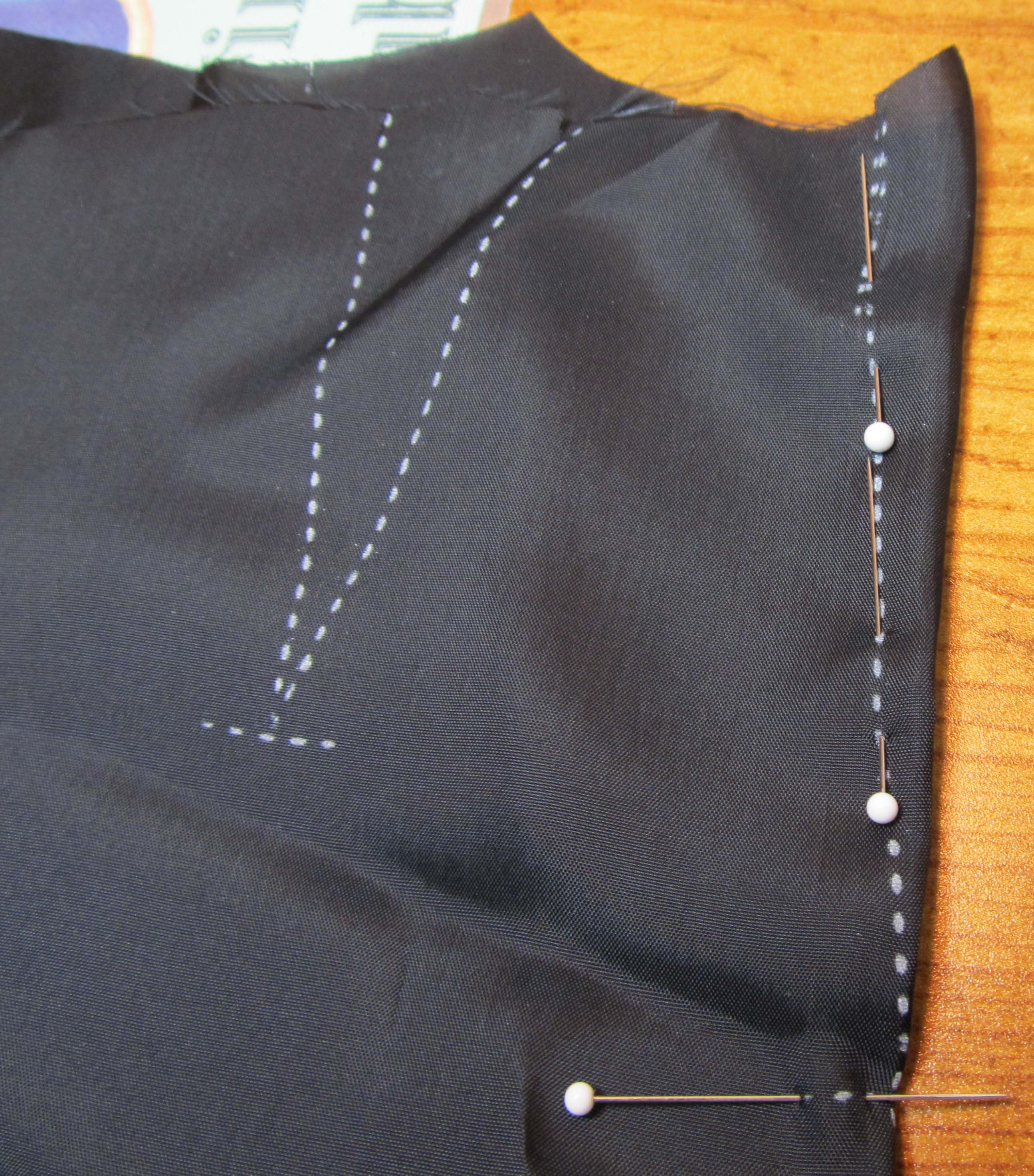
A lot of the fabrics I work with are drapey and some are also slippery, and I was getting frustrated with the way my darts were turning out. I’d mark them carefully, usually with a tracing wheel, plus snip marks at the cut edge. Then I’d pin them across and get everything lined up, but when they came out of the sewing machine only the side I could see as I was stitching followed the markings. The hidden side almost always came out all wonky. Couture’s answer to this problem is hand basting, but I was still in avoiding hand basting mode when I tackled this problem. The solution that works for me is actually pin basting, which looks something like this.

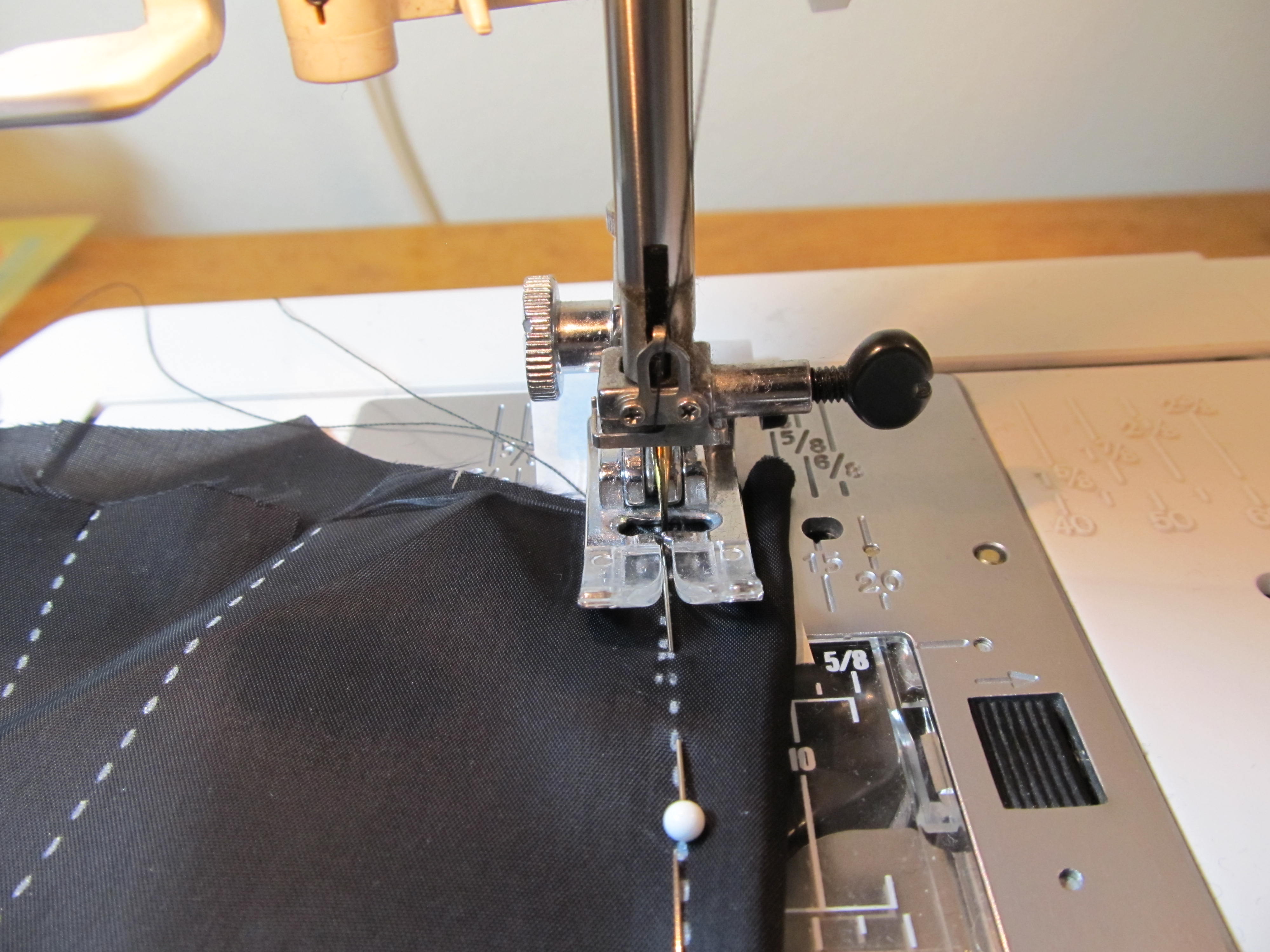
Pin BastingDepending on how wiggly the fabric is, I might weave each pin through twice. I also always put a pin across the work at the point so I can see clearly where the stitching needs to end.

Once the pins are in with the heads facing me I slide them toward me as I sew with the marked line centered between the toes of the presser foot and remove each one as I get to it. I always set the machine to stop with the needle down, so everything stays pretty much where it is supposed to be.

Dart StitchAs for the big debate about whether to start sewing darts at the cut edge or the point, I think there is something to be said about both approaches. For the most part, I start at the cut edge, but for really narrow darts or times when when hitting the point exactly as marked seems critical, I start at the point.

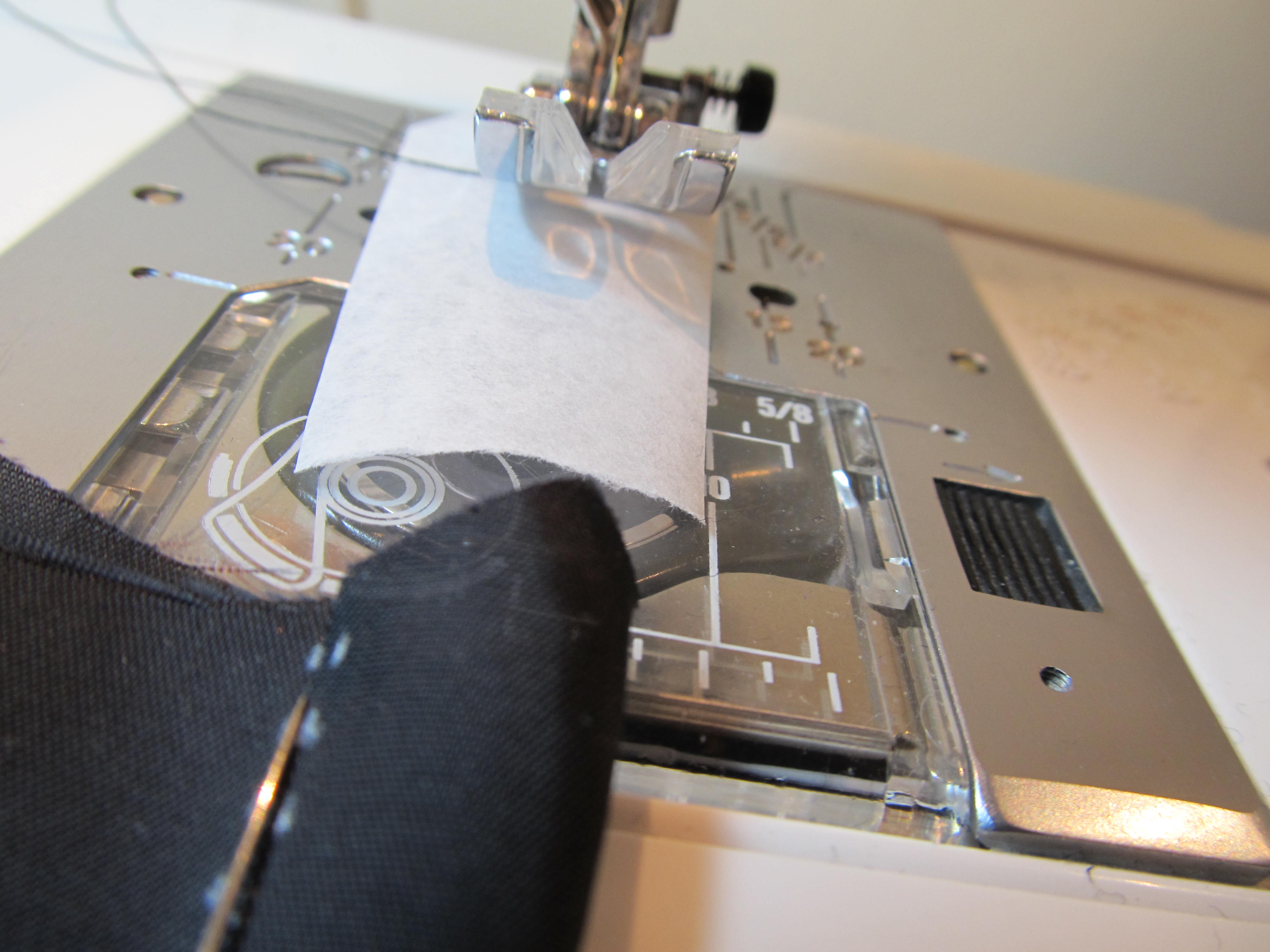
One cool trick I tried out while sewing the tulip dress was using paper to keep the cut edge of the lining fabric from disappearing into the machine. This doesn’t happen often with my machine, but with China silk lining, why not try an ounce of prevention? Some teachers say you should use a paper stabilizer for the entire seam on certain fabrics, but I recently saw a teacher use just a small scrap of paper at the beginning of the seam. It works like a charm.

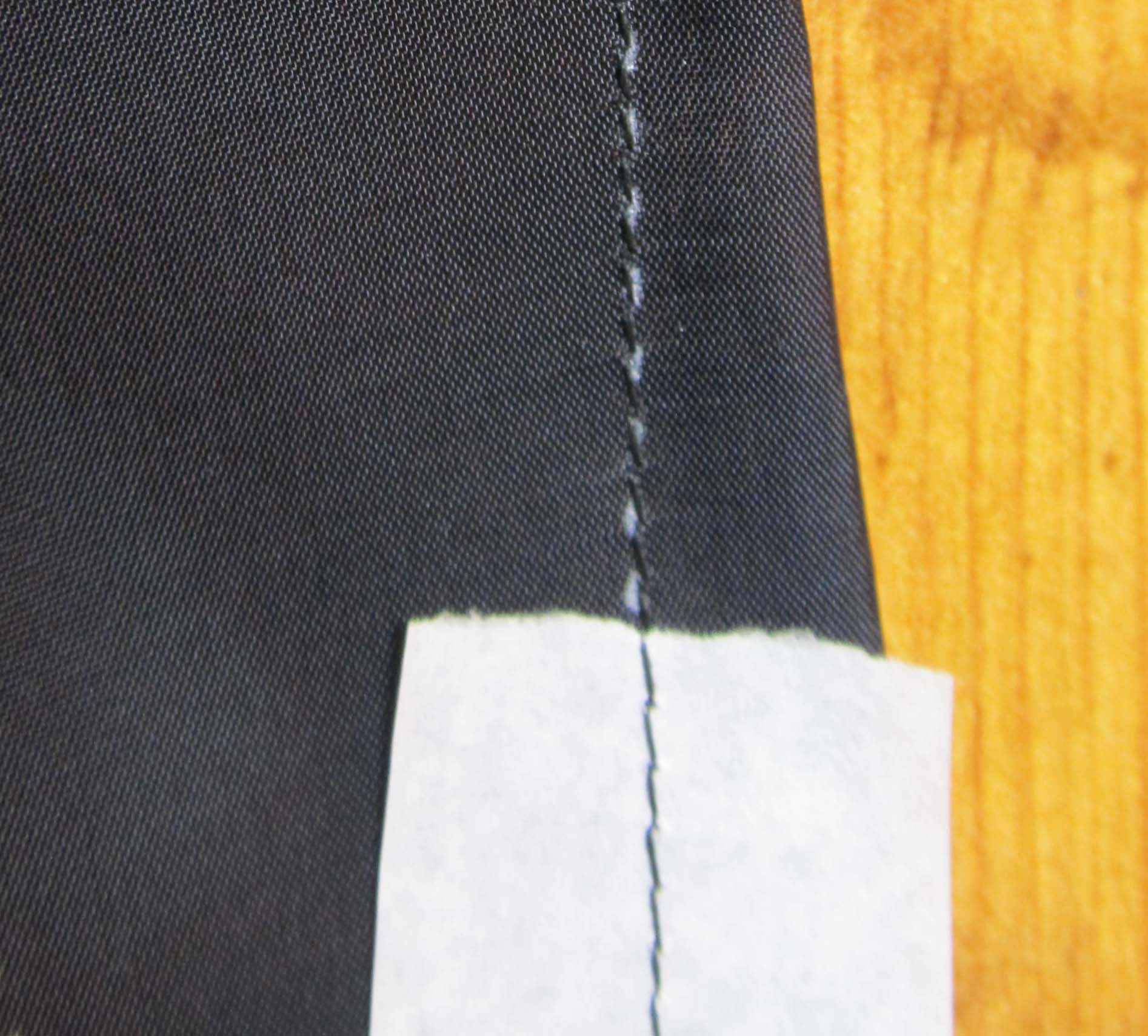
Paper on MachineThis is what it looks like from the back.

Paper BackFor some seams, I used paper at both the beginning and the end. You could do the same with a dart, using paper at the point if you think it would help.

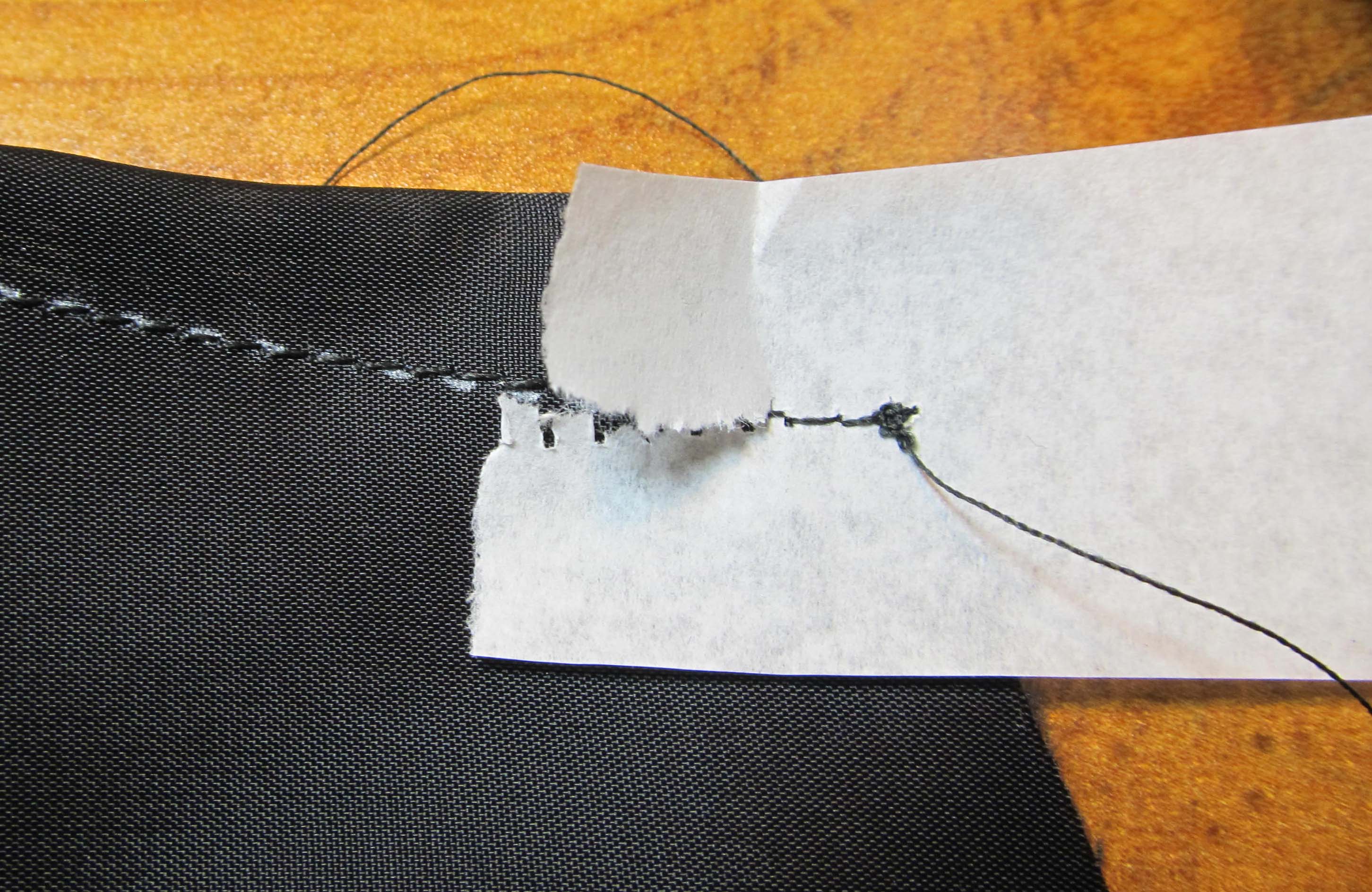
When you finish the seam or the dart, the paper tears away easily. And, if it doesn’t, that’s why we keep a pair of tweezers handy.

Tear Paper

My general approach to construction order once any darts I might have are sewn and pressed is to sew the princess seams so I have full front and back units. I know some people like to stay stitch and clip (or just clip without stay stitching) the curved part of princess seams, but I find that working with 3/8″ seam allowances and fabrics made from natural fibers that are pretty cooperative allows me to manipulate the curves with a few pins and stopping to manipulate the fabric with my hands. I love the tactile experience of sewing and this is a big part of it. When I press the princess seam allowances open using the curves on a tailor board, I can tell what areas need to be clipped and so I just do the clipping right there.

Usually, the next order of business is to get the zipper sewn in while the garment is flat. We can talk zippers another time.

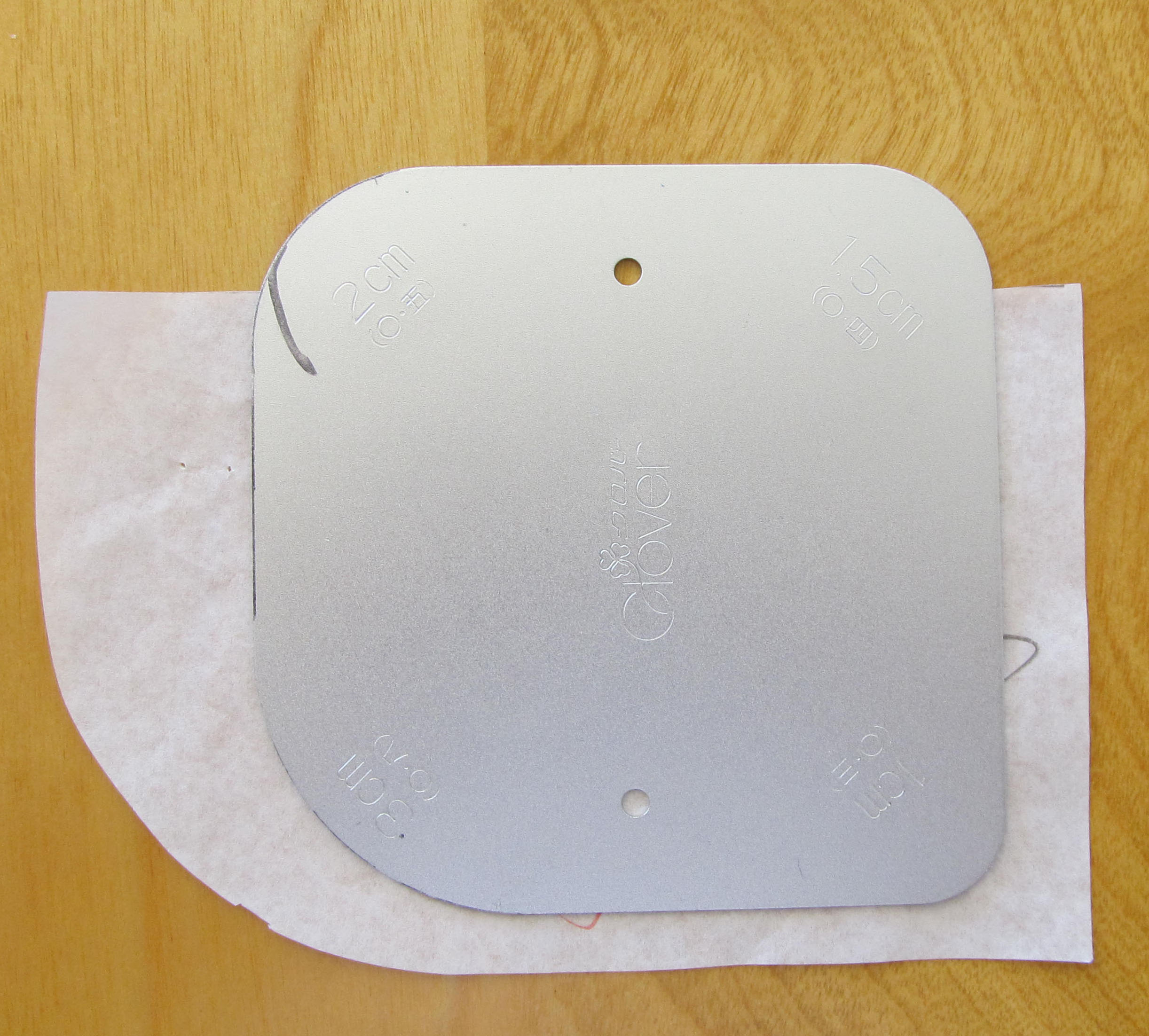
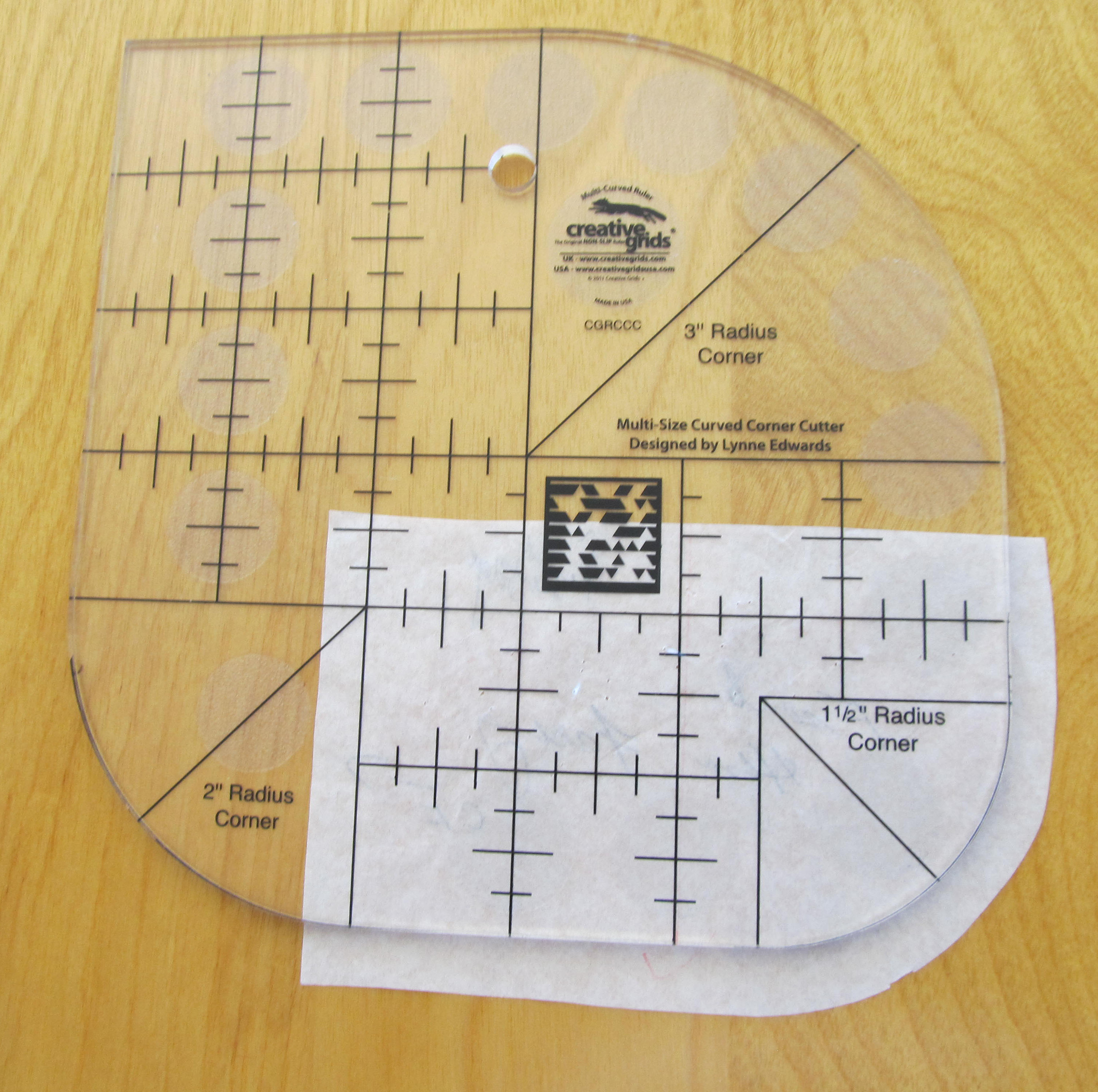
This was the first time I tried a shaped hem with facings. As  I was approaching that step, I asked myself why I had thought a shaped hem was a good idea. How was I ever going to get each one of those curves to look the same? The answer, of course, is to mark the stitching lines using a rounded corner template. Curve 2Except I forgot which template I had used to make the pattern(!) In fact, I forgot I even had the one I used. Remember. I said I cut this garment out months before I started to sew it.

Right curve

One option for marking the stitching line would have been to draw it on the pattern and use a tracing wheel and waxed tracing paper. Had I done that at the beginning, I wouldn’t have wasted all that time trying to figure out where that particular curve came from. What I ended up doing is tracing the template with a chalk pen made by Bohin that makes a very thin line. Sarah Veblen told me about this. It’s one of those wonderful tools quilters know about and garment sewists find out about later. Here it is with my trusty roll of painter’s tape.

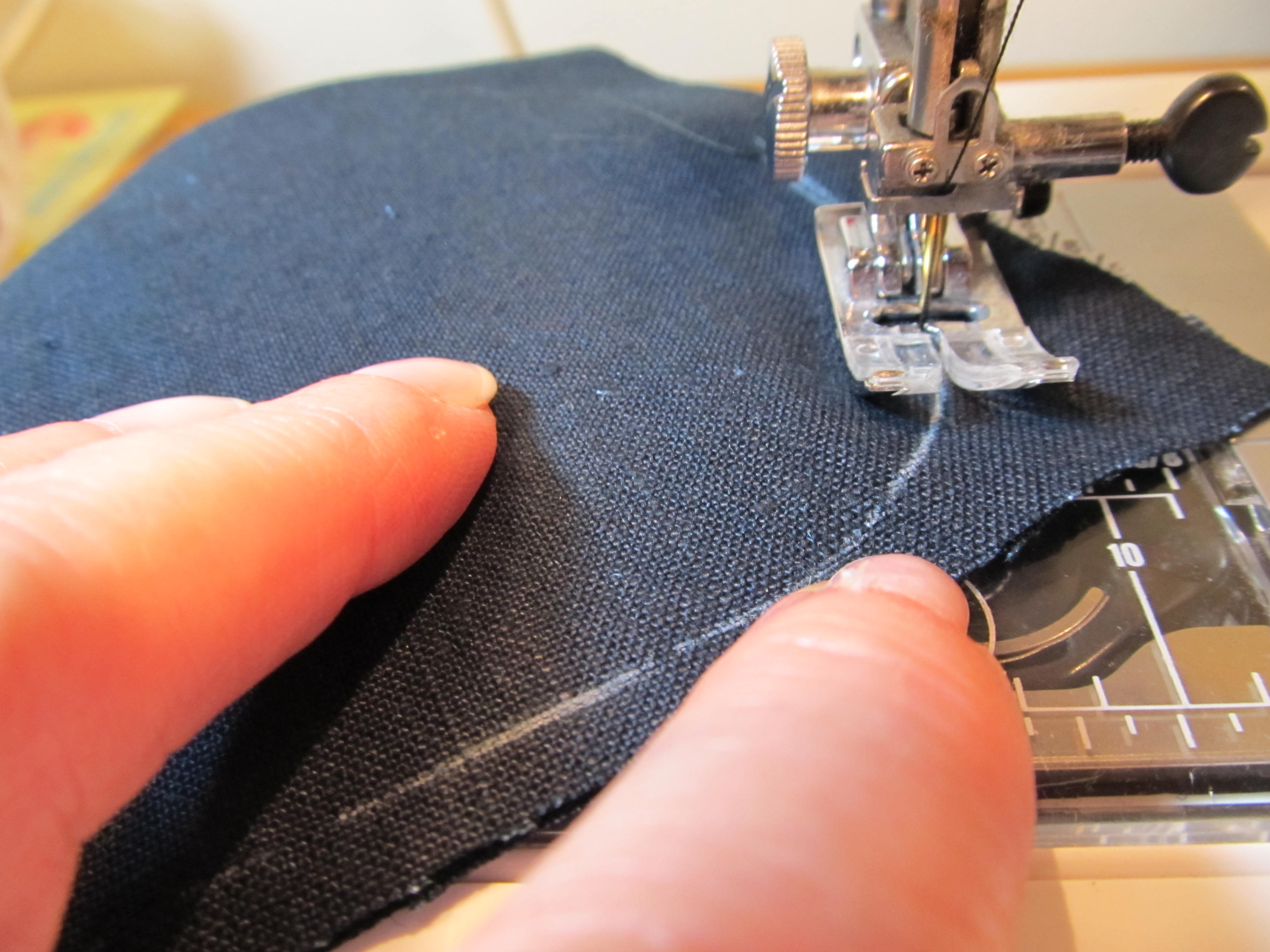
Tape and Chalk PenOnce the line was drawn, sewing the curve slowly with smaller stitches got the job done.

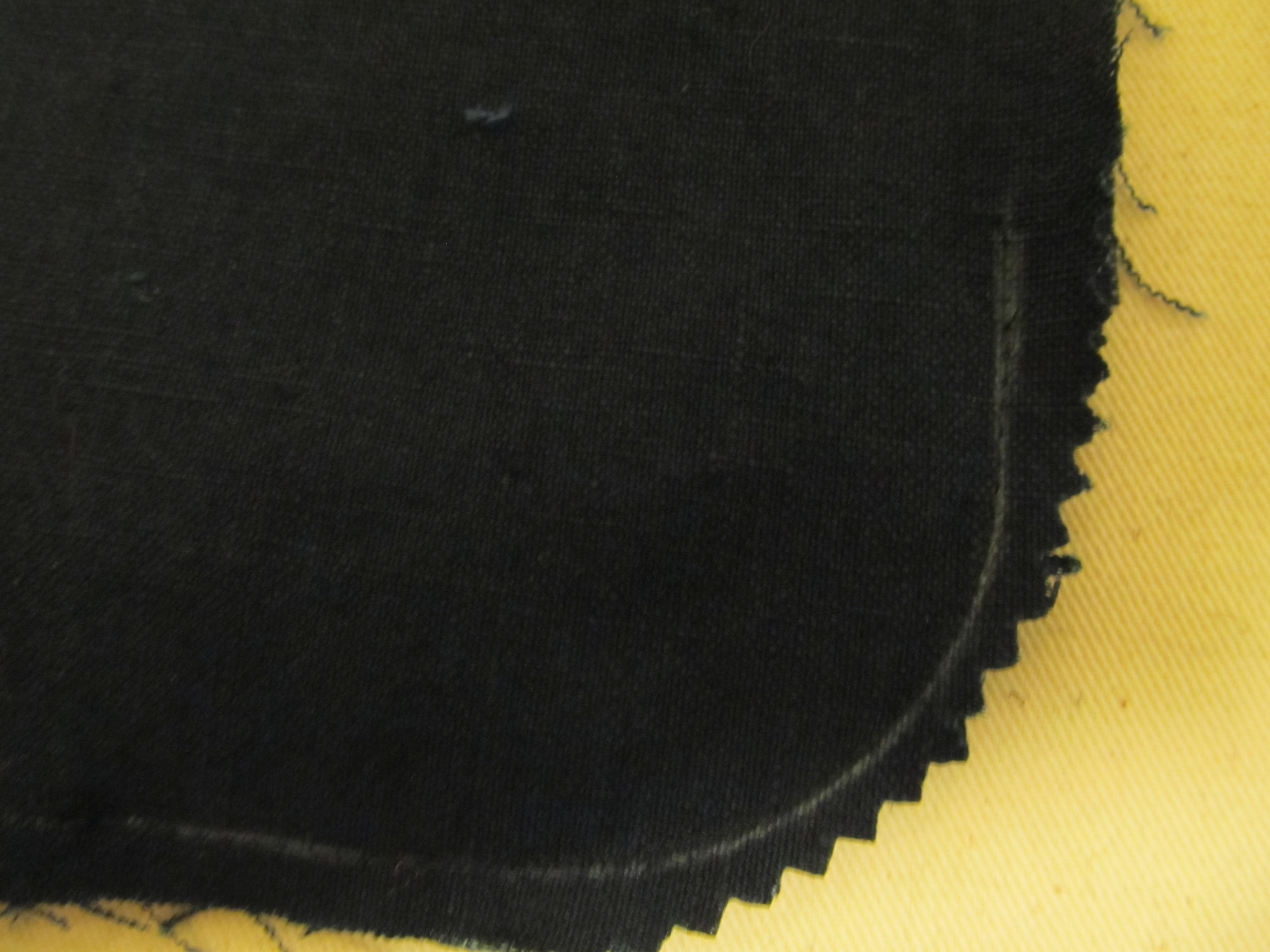
Sew Curved CornerThen I followed another tip I picked up recently, which is to trim curves using pinking shears instead of making a bunch of snips or clips one by one. How great is that?

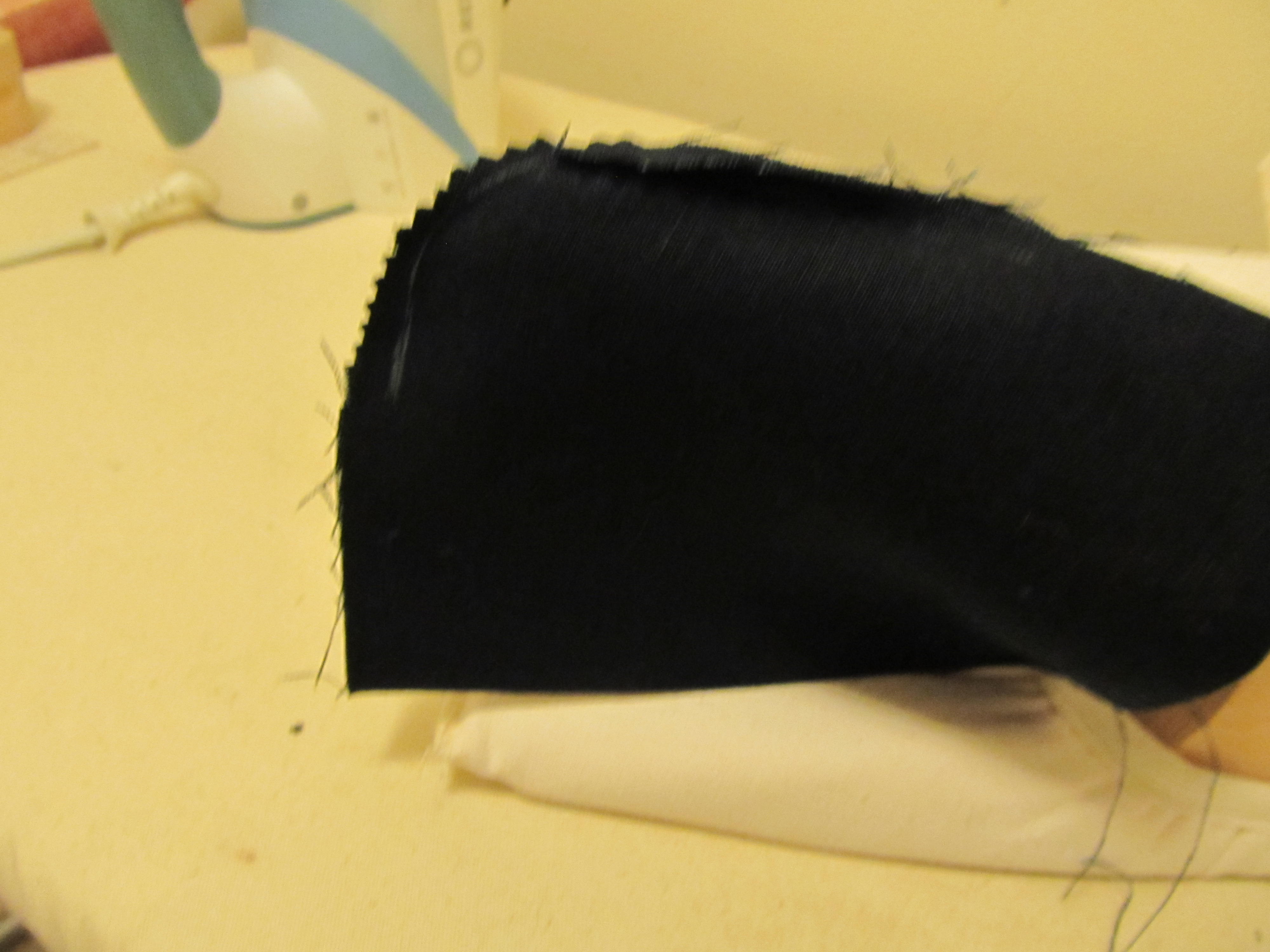
Trimmed 2Next, I pressed the seams open over a tailor board. I know it sounds weird, but I got in the habit of doing this after taking a workshop a while back and it seems to make points and curves turn more easily and allow you to favor one side when you do the final press.

On Pt Presser

Press Open Curve

Turned Curved CornerThe one thing about constructing this dress that was exactly like every garment I make is that it took much, much longer than I had thought it would. A lovely friend of mine tells me that the reason I always underestimate the amount of time something will take is because I’m an optimist. I’m going to go with that.

The thing is, after all that time and no small amount of anxiety, I really enjoy wearing this dress.

Linen Tulip Dress

Designing the Tulip Dress

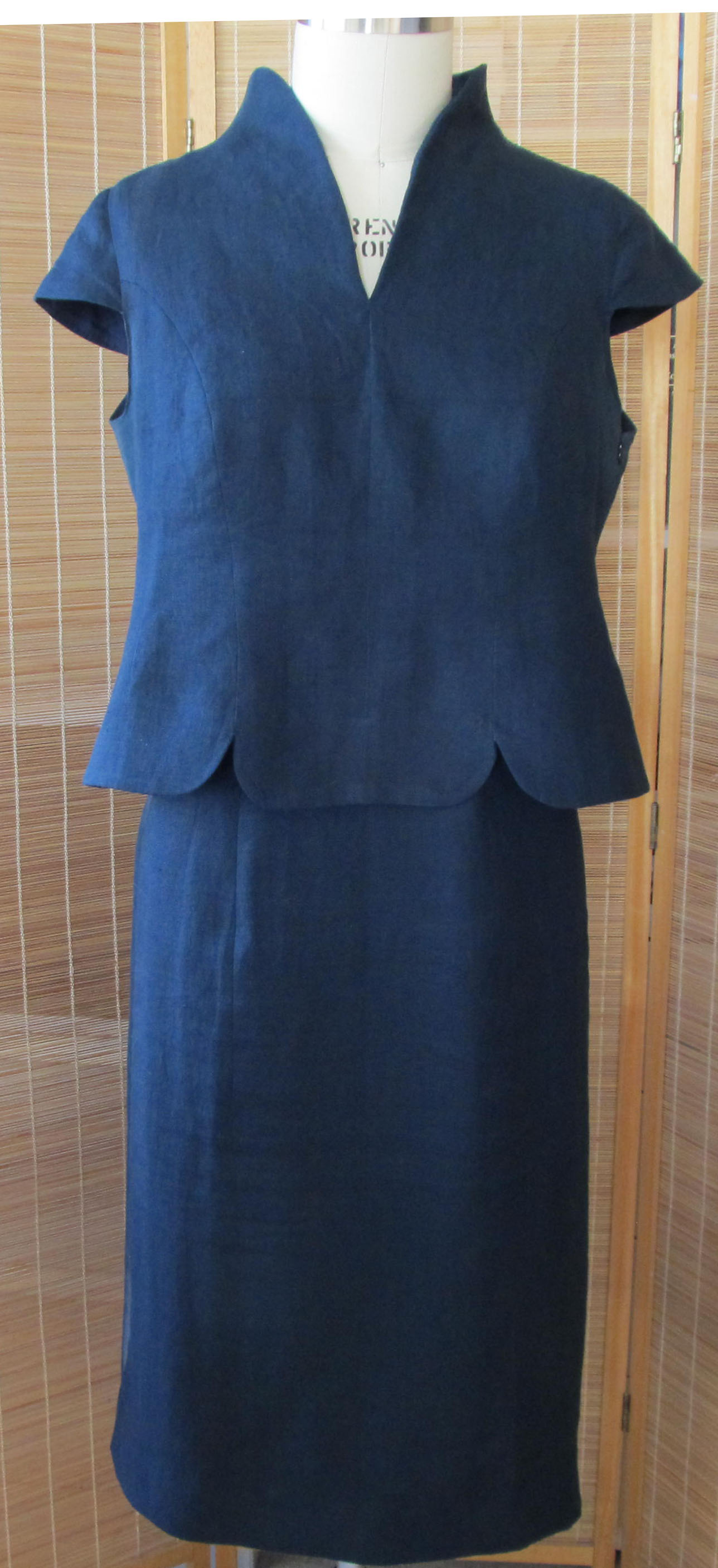
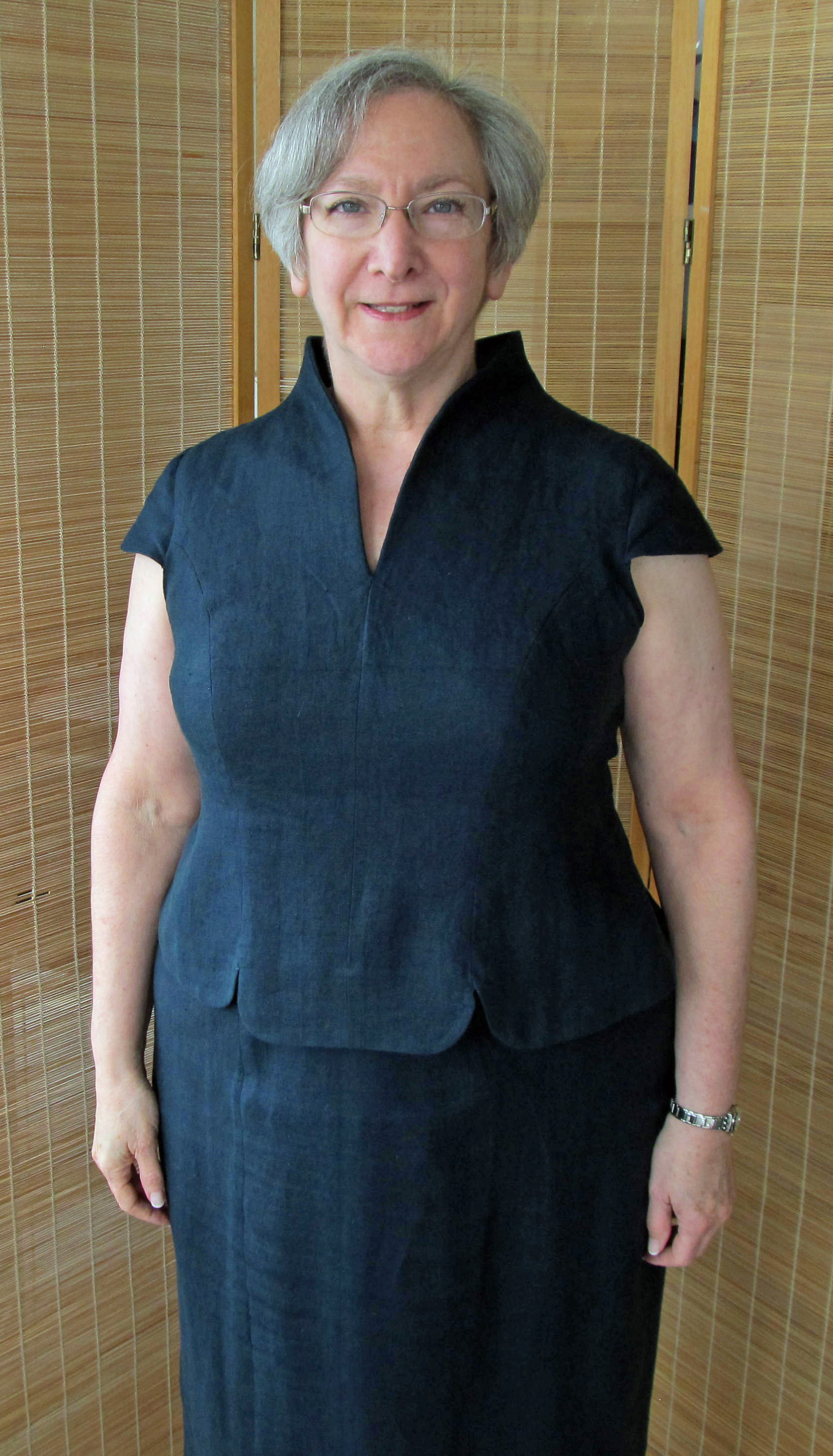
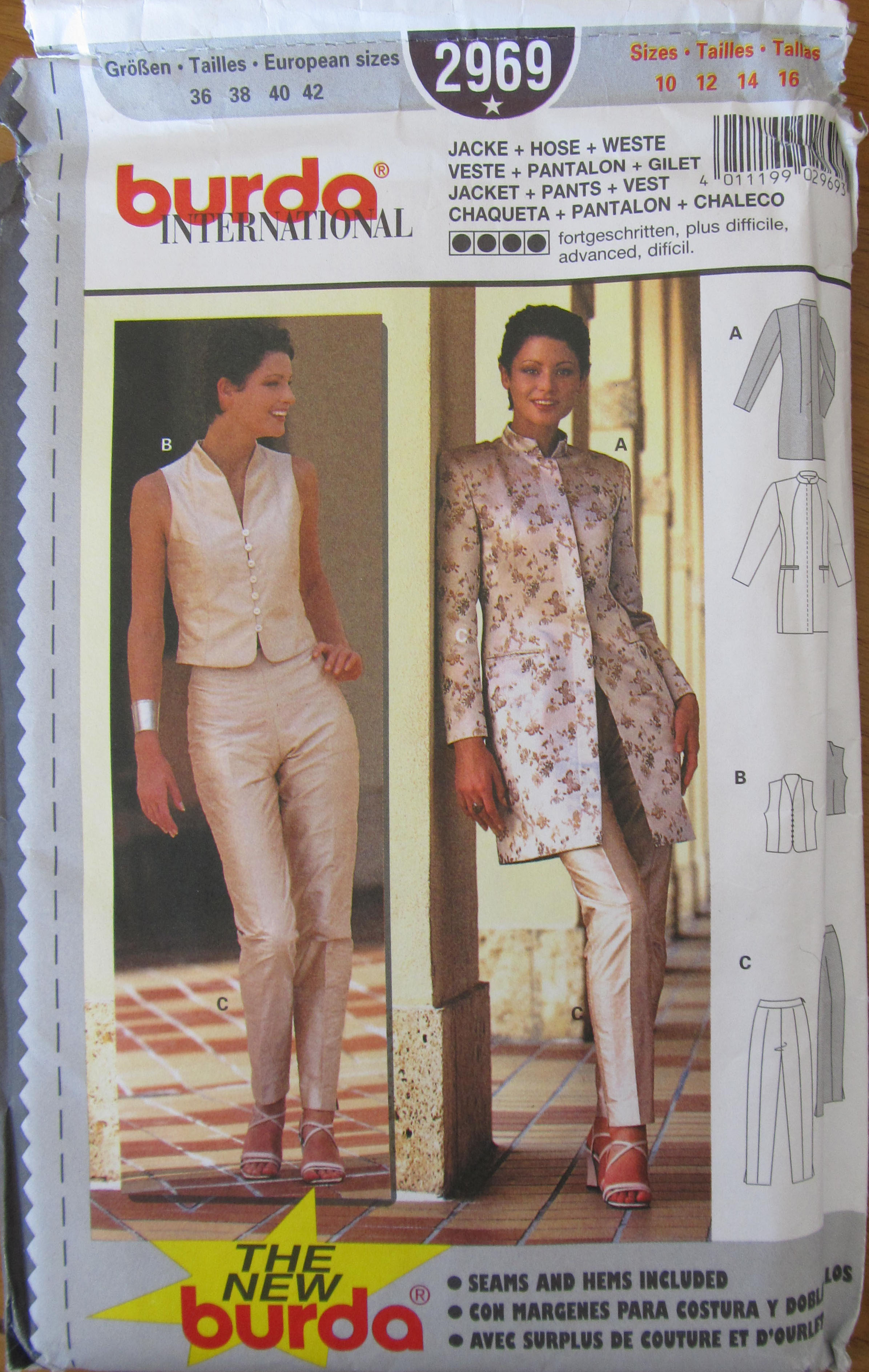
tulip dress modeled copyThis dress has a neckline I’ve been wanting to incorporate into a garment for a long time. I first encountered something similar in a knit top from Talbot’s and later in a jacket from Chico’s. I set out on a mission to find a pattern for it, but I never thought they got it quite right. The knit versions collapsed and the patterns for the woven versions stood up a bit but leaned into the neck. Then I saw a picture of a jacket made from a Burda pattern that looked right. I tracked down the pattern on a vintage pattern web site, bought the only size they had and discovered the secret to achieving the effect I was after: darts.

Burda         Back Facing

Shaped darts in the back of the neck, to be precise. One on either side of the center back seam.

The pattern drafting was pretty straightforward.  I decided how high I wanted the neck to go up and extended center back to that point. I curved the line out a bit, which meant using a center back seam instead of cutting the back on the fold. A center back seam also has the advantage of adding structure, which helps prevent the neckline from collapsing.

From the shoulder, I drew a curve to the height I was going for, then connected those two points and added the dart. The picture below compares the final back pattern piece to my jacket block pattern piece. The back seam is at the left in this picture.

9For the front, I wanted the neckline to open out into a shape reminiscent of a tulip. Starting from a copy of my sloper bodice front piece, I marked the same height that I used for the back and drew a shoulder seam that curved from the shoulder point to that highest point. I played with curves from center front to the highest point until I was happy with the shape. Here is a comparison between the final front pattern piece and the front of my jacket block.

8The next step was to test it out. I made a mock-up of the upper part of the front and back pattern piece, sewed in the darts and tried it on. I brought it with me on a trip to work with Sarah Veblen and she made some adjustments.

Mockup FrontMock Up

During that same session, Sarah draped a cap sleeve on me that I used in a blouse and this dress.

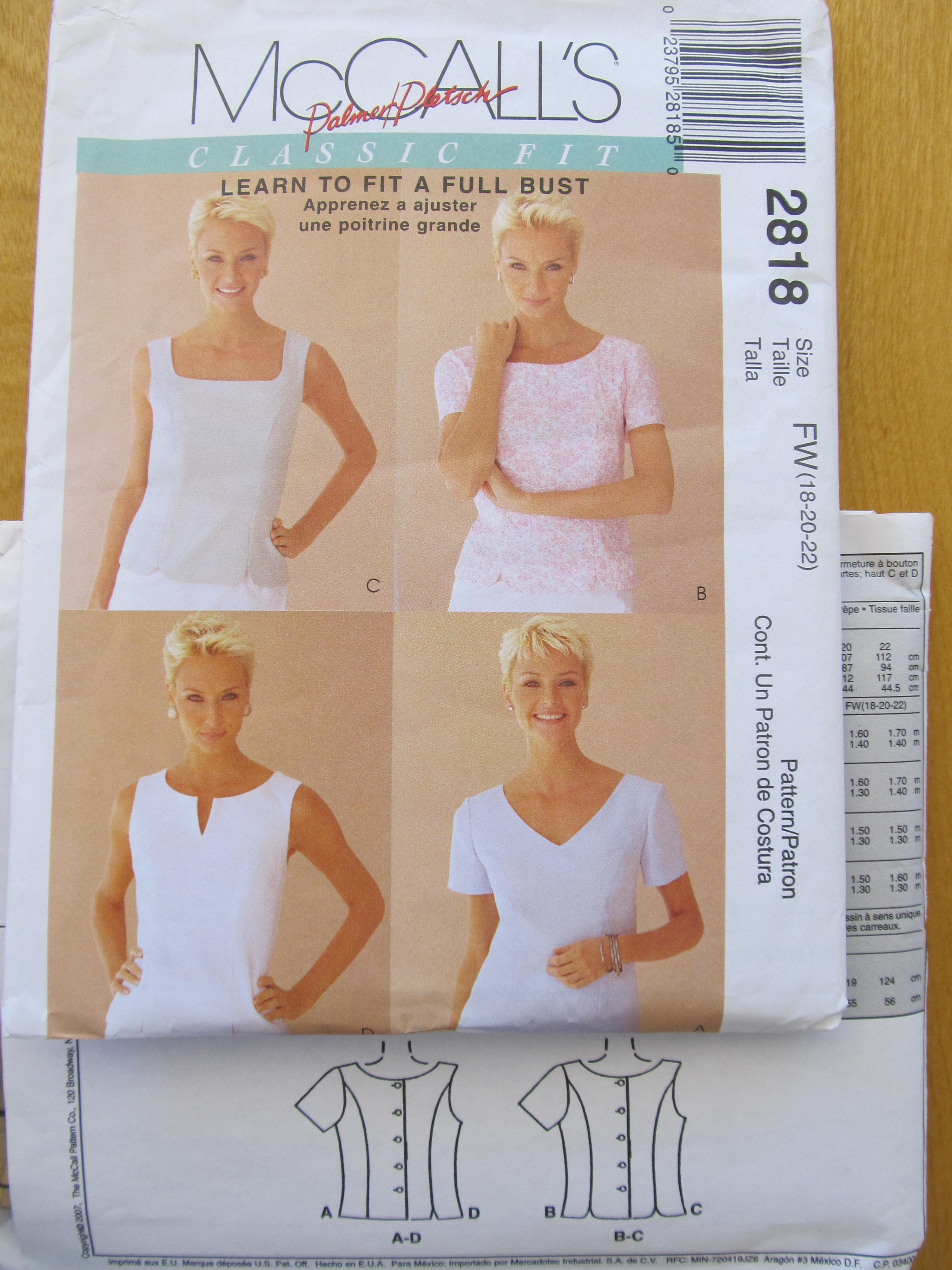
The next idea I had to complete the tulip theme of this dress was to incorporate a shaped faced hem like the one in McCall’s pattern 2818.

IMG_0028(Do I have two copies of this pattern? Oh no. I have three. Tracking my patterns in an app is the subject of a future blog post.)

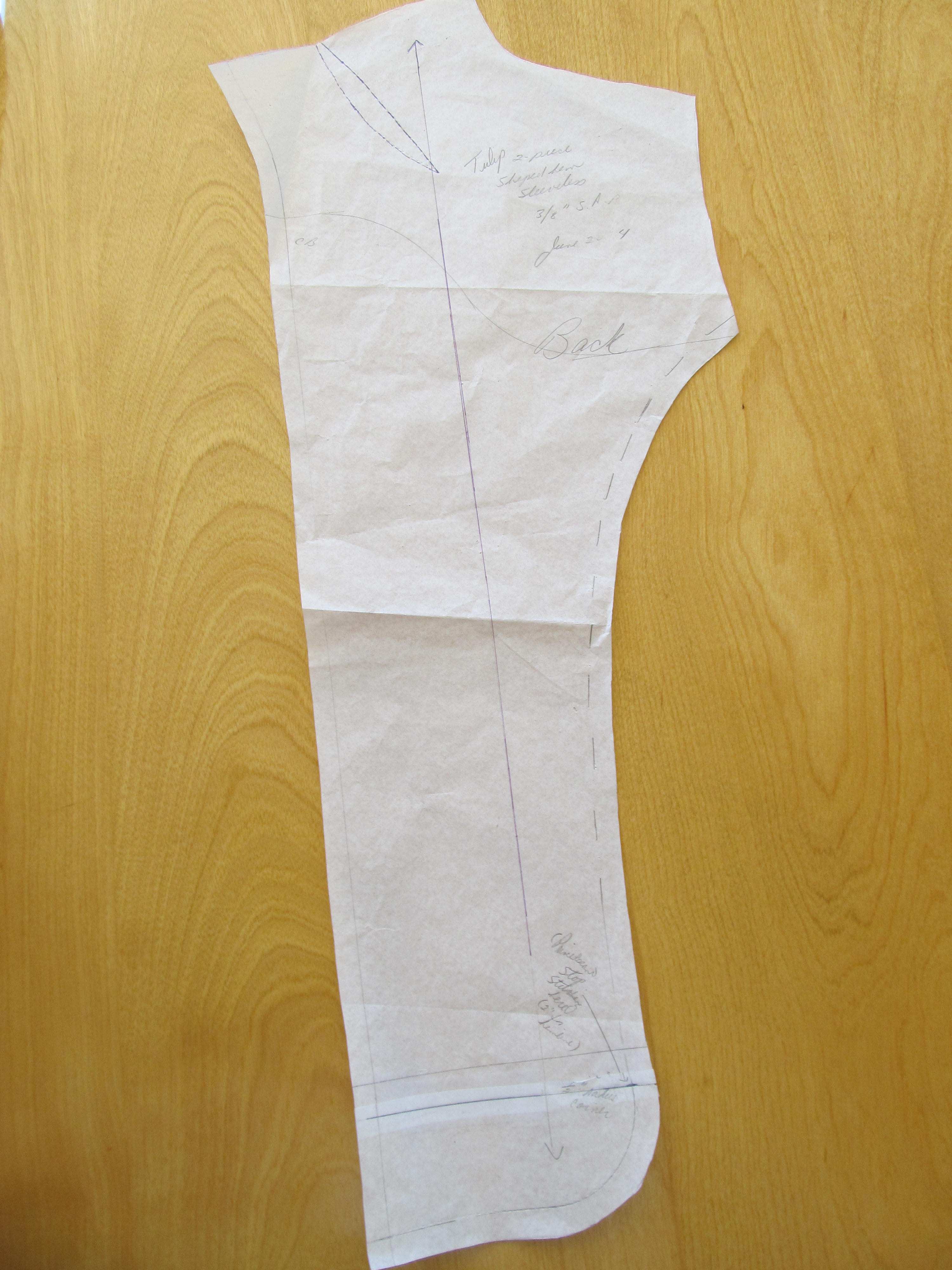
To achieve this, I drew a curve at the bottom of each princess seam with the help of one of those pocket curve templates. I also marked the point where the stitching needed to stop when joining the seams and I drew a line to mark the top of the hem facing pattern piece I needed to make. The curved line drawn toward the top of the pattern piece is the bottom edge of the back facing piece.

IMG_0024

With the pattern work done, I was all set to make the dress. The problem was that I wanted to use the inky navy linen from MarcyTilton.com that I had been saving for just the right summer business meeting-appropriate dress and there wasn’t enough of summer 2014 left for me to get it done. So, I packed the partially-constructed dress away and worked on it in spring 2015. Constructing this dress was an adventure in itself that we’ll cover in the next blog post.